Loading...
Done
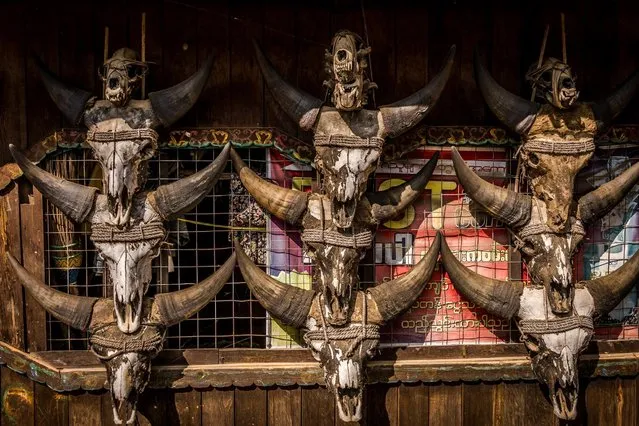
Traditional sculptures by Chin tribe in, Mindat, Myanmar, November 2016. (Photo by Teh Han Lin/Barcroft Images)

Traditional sculptures by Chin tribe in, Mindat, Myanmar, November 2016. In the mountains of Myanmar lives a tribe where the women have taken a unique approach to their beauty regime by decorating their faces with tattoos. The Chin people in the remote mountain town of Mindat, have been marking women in the area with intricate face tattoos for centuries. (Photo by Teh Han Lin/Barcroft Images)
Details
28 Dec 2016 07:01:00
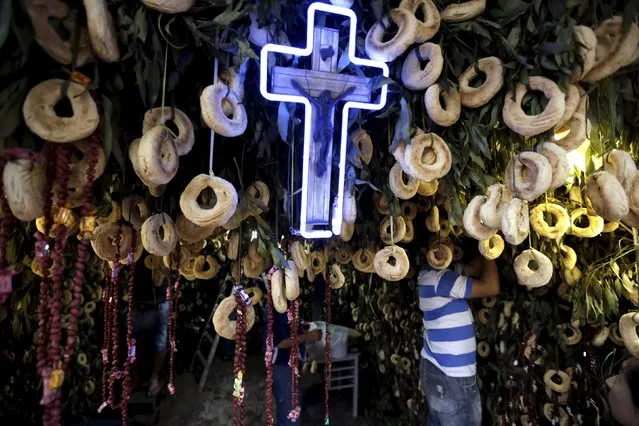
An altar is pictured after it was decorated by the Antar family with some 3,000 traditional cheese and corn buns called “chipas”, in celebration of Kurusu Ara in Asuncion May 3, 2015. (Photo by Jorge Adorno/Reuters)

An altar is pictured after it was decorated by the Antar family with some 3,000 traditional cheese and corn buns called “chipas”, in celebration of Kurusu Ara in Asuncion May 3, 2015. Kurusu Ara, the Day of the Cross, is a Catholic festival that is combined with local Gurani culture and falls annually on May 3. Paraguayans typically celebrate the festival with chipas, used to decorate religious shrines and altars. The chipas are later distributed to attendees. The buns at the top are arranged to read, “March 3 live”. (Photo by Jorge Adorno/Reuters)
Details
04 May 2015 09:18:00
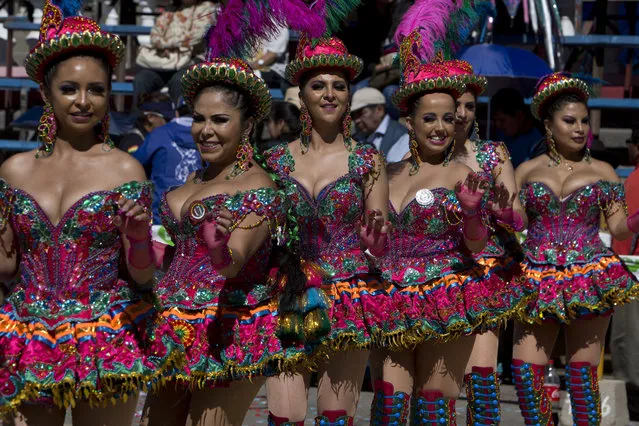
Women perform in the traditional “Morenada” dance during Carnival, in Oruro, Bolivia, Saturday, March 2, 2019. (Photo by Juan Karita/AP Photo)

Women perform in the traditional “Morenada” dance during Carnival, in Oruro, Bolivia, Saturday, March 2, 2019. The unique festival features spectacular folk dances, extravagant costumes, beautiful crafts, lively music, and up to 20 hours of continuous partying with lots of tourists, drawing crowds of up people annually. (Photo by Juan Karita/AP Photo)
Details
06 Mar 2019 00:07:00
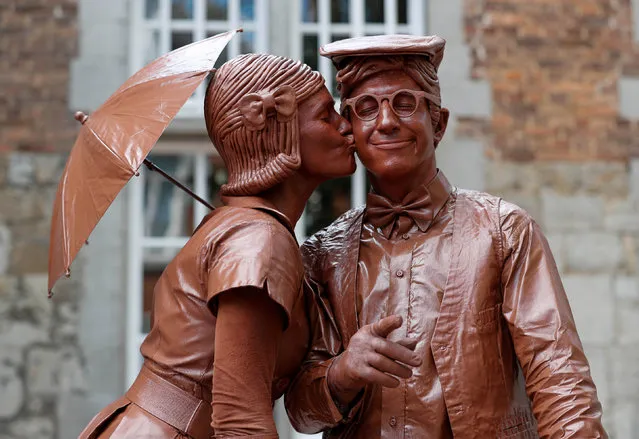
Artists called “Le couple en chocolat” take part in the festival “Statues en Marche” in Marche-en-Famenne, Belgium, July 22, 2018. (Photo by Yves Herman/Reuters)

Artists called “Le couple en chocolat” take part in the festival “Statues en Marche” in Marche-en-Famenne, Belgium, July 22, 2018. Living statues are a common sight in many city centres, but it is rare to see such a diverse range of this peculiar form of street art for which performers must keep still for painfully long periods of time to create the desired illusion. (Photo by Yves Herman/Reuters)

Details
25 Jul 2018 00:05:00
Spectacular images offering insight into the lives of the Huaorani people in the Ecuadorian Amazon have been revealed showing how they use traditional methods to hunt monkeys for food. The stunning pictures were taken by conservation photographer Pete Oxford from Torquay, Devon in the Ecuadorian Amazon. “The Huaorani Indians are a forest people highly in tune with their environment. Many are now totally acculturated since the 1950s by missionaries”, said Pete. “Today they face radical change to their culture to the proximity of oil exploration within their territory and the Yasuni National Park and Biosphere Reserve, they are vastly changed. Some still live very traditionally and for this shoot, through my Huaorani friend, a direct relative of those photographed he wanted to depict them as close to their original culture as possible. They still largely hunt with blow pipes and spears eating a lot of monkeys and peccaries”. The Huaorani are also known as the Waorani, Waodani or the Waos and are native Amerindians. Their lands are located between the Curaray and Napo rivers and speak the Huaorani language. Pete says that during his visit he was welcomed into the group and hopes that ancient cultures can be saved. Here: The tribe were seen celebrating after a hunter returned to camp with a wild pig. (Photo by Pete Oxford/Mediadrumworld.com)

Spectacular images offering insight into the lives of the Huaorani people in the Ecuadorian Amazon have been revealed showing how they use traditional methods to hunt monkeys for food. The stunning pictures were taken by conservation photographer Pete Oxford from Torquay, Devon in the Ecuadorian Amazon. Here: The tribe were seen celebrating after a hunter returned to camp with a wild pig. (Photo by Pete Oxford/Mediadrumworld.com)
Details
20 Jan 2017 07:58:00
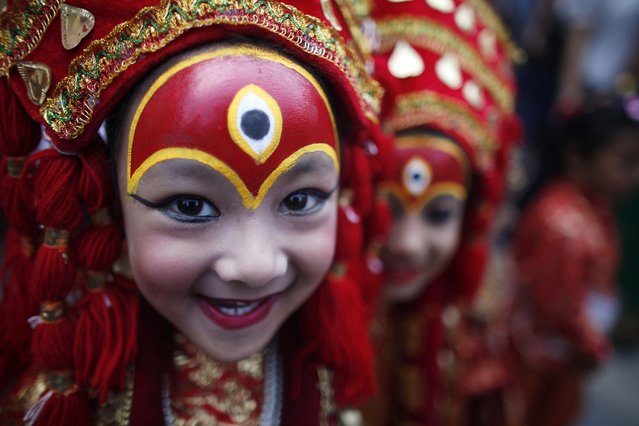
A young Nepalese girl dressed as a Kumari or living Goddess, smiles for camera as she waits for Kumari puja at Hanuman Dhoka, Basantapur Durbar Square in Katmandu, Nepal, Tuesday, Sept 17, 2013. More than hundred girls under the age of nine gathered for Kumari puja, a tradition of worshiping young pre-pubescent girls as manifestations of the divine female energy. The ritual holds a strong religious significance in Newar community. It is a community affair held primarily to save small girls from diseases and bad luck in the years to come. (AP Photo/Niranjan Shrestha)

The festival marks the end of the monsoon season and beginning of autumn. More than hundred girls under the age of nine gathered for the tradition of worshiping young pre-pubescent girls as manifestations of the divine female energy. The ritual holds a strong religious significance in Newar community. It is a community affair held primarily to save small girls from diseases and bad luck in the years to come. Photo: A young Nepalese girl dressed as a Kumari or living Goddess, smiles for camera as she waits for Kumari puja at Hanuman Dhoka, Basantapur Durbar Square in Katmandu, Nepal, Tuesday, September 17, 2013. (Photo by Niranjan Shrestha/AP Photo)
Details
18 Sep 2013 09:33:00
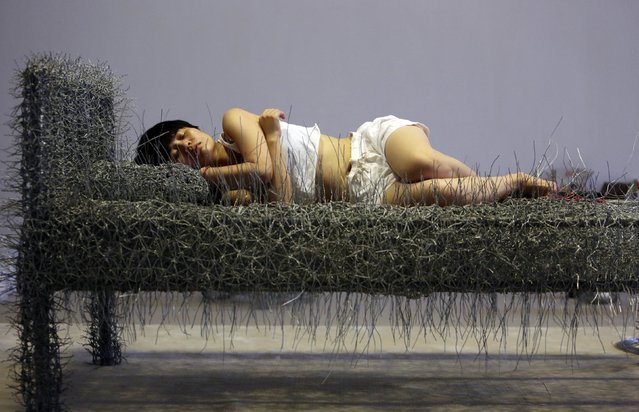
Chinese artist Zhou Jie takes a nap on an unfinished iron wire bed, one of her sculpture works, after lunch at Beijing Now Art Gallery, in Beijing August 11, 2014. Zhou started her art project titled “36 Days” on August 9, in which she would live inside an exhibition hall with an unfinished iron wire bed, some iron wire sculptures in the shape of stuffed animal dolls, a certain amount of food and her mobile phone, for 36 days. (Photo by Jason Lee/Reuters)

Chinese artist Zhou Jie takes a nap on an unfinished iron wire bed, one of her sculpture works, after lunch at Beijing Now Art Gallery, in Beijing August 11, 2014. Zhou started her art project titled “36 Days” on August 9, in which she would live inside an exhibition hall with an unfinished iron wire bed, some iron wire sculptures in the shape of stuffed animal dolls, a certain amount of food and her mobile phone, for 36 days. The entire process is open to visitors and she may also interact with them, according to Zhou. (Photo by Jason Lee/Reuters)
Details
22 Aug 2014 12:04:00
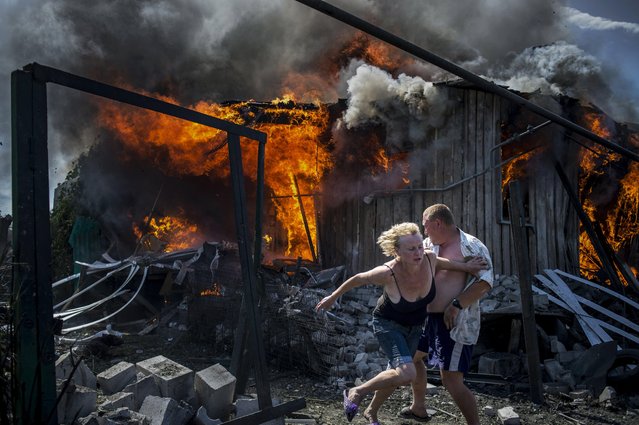
A handout photo made available by the World Press Photo (WPP) organization on 13 February 2017 shows a picture by Rossiya Segodnya photographer Valery Melnikov that won the Long-Term Projects – First Prize award of the 60th annual World Press Photo Contest, it was announced by the WPP Foundation in Amsterdam, The Netherlands on 13 February 2017. Caption: Civilians escape from a fire at a house destroyed by an air attack in the Luhanskaya village. Story: Ordinary people became victims of the conflict between self-proclaimed republics and the official Ukrainian authorities from 2014 onwards in the region of Donbass. Disaster came into their lives unexpectedly. These people were involved in the military confrontation against their will. They experienced the most terrible things: the death of their friends and relatives, destroyed homes and the ruined lives of thousands of people. (Photo by Valery Melnikov/EPA/Rossiya Segodnya/World Press Photo)

A handout photo made available by the World Press Photo (WPP) organization on 13 February 2017 shows a picture by Rossiya Segodnya photographer Valery Melnikov that won the Long-Term Projects – First Prize award of the 60th annual World Press Photo Contest, it was announced by the WPP Foundation in Amsterdam, The Netherlands on 13 February 2017. Caption: Civilians escape from a fire at a house destroyed by an air attack in the Luhanskaya village. (Photo by Valery Melnikov/EPA/Rossiya Segodnya/World Press Photo)
Details
15 Feb 2017 00:06:00