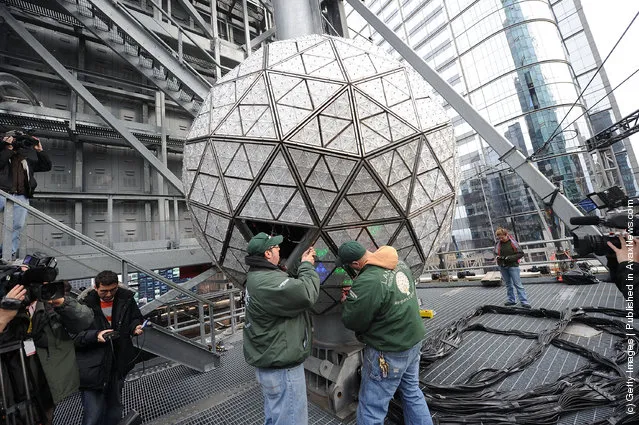
Workers attach 288 new Waterford Crystal Triangles on the 2012 Times Square New Year's Eve Ball at One Times Square on December 27, 2011 in New York City. (Photo by Jason Kempin/Getty Images)
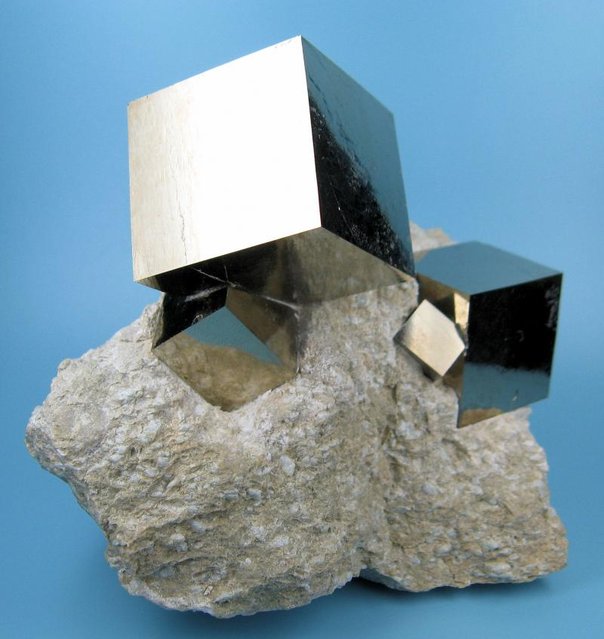
The mineral pyrite, or iron pyrite, also known as fool's gold, is an iron sulfide with the formula FeS2. This mineral's metallic luster and pale brass-yellow hue give it a superficial resemblance to gold, hence the well-known nickname of fool's gold. The color has also led to the nicknames brass, brazzle, and Brazil, primarily used to refer to pyrite found in coal.
In crystallography, the cubic (or isometric) crystal system is a crystal system where the unit cell is in the shape of a cube. This is one of the most common and simplest shapes found in crystals and minerals.
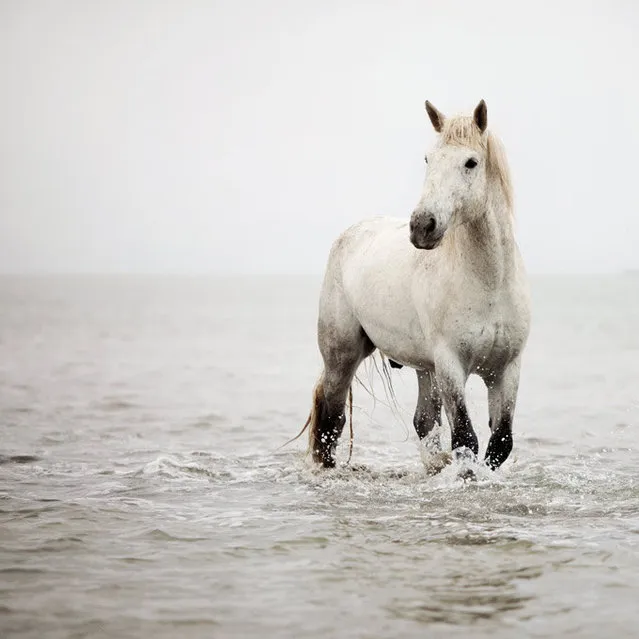
The wild white horses of Camargue, France have a mythical charm that can be difficult to capture in a photo. But Irene Suchocki has accomplished the task. Beauty, mystery and wildness are all there.
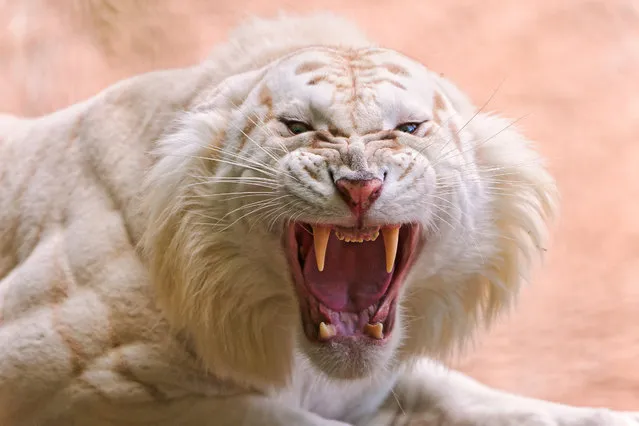
“The white tiger is a recessive mutant of the Bengal tiger, which was reported in the wild from time to time in Assam, Bengal, Bihar and especially from the former State of Rewa”. – Wikipedia. (Photo by Tambako The Jaguar)
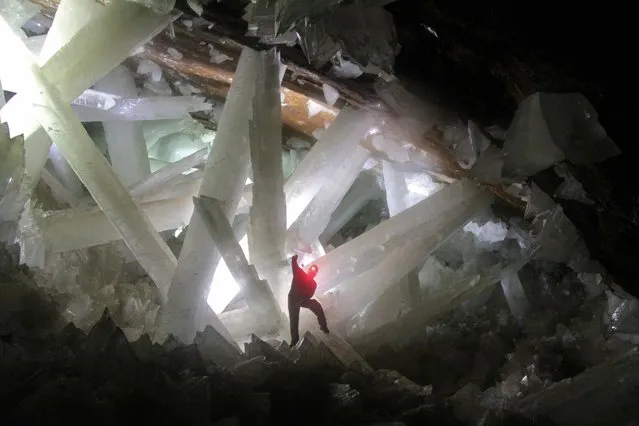
Cave of the Crystals or Giant Crystal Cave is a cave connected to the Naica Mine 300 metres (980 ft) below the surface in Naica, Chihuahua, Mexico. The main chamber contains giant selenite crystals (gypsum, CaSO4·2 H2O), some of the largest natural crystals ever found. The cave's largest crystal found to date is 12 m (39 ft) in length, 4 m (13 ft) in diameter and 55 tons in weight. The cave is extremely hot with air temperatures reaching up to 58 °C (136 °F) with 90 to 99 percent humidity. The cave is relatively unexplored due to these factors. Without proper protection people can only endure approximately ten minutes of exposure at a time.
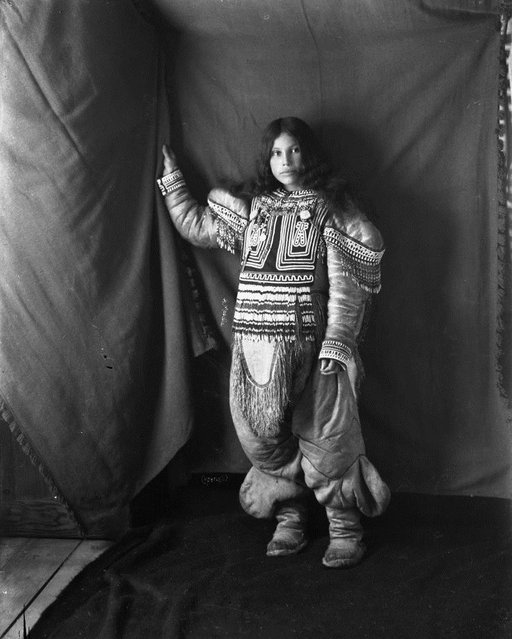
Geraldine Moodie overcame harsh conditions to become western Canada’s first professional female photographer, capturing beautiful images in the country’s most remote regions. An exhibition, “North of Ordinary: The Arctic Photographs of Geraldine and Douglas Moodie”, is at Glenbow, Calgary, 18 February – 10 September. Here: Inuit woman, Kootucktuck, in her beaded attigi. Fullerton Harbour, Nunavut, February 1905. (Photo by Geraldine Moodie/The Guardian)
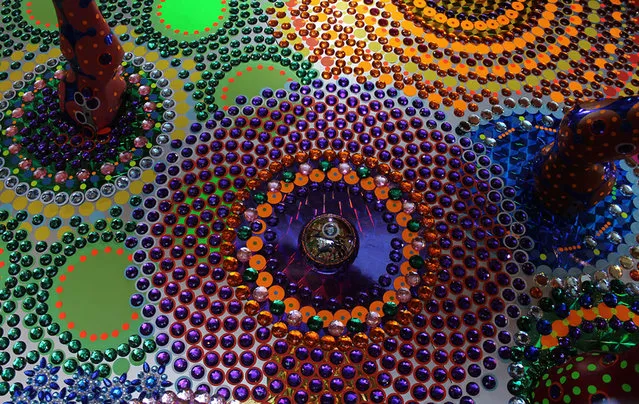
Dutch artist Suzan Drummen‘s large-scale floor installations are mesmerizing and complex circular patterns made out of mirrors and brightly colored glass. The fractal-like arrangements feature ornate and elaborate circles growing exponentially out of each other and vibrant rings of spiraling colors winding into the surface of the floor. They are composed of crystals, chromed metal, precious stones, mirrors and optical glass. A sensory experience, and visually stimulating, the glittering installations play with the architecture of the space — climbing up walls and sweeping across the surfaces — examining the idea of illusion and optical effects.
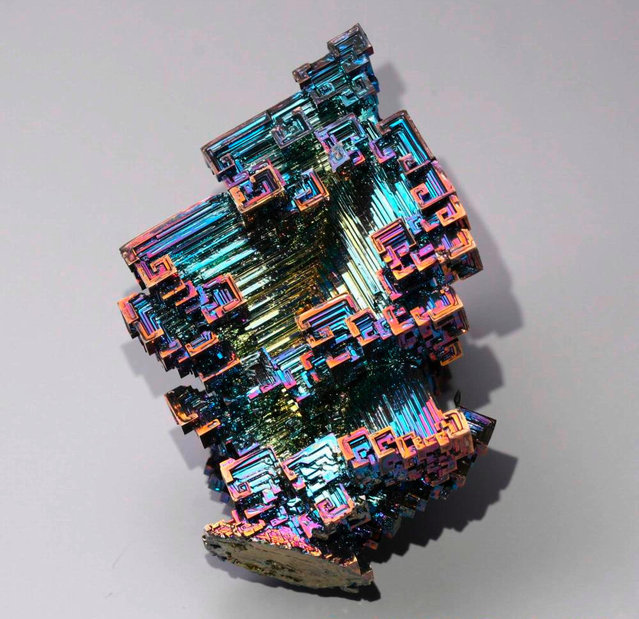
Bismuth is a chemical element with symbol Bi and atomic number 83. Bismuth, a pentavalent poor metal, chemically resembles arsenic and antimony. Elemental bismuth may occur naturally, although its sulfide and oxide form important commercial ores. The free element is 86% as dense as lead. It is a brittle metal with a silvery white color when freshly produced, but is often seen in air with a pink tinge owing to surface oxidation. Bismuth is the most naturally diamagnetic and has one of the lowest values of thermal conductivity among metals.