Loading...
Done
Kawakanih Yawalapiti, 9, Upper Xingu region of Mato Grosso, Brazil, 2018: Kawakanih lives with her tribe, the Yawalapiti, in Xingu national park, a preserve in the Amazon basin of Brazil. The Yawalapiti collect seeds to preserve species unique to their ecosystem, which lies between the rain forest and savannah. Kawakanih’s diet is simple, consisting mainly of fish, cassava, porridge, fruit and nuts. “It takes five minutes to catch dinner”, says Kawakanih. “When you’re hungry, you just go to the river with your net”. (Photo by Gregg Segal/The Guardian)

Photographer Gregg Segal travelled the world to document children and the food they eat in a week. Partly inspired by the increasing problems of childhood obesity, he tracked traditional regional diets as yet unaffected by globalisation, and ironically, found that the healthiest diets were often eaten by the least well off. (Photo by Gregg Segal/The Guardian)
Details
03 Jul 2019 00:03:00
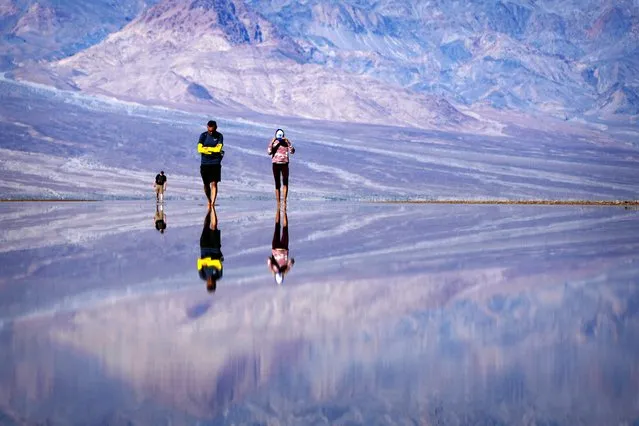
Vinaya Vijay, right, and Vijay Parthasarathy wade through water at Badwater Basin, Thursday, February 22, 2024, in Death Valley National Park, Calif. The basin, normally a salt flat, has filled from rain over the past few months. (Photo by John Locher/AP Photo)

Vinaya Vijay, right, and Vijay Parthasarathy wade through water at Badwater Basin, Thursday, February 22, 2024, in Death Valley National Park, Calif. The basin, normally a salt flat, has filled from rain over the past few months. (Photo by John Locher/AP Photo)
Details
03 Apr 2024 05:41:00
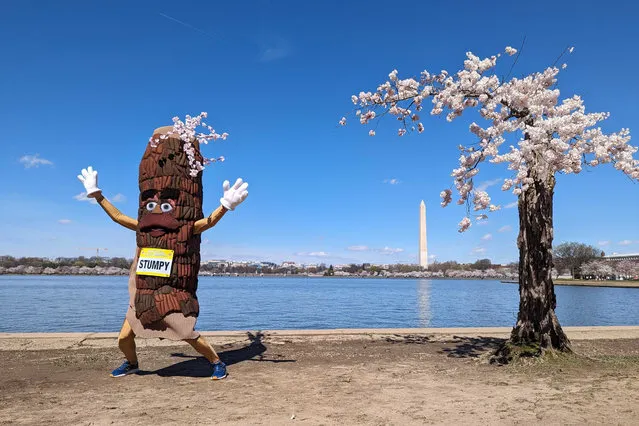
Stumpy the mascot dances near “Stumpy” the cherry tree at the tidal basin in Washington, Tuesday, March 19, 2024. The weakened tree is experiencing its last peak bloom before being removed for a renovation project that will rebuild seawalls around Tidal Basin and West Potomac Park. (Photo by Nathan Ellgren/AP Photo)

Stumpy the mascot dances near “Stumpy” the cherry tree at the tidal basin in Washington, Tuesday, March 19, 2024. The weakened tree is experiencing its last peak bloom before being removed for a renovation project that will rebuild seawalls around Tidal Basin and West Potomac Park. (Photo by Nathan Ellgren/AP Photo)
Details
27 Mar 2024 07:55:00
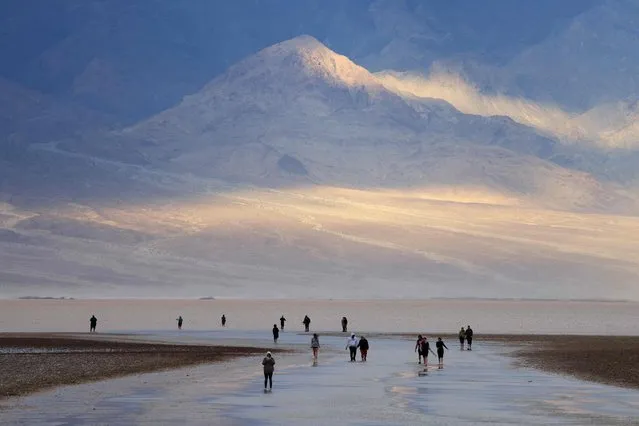
Tourists enjoy the rare opportunity to walk in water as they visit Badwater Basin, the normally driest place in the US, in Death Valley National Park, Inyo County, California on February 18, 2024. Badwater Basin, an endorheic basin in Death Valley National Park, was flooded by Hurricane Hilary in August 2023 and recent rains in California. It is the lowest point in North America, at 282 feet (86 meters) below sea level. (Photo by David Swanson/AFP Photo)

Tourists enjoy the rare opportunity to walk in water as they visit Badwater Basin, the normally driest place in the US, in Death Valley National Park, Inyo County, California on February 18, 2024. Badwater Basin, an endorheic basin in Death Valley National Park, was flooded by Hurricane Hilary in August 2023 and recent rains in California. It is the lowest point in North America, at 282 feet (86 meters) below sea level. (Photo by David Swanson/AFP Photo)
Details
27 Feb 2024 07:33:00
Cherry blossoms are in bloom along the Tidal Basin in Washington,DC on March 24, 2016. (Photo by Marc-Antoine Baudoux/AFP Photo)

Cherry blossoms are in bloom along the Tidal Basin in Washington,DC on March 24, 2016. (Photo by Marc-Antoine Baudoux/AFP Photo)
Details
26 Mar 2016 13:02:00
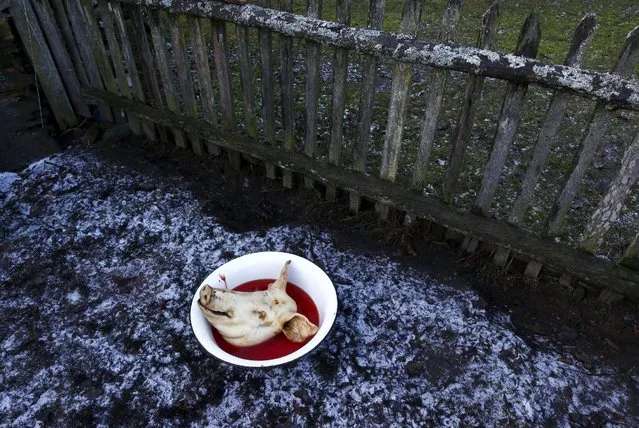
A pig's head is seen in a basin after it was slaughtered it in the village of Azerany, Belarus, December 12, 2015. (Photo by Vasily Fedosenko/Reuters)

A pig's head is seen in a basin after it was slaughtered it in the village of Azerany, Belarus, December 12, 2015. (Photo by Vasily Fedosenko/Reuters)
Details
14 Dec 2015 08:02:00
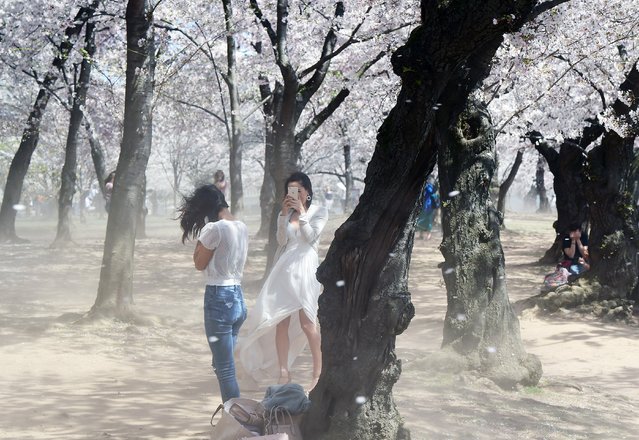
Blossoms and dust are blown by the wind as Jasmin Ricks, left, and her sister, Jessica Ricks, center, take in the cherry blossoms near the Tidal Basin in Washington on April 12, 2018. (Photo by Matt McClain/The Washington Post)

Blossoms and dust are blown by the wind as Jasmin Ricks, left, and her sister, Jessica Ricks, center, take in the cherry blossoms near the Tidal Basin in Washington on April 12, 2018. (Photo by Matt McClain/The Washington Post)
Details
01 May 2018 00:03:00
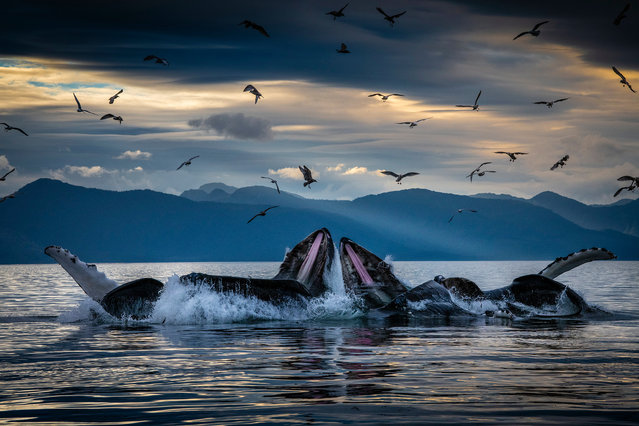
“Secrets of the Whales”. Skerry’s photographs celebrate the lives and culture of whales, illuminating recent research and their diverse behaviours. His latest work focuses on four key species: sperm whales, humpbacks, orca and beluga whales. Humpback whales bubble-net feeding off the coast of Alaska. They work cooperatively to feed on herring by blowing a perfect ring of bubbles underwater to form a net encircling the fish. The whales then swim up through the centre of the bubble net with their mouths open. (Photo by Brian Skerry/National Geographic Photo/Visa pour l'Image)

“Secrets of the Whales”. Skerry’s photographs celebrate the lives and culture of whales, illuminating recent research and their diverse behaviours. His latest work focuses on four key species: sperm whales, humpbacks, orca and beluga whales. Humpback whales bubble-net feeding off the coast of Alaska. They work cooperatively to feed on herring by blowing a perfect ring of bubbles underwater to form a net encircling the fish. The whales then swim up through the centre of the bubble net with their mouths open. (Photo by Brian Skerry/National Geographic Photo/Visa pour l'Image)
Details
04 Sep 2021 09:02:00