Loading...
Done
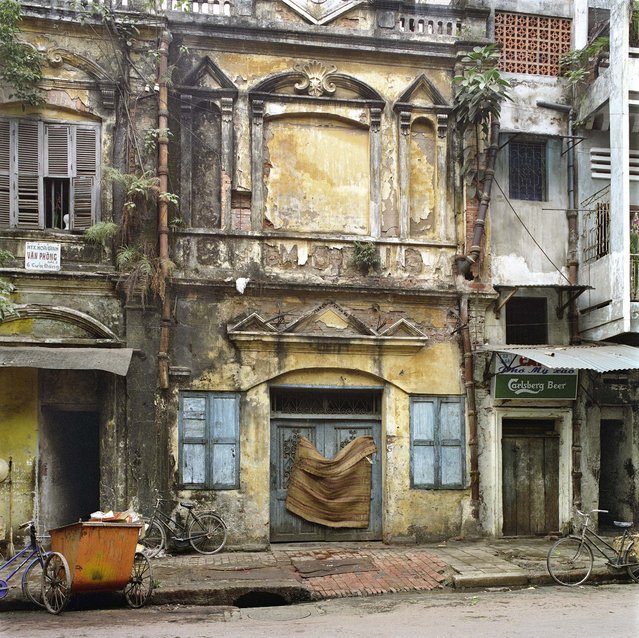
54 Hàng Ga (Chicken Street), 1994. (Photo by  William E. Crawford from the book “Hanoi Streets 1985-2015: In the Years of Forgetting”)

Documentary photographer William E. Crawford was one of the first Western photographers to gain access to North Vietnam after the war ended. He has photographed the capital, Hanoi, at regular intervals since 1985, concentrating on the colonial and indigenous architecture, urban details, landscapes and intimate portraits of people in their home settings, street scenes and the city’s surrounding countryside. Here: 54 Hàng Ga (Chicken Street), 1994. (Photo by William E. Crawford from the book “Hanoi Streets 1985-2015: In the Years of Forgetting”)
Details
27 Jun 2018 00:01:00
Participants are covered by colored powder as they compete in The Color Run, a five-kilometre untimed race, in Hanoi, Vietnam September 26, 2015. (Photo by Reuters/Kham)

Participants are covered by colored powder as they compete in The Color Run, a five-kilometre untimed race, in Hanoi, Vietnam September 26, 2015. Approximately 7,000 participants took part in Hanoi's first Color Run, reported local media. (Photo by Reuters/Kham)
Details
29 Sep 2015 08:04:00
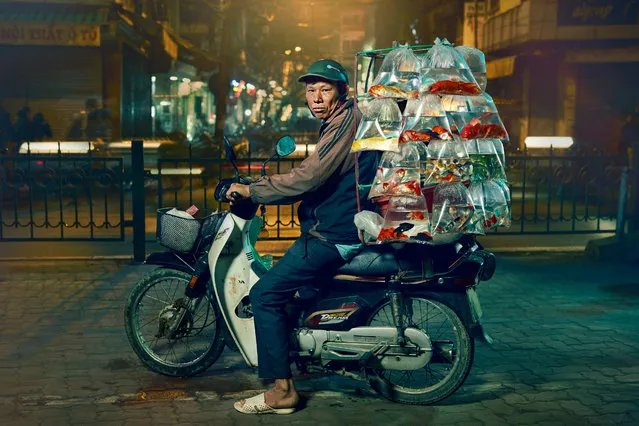
Live fish. Vietnam has the highest number of motorbikes in all of south-east Asia – Hanoi alone has 5m of them, and only half a million cars. Now the city is planning to ban them by 2030 to cut pollution. (Photo by Jon Enoch/The Guardian)

From footballs to live fish, delivery mopeds piled high with unwieldy, unlikely goods are one of the Vietnamese capital’s most distinctive sights. As the city plans to ban motorbikes altogether, photographer Jon Enoch captured the drivers at work. (Photo by Jon Enoch/The Guardian)

Details
11 May 2019 00:05:00
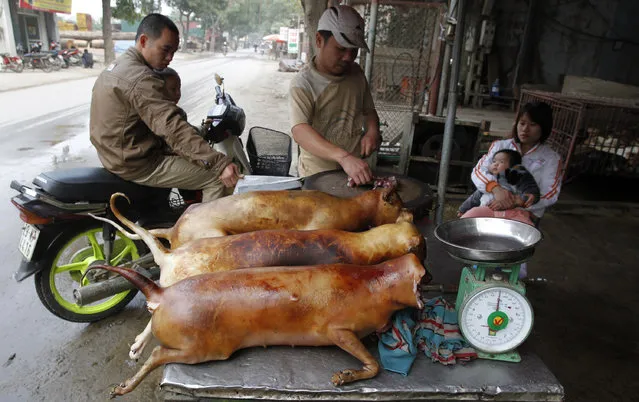
A vendor (C) cuts slaughtered dogs for sale at his roadside stall in Duong Noi village, outside Hanoi December 16, 2011. While animal rights activists have condemned eating dog meat as cruel treatment of the animals, it is still an accepted popular delicacy for some Vietnamese, as well in some other Asian countries. (Photo by Reuters/Kham)

A vendor (C) cuts slaughtered dogs for sale at his roadside stall in Duong Noi village, outside Hanoi December 16, 2011. While animal rights activists have condemned eating dog meat as cruel treatment of the animals, it is still an accepted popular delicacy for some Vietnamese, as well in some other Asian countries. Duong Noi is well-known as a dog-meat village, where hundreds of dogs are killed each day for sale as popular traditional food. Dog-eating as a custom is rooted in Vietnam and was developed as a result of poverty. One kilogram of dog meat costs about 130,000 dongs ($6.2). (Photo by Reuters/Kham)
Details
16 Jul 2013 11:40:00
In this photo illustration a young girl licks a lollipop in which a scorpion is suspended on May 7, 2014 in Berlin, Germany. An increasing numbers of advocates worldwide are promoting insects as a viable source of food for humans, citing the high protein value, abundance and low cost. (Photo Illustration by Sean Gallup/Getty Images)

In this photo illustration a young girl licks a lollipop in which a scorpion is suspended on May 7, 2014 in Berlin, Germany. An increasing numbers of advocates worldwide are promoting insects as a viable source of food for humans, citing the high protein value, abundance and low cost. (Photo Illustration by Sean Gallup/Getty Images)
Details
14 May 2014 10:35:00
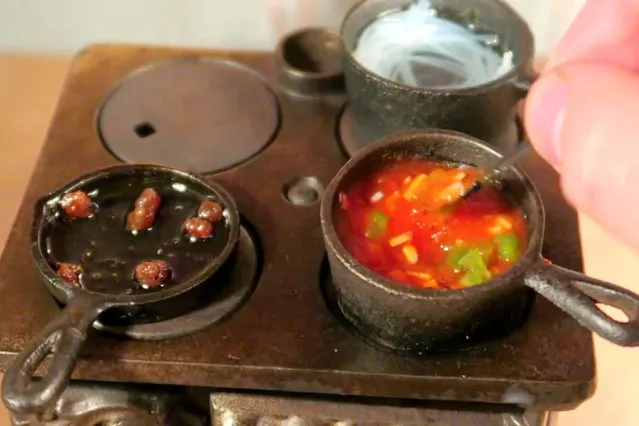
Jay cooks the ingredients of the tiny spaghetti on the tiny stove. (Photo by Jay Baron/Caters News)

Videographer Jay Baron, from Utah, spends up to nine hours cooking super small dishes and serving them up to his YouTube audience. The tiny portions feature cuisine from all over the world, from ultra-American apple pie to Japanese ramen. The 22-year-old confines himself to cooking in a 2ft by 2ft box, so the only heat he can use comes from a tea light. Here: Jay cooks the ingredients of the tiny spaghetti on the tiny stove. (Photo by Jay Baron/Caters News)
Details
26 Nov 2016 10:34:00
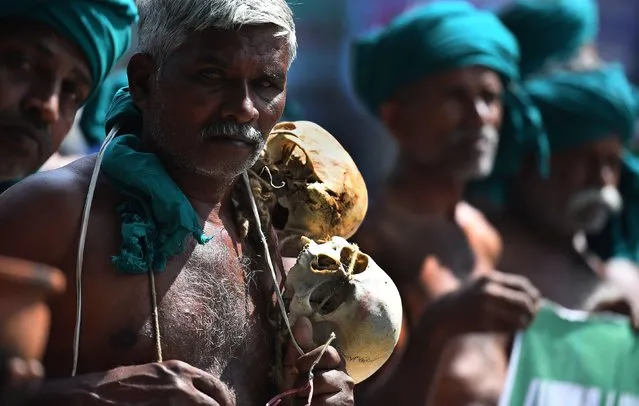
An Indian farmer from Tamil Nadu state wearing a necklace of human skulls representing suicides by agricultural workers takes part in a protest with other farmers in New Delhi on March 15, 2017. Tamil Nadu state farmers protested to demand a profitable price for their agricultral products, and called for the formation of management committee for solving Cauvery river water disputes. More than 200 farmers have committed suicide in Tamil Nadu in recent months following crop failure due to poor rainfall and inadequate water for irrigation. (Photo by Prakash Singh/AFP Photo)

An Indian farmer from Tamil Nadu state wearing a necklace of human skulls representing suicides by agricultural workers takes part in a protest with other farmers in New Delhi on March 15, 2017. Tamil Nadu state farmers protested to demand a profitable price for their agricultral products, and called for the formation of management committee for solving Cauvery river water disputes. More than 200 farmers have committed suicide in Tamil Nadu in recent months following crop failure due to poor rainfall and inadequate water for irrigation. (Photo by Prakash Singh/AFP Photo)
Details
17 Mar 2017 00:02:00
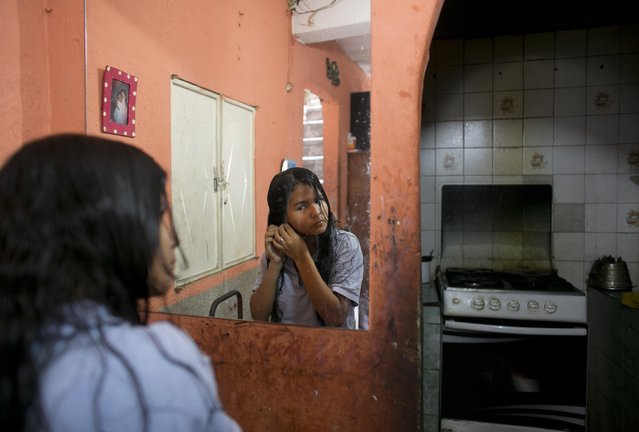
In this June 1, 2016 photo, Maria Arias stands near her kitchen as she puts on earrings while getting ready for school in Caracas, Venezuela. So many students have fainted from hunger at Maria's school that administrators told parents to keep their children home until they could find more food. (Photo by Ariana Cubillos/AP Photo)

In this June 1, 2016 photo, Maria Arias stands near her kitchen as she puts on earrings while getting ready for school in Caracas, Venezuela. So many students have fainted from hunger at Maria's school that administrators told parents to keep their children home until they could find more food. (Photo by Ariana Cubillos/AP Photo)
Details
17 Jun 2016 13:03:00