Loading...
Done
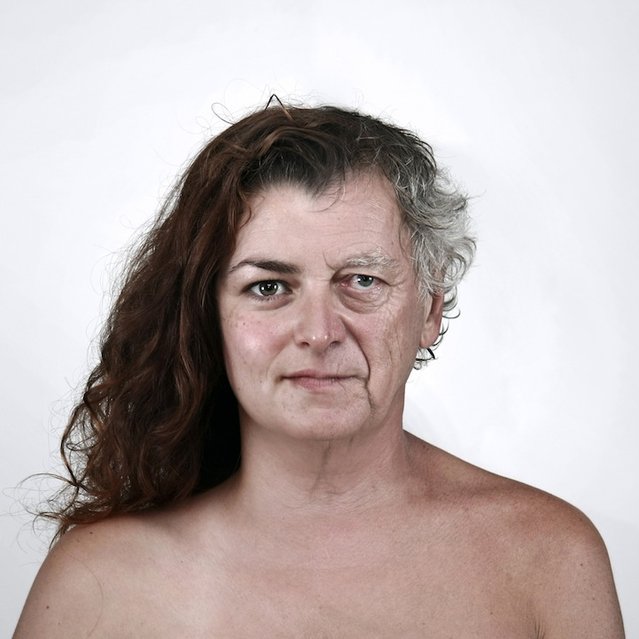
Genetic Portraits By Ulric Collette

Canada-based photographer and graphic designer Ulric Collette came up with probably the coolest family photo shoot idea ever.
Details
11 Jul 2013 08:23:00
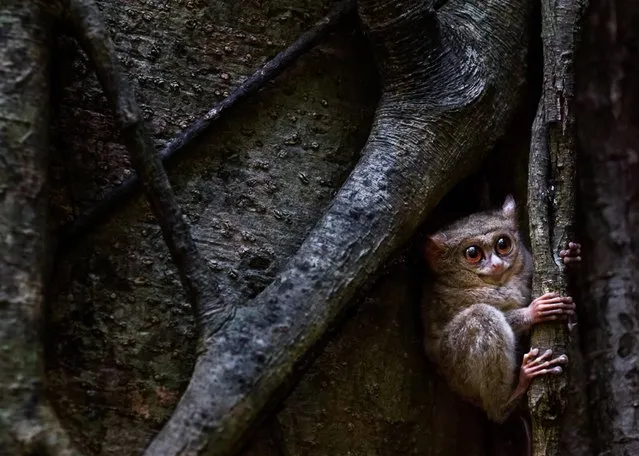
“Spectral Tarsier”. Tangkoko, Northern Sulawesi, Indonesia: Spectral tarsier by Wolfgang Weinhardt. (Photo and caption by Wolfgang Weinhardt/UK Society of Biology Photography Award 2014)

From rural life in India to a chick growing inside its embryo and a sea turtle eating a purple jellyfish, the Society of Biology has released their stunning photography competition shortlist. Here: “Spectral Tarsier”. Tangkoko, Northern Sulawesi, Indonesia: Spectral tarsier by Wolfgang Weinhardt. (Photo and caption by Wolfgang Weinhardt/UK Society of Biology Photography Award 2014)
Details
06 Oct 2014 09:20:00
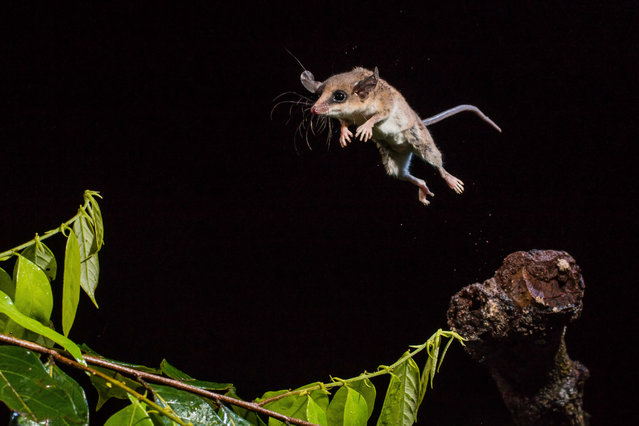
Tropical acrobatics by Adrià López Baucells in Manaus, Brazil. An unidentified South American marsupial, although the characteristic black markings on its face indicate it may be a mouse opossum. These small creatures are nocturnal and feed on bugs, fruit and bird eggs. (Photo by Adrià López Baucells/2019 Royal Society of Biology Photography Competition)

Tropical acrobatics by Adrià López Baucells in Manaus, Brazil. An unidentified South American marsupial, although the characteristic black markings on its face indicate it may be a mouse opossum. These small creatures are nocturnal and feed on bugs, fruit and bird eggs. (Photo by Adrià López Baucells/2019 Royal Society of Biology Photography Competition)
Details
10 Oct 2019 00:03:00
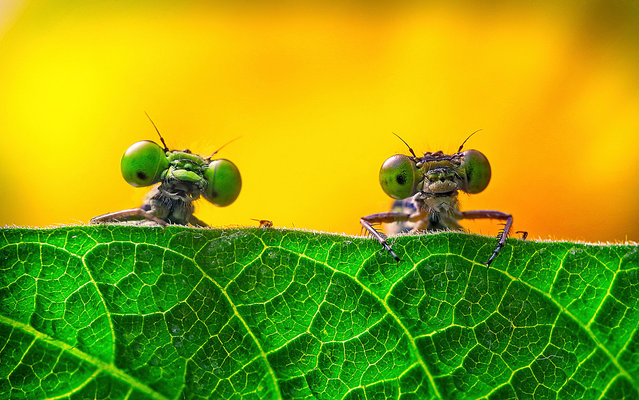
Shortlisted: “Two big eyes” by Miao Yong (Zejiang province, China). Damselflies look over the leaves. “I was photographing insects in a park near my home when suddenly I found two damselflies in the grass. They kept flying and it was very difficult to focus until suddenly they parked behind a leaf”. (Photo by Miao Yong/2017 Royal Society of Biology Photographer of the Year)

Shortlisted: “Two big eyes” by Miao Yong (Zejiang province, China). Damselflies look over the leaves. “I was photographing insects in a park near my home when suddenly I found two damselflies in the grass. They kept flying and it was very difficult to focus until suddenly they parked behind a leaf”. (Photo by Miao Yong/2017 Royal Society of Biology Photographer of the Year)
Details
16 Oct 2017 09:04:00
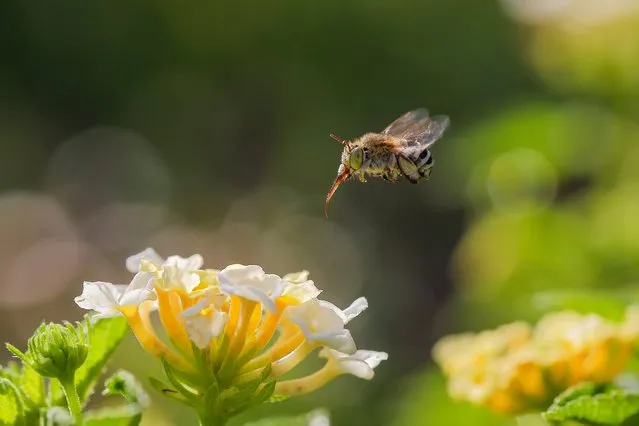
“Tasty Nature” by Dipesh Bhatt. “The blue banded bee (Amegilla cingulata) is pointing this sheath towards the flowers in preparation for sipping nectar”. Taken in Gujarat, India. (Photo by Dipesh Bhatt/2016 Royal Society of Biology Photographer of the Year competition)

“Tasty Nature” by Dipesh Bhatt. “The blue banded bee (Amegilla cingulata) is pointing this sheath towards the flowers in preparation for sipping nectar”. Taken in Gujarat, India. (Photo by Dipesh Bhatt/2016 Royal Society of Biology Photographer of the Year competition)
Details
30 Sep 2016 09:32:00
Runner-up; Hon Yen marine ecosystem. Phu Yen, Vietnam. Every year between May and August, the coral of this rich and diverse ecosystem becomes exposed at low tide. (Photo by Truong Hoai Vu/Royal Society of Biology Photography Competition)

Runner-up; Hon Yen marine ecosystem. Phu Yen, Vietnam. Every year between May and August, the coral of this rich and diverse ecosystem becomes exposed at low tide. (Photo by Truong Hoai Vu/Royal Society of Biology Photography Competition)
Details
31 Oct 2021 05:12:00
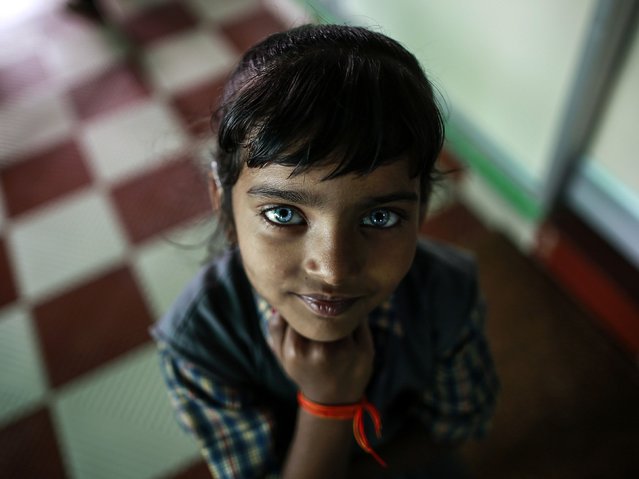
A girl who suffers from hearing and speech disorders reacts to the camera at a rehabilitation centre supported by Bhopal Medical Appeal, for children who were born with mental and physical disabilities, in Bhopal November 11, 2014.(Photo by Danish Siddiqui/Reuters)

A girl who suffers from hearing and speech disorders reacts to the camera at a rehabilitation centre supported by Bhopal Medical Appeal, for children who were born with mental and physical disabilities, in Bhopal November 11, 2014. The rehabilitation centre only treats families they believe have been affected by the Union Carbide gas leak 30 years ago. Human rights groups say that thousands of tonnes of hazardous waste remain buried underground, and the government has conceded it is contaminated. There has, however, been no long-term epidemiological research which conclusively proves that birth defects are directly related to the drinking of the contaminated water. (Photo by Danish Siddiqui/Reuters)
Details
30 Nov 2014 12:00:00
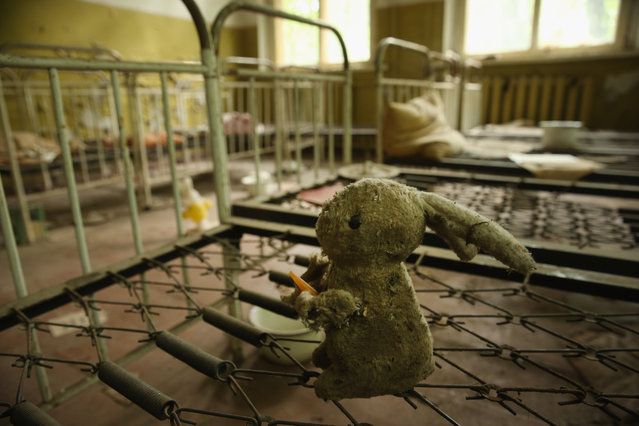
A stuffed rabbit doll sits among children's beds standing in the abandoned kindergarten of Kopachi village located inside the Chernobyl Exclusion Zone on September 29, 2015 near Chornobyl, Ukraine. Kopachi, a village that before 1986 had a population of 1,114, lies only a few kilometers south of the former Chernobyl nuclear power plant, where in 1986 workers inadvertantly caused reactor number four to explode, creating the worst nuclear accident in history. Radiation fallout was so high that authorities bulldozed and buried all of Kopachi's structures except for the kindergarten. (Photo by Sean Gallup/Getty Images)

A stuffed rabbit doll sits among children's beds standing in the abandoned kindergarten of Kopachi village located inside the Chernobyl Exclusion Zone on September 29, 2015 near Chornobyl, Ukraine. Kopachi, a village that before 1986 had a population of 1,114, lies only a few kilometers south of the former Chernobyl nuclear power plant, where in 1986 workers inadvertantly caused reactor number four to explode, creating the worst nuclear accident in history. (Photo by Sean Gallup/Getty Images)
Details
27 Apr 2016 09:28:00