Loading...
Done
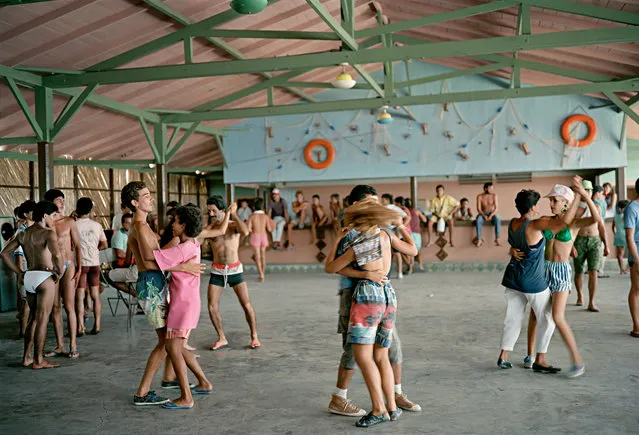
Giovan set out to capture the people’s resilience, during what Fidel Castro, with typical hyperbole, called the “special period”. (Photo by Tria Giovan/The Guardian)

As an American in 1990s Cuba, Tria Giovan risked being branded a traitor. But the photographer continued to visit and, from the dance hall to the hair salon, she captured the resilient spirit of the Cuban people. The 120 images in Tria Giovan’s “The Cuba Archive” are from the period in the 90s when, as an American, travel to Cuba could have seen her branded a traitor, as the country was subject to a US trade embargo. Her trip required lots of planning – and patience. (Photo by Tria Giovan/The Guardian)
Details
21 Sep 2017 09:04:00
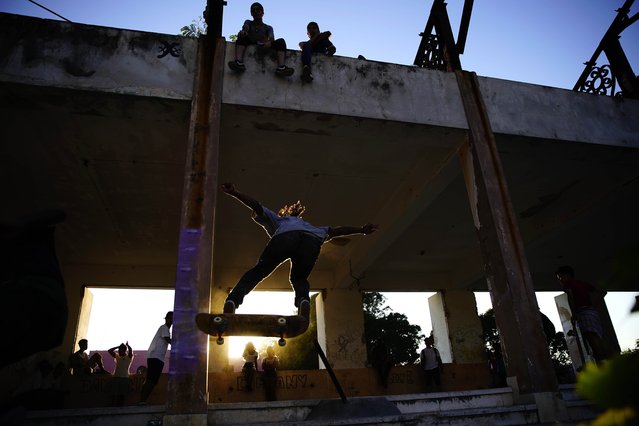
In this January 11, 2018 photo, a skater jumps a ramp during the inauguration of a new recreational space for skateboarders, created in an abandoned gym at the Educational complex Ciudad Libertad, a former military barracks that the late Fidel Castro turned into a school complex after the revolution in Havana, Cuba. Foreign skateboard enthusiasts supply their Cuban counterparts with boards and other equipment. (Photo by Ramon Espinosa/AP Photo)

In this January 11, 2018 photo, a skater jumps a ramp during the inauguration of a new recreational space for skateboarders, created in an abandoned gym at the Educational complex Ciudad Libertad, a former military barracks that the late Fidel Castro turned into a school complex after the revolution in Havana, Cuba. Foreign skateboard enthusiasts supply their Cuban counterparts with boards and other equipment. (Photo by Ramon Espinosa/AP Photo)
Details
03 Feb 2018 06:51:00
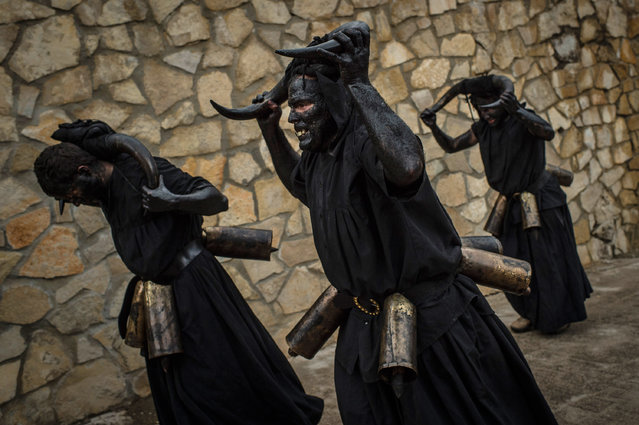
People with his face covered in oil and soot and carrying bull horns representing a devil join a carnival festival on February 14, 2015 in Luzon, Spain. (Photo by David Ramos/Getty Images)

People with his face covered in oil and soot and carrying bull horns representing a devil join a carnival festival on February 14, 2015 in Luzon, Spain. (Photo by David Ramos/Getty Images)
Details
15 Feb 2015 15:09:00
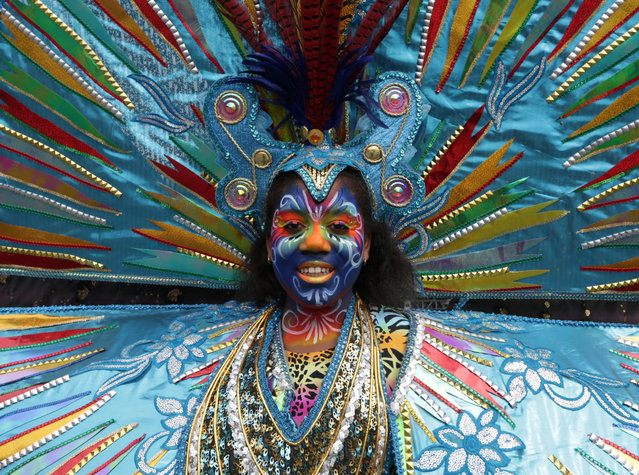
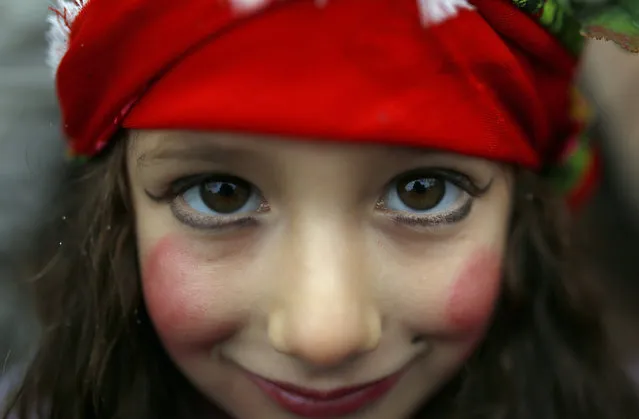
A young reveller participates in the annual Trinidad and Tobago Red Cross Society's Children's Carnival Competition at the Queen's Park Savannah in Port-Of-Spain, Trinidad and Tobago February 18, 2017. (Photo by Andrea De Silva/Reuters)

A young reveller participates in the annual Trinidad and Tobago Red Cross Society's Children's Carnival Competition at the Queen's Park Savannah in Port-Of-Spain, Trinidad and Tobago February 18, 2017. (Photo by Andrea De Silva/Reuters)
Details
21 Feb 2017 00:05:00
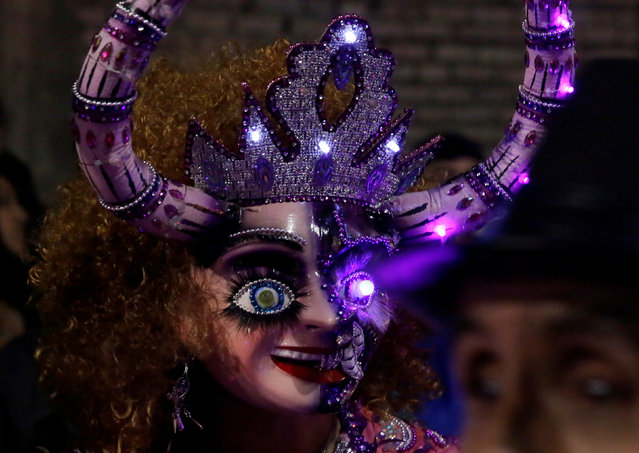
A member of the Diablada  Urus group attends  the carnival parade in Oruro, Bolivia February 25, 2017. (Photo by David Mercado/Reuters)

A member of the Diablada Urus group attends the carnival parade in Oruro, Bolivia February 25, 2017. (Photo by David Mercado/Reuters)
Details
28 Feb 2017 00:04:00
Revellers participate in a parade on the street during a carnival in the village of Vevcani, south of Skopje, Macedonia January 13, 2016. Vevcani village marks the annual Orthodox St. Vasilij Day with a carnival that features a 1,400-year-old celebration with pagan roots. The highlights of the carnival include a political satire where masked villagers act out current events. (Photo by Ognen Teofilovski/Reuters)

Revellers participate in a parade on the street during a carnival in the village of Vevcani, south of Skopje, Macedonia January 13, 2016. Vevcani village marks the annual Orthodox St. Vasilij Day with a carnival that features a 1,400-year-old celebration with pagan roots. The highlights of the carnival include a political satire where masked villagers act out current events. (Photo by Ognen Teofilovski/Reuters)
Details
15 Jan 2016 08:05:00
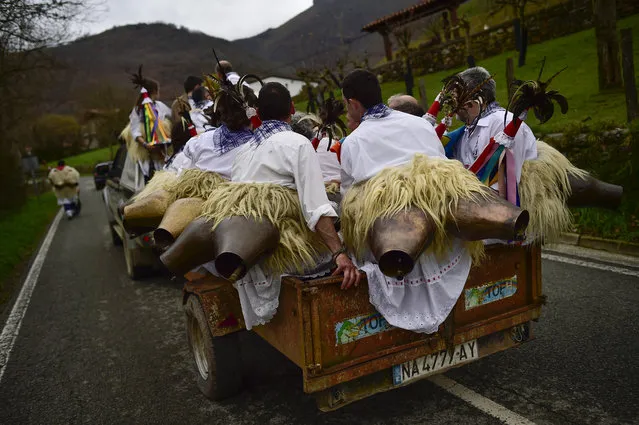
Joaldunaks return in a trailer to their town at the end of Carnival between of the Pyrenees villages of Ituren and Zubieta, northern Spain, Monday, February 1, 2016. In one of the most ancient carnivals in Europe, dating from before the Roman empire, companies of Joaldunak (cowbells) made up of residents of two towns, Ituren and Zubieta, parade the streets costumed in sandals, lace petticoats, sheepskins around the waist and shoulders, coloured neckerchiefs, conical caps with ribbons and a hyssop of horsehair in their right hands and cowbells hung across their lower back. (Photo by Alvaro Barrientos/AP Photo)

Joaldunaks return in a trailer to their town at the end of Carnival between of the Pyrenees villages of Ituren and Zubieta, northern Spain, Monday, February 1, 2016. In one of the most ancient carnivals in Europe, dating from before the Roman empire, companies of Joaldunak (cowbells) made up of residents of two towns, Ituren and Zubieta, parade the streets costumed in sandals, lace petticoats, sheepskins around the waist and shoulders, coloured neckerchiefs, conical caps with ribbons and a hyssop of horsehair in their right hands and cowbells hung across their lower back. (Photo by Alvaro Barrientos/AP Photo)
Details
02 Feb 2016 13:07:00
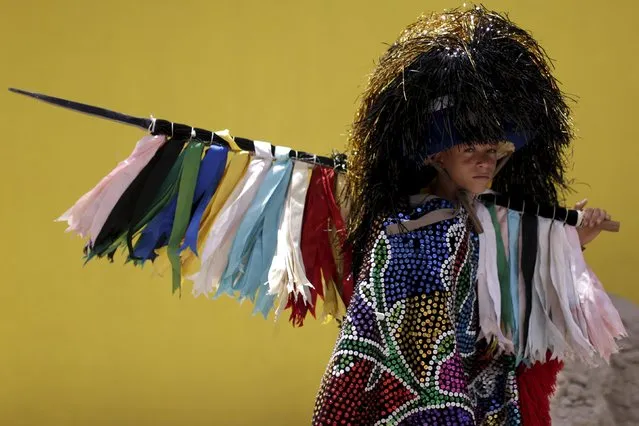
A reveller is photographed during a traditional Maracatu carnival in Olinda, Brazil February 8, 2016. (Photo by Ueslei Marcelino/Reuters)

A reveller is photographed during a traditional Maracatu carnival in Olinda, Brazil February 8, 2016. (Photo by Ueslei Marcelino/Reuters)
Details
10 Feb 2016 11:53:00