Loading...
Done
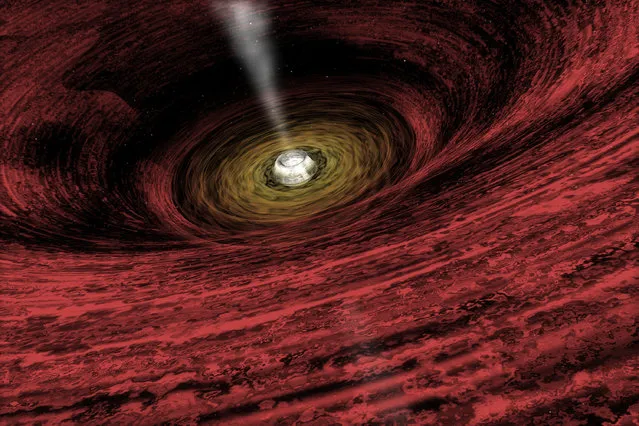
An artist's impression of a growing supermassive black hole located in the early Universe is seen in this NASA handout illustration released on June 15, 2011. Using the deepest X-ray image ever taken, astronomers found the first direct evidence that massive black holes were common in the early universe. This discovery from NASA's Chandra X-Ray Observatory shows that very young black holes grew more aggressively than previously thought, in tandem with the growth of their host galaxies. (Photo by Reuters/NASA/Chandra X-Ray Observatory/A.Hobart)

An artist's impression of a growing supermassive black hole located in the early Universe is seen in this NASA handout illustration released on June 15, 2011. Using the deepest X-ray image ever taken, astronomers found the first direct evidence that massive black holes were common in the early universe. This discovery from NASA's Chandra X-Ray Observatory shows that very young black holes grew more aggressively than previously thought, in tandem with the growth of their host galaxies. (Photo by Reuters/NASA/Chandra X-Ray Observatory/A.Hobart)
Details
11 Feb 2016 12:57:00
Chris Keegan By Cosmic Creatures

Looking up at the sky and forming images from the stars has been going on for just about as long as human life has existed, but that was only what could be seen from the Earth. Digital illustrator Chris Keegan has taken constellations to a whole new level with the use of images from NASA’s Chandra X-ray Observatory.
Details
10 Jun 2015 09:50:00
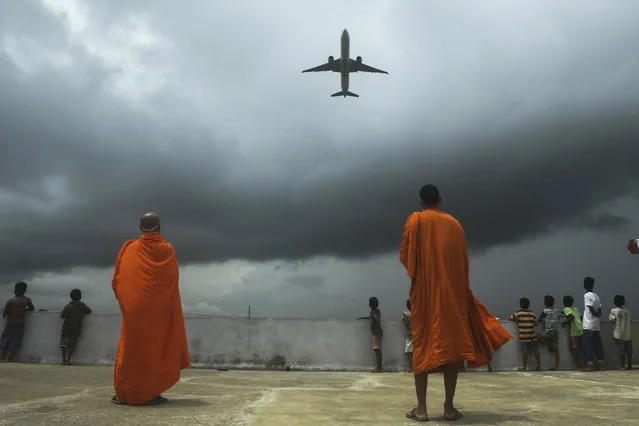
Buddhists monks and children look out from the rooftop at a Buddhist mission hostel and school for underprivileged children as an international passenger flight takes off at the Netaji Subhash Chandra Bose International Airport as the authorities eased restrictions imposed as a preventive measure against the spread of the COVID-19 coronavirus, in Kolkata on July 5, 2020. (Photo by Dibyangshu Sarkar/AFP Photo)

Buddhists monks and children look out from the rooftop at a Buddhist mission hostel and school for underprivileged children as an international passenger flight takes off at the Netaji Subhash Chandra Bose International Airport as the authorities eased restrictions imposed as a preventive measure against the spread of the COVID-19 coronavirus, in Kolkata on July 5, 2020. (Photo by Dibyangshu Sarkar/AFP Photo)
Details
13 Jul 2020 00:03:00
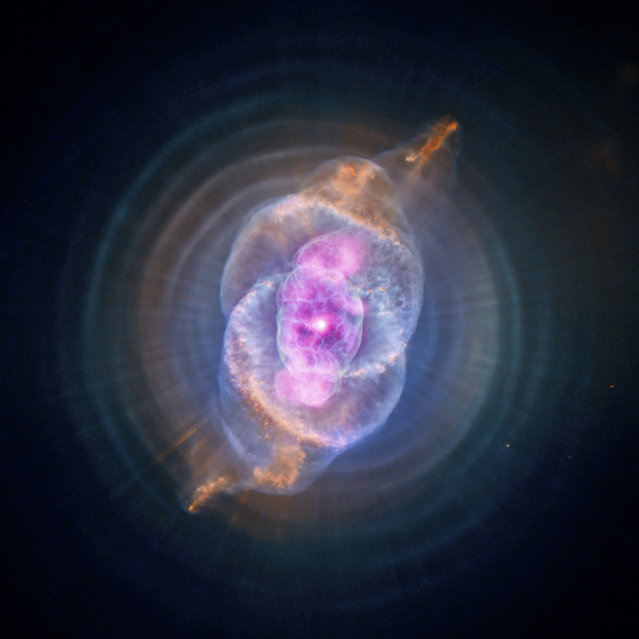
This image is NGC 6543 known as the Cat's Eye Nebula as it appears to the Chandra X-Ray Observatory and Hubble Telescope. A planetary nebula is a phase of stellar evolution that the sun should experience several billion years from now, when it expands to become a red giant and then sheds most of its outer layers, leaving behind a hot core that contracts to form a dense white dwarf star. This image was released October 10, 2012. (Photo by J. Kastner/NASA/CXC/RIT)

This image is NGC 6543 known as the Cat's Eye Nebula as it appears to the Chandra X-Ray Observatory and Hubble Telescope. A planetary nebula is a phase of stellar evolution that the sun should experience several billion years from now, when it expands to become a red giant and then sheds most of its outer layers, leaving behind a hot core that contracts to form a dense white dwarf star. This image was released October 10, 2012. (Photo by J. Kastner/NASA/CXC/RIT)
Details
15 Apr 2013 10:09:00
Overall winner. Mont Saint-Michel by Daniel Burton. (Photo by Daniel Burton/The Guardian)

The Historic Photographer of the Year awards celebrate historic places and cultural sites across the globe, from national treasures to hidden gems. Entries were judged on originality, composition and technical proficiency as well as the story that inspired the submission and its historical impact. Here: Overall winner. Mont Saint-Michel by Daniel Burton. (Photo by Daniel Burton/The Guardian)
Details
30 Nov 2018 00:05:00
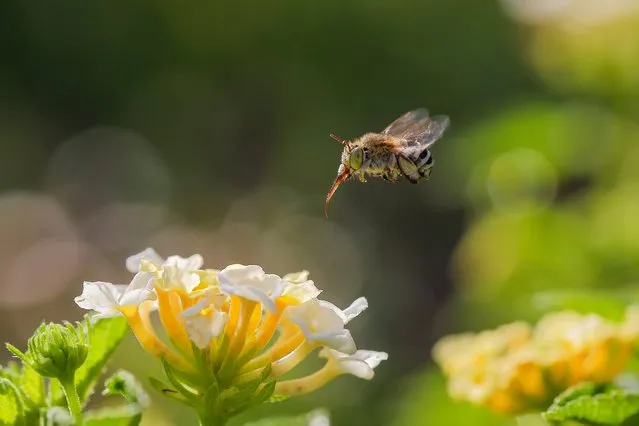
“Tasty Nature” by Dipesh Bhatt. “The blue banded bee (Amegilla cingulata) is pointing this sheath towards the flowers in preparation for sipping nectar”. Taken in Gujarat, India. (Photo by Dipesh Bhatt/2016 Royal Society of Biology Photographer of the Year competition)

“Tasty Nature” by Dipesh Bhatt. “The blue banded bee (Amegilla cingulata) is pointing this sheath towards the flowers in preparation for sipping nectar”. Taken in Gujarat, India. (Photo by Dipesh Bhatt/2016 Royal Society of Biology Photographer of the Year competition)
Details
30 Sep 2016 09:32:00
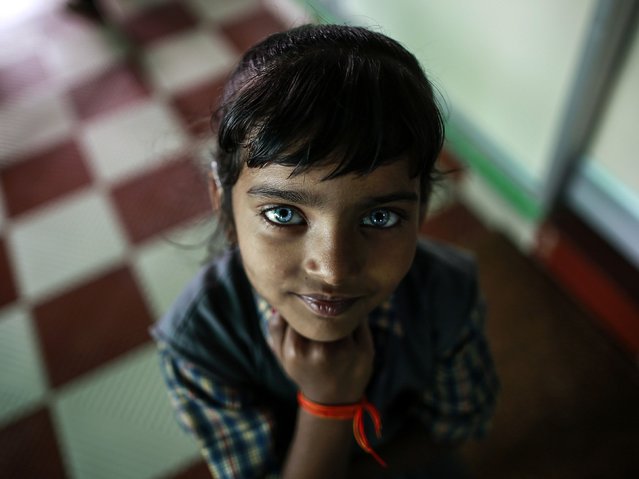
A girl who suffers from hearing and speech disorders reacts to the camera at a rehabilitation centre supported by Bhopal Medical Appeal, for children who were born with mental and physical disabilities, in Bhopal November 11, 2014.(Photo by Danish Siddiqui/Reuters)

A girl who suffers from hearing and speech disorders reacts to the camera at a rehabilitation centre supported by Bhopal Medical Appeal, for children who were born with mental and physical disabilities, in Bhopal November 11, 2014. The rehabilitation centre only treats families they believe have been affected by the Union Carbide gas leak 30 years ago. Human rights groups say that thousands of tonnes of hazardous waste remain buried underground, and the government has conceded it is contaminated. There has, however, been no long-term epidemiological research which conclusively proves that birth defects are directly related to the drinking of the contaminated water. (Photo by Danish Siddiqui/Reuters)
Details
30 Nov 2014 12:00:00
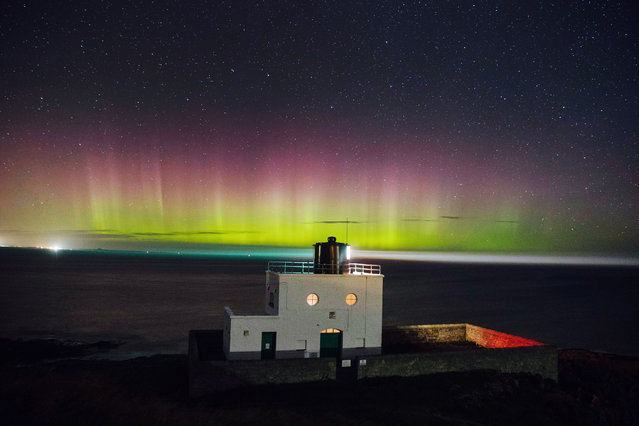
The northern lights, or aurora borealis, appear in the sky over the Bamburgh lighthouse at Stag Rock in Northumberland, England on September 28, 2016. (Photo by Owen Humphreys/PA Wire via ZUMA Press)

The northern lights, or aurora borealis, appear in the sky over the Bamburgh lighthouse at Stag Rock in Northumberland, England on September 28, 2016. (Photo by Owen Humphreys/PA Wire via ZUMA Press)
Details
30 Sep 2016 09:25:00