Loading...
Done
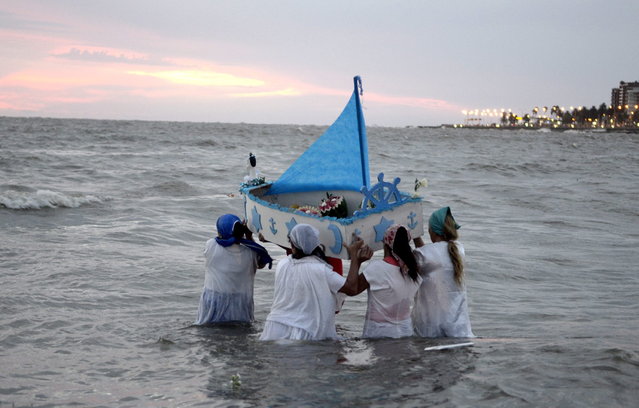
Faithful carry a boat out to sea, filled with offerings to Yemanja, the African sea goddess, during a ceremony honoring the deity in Montevideo, Uruguay, Saturday, February 2, 2013. Thousands of worshippers come to the beach in Montevideo on her feast day, February 2, bearing candles, flowers, perfumes and fruit to show their gratitude for her blessings bestowed upon them. The belief in the goddess sprouts from Umbanda, a blend of religions that include African, Catholicism and Spiritism. (Photo by Matilde Campodonico/AP Photo)

Faithful carry a boat out to sea, filled with offerings to Yemanja, the African sea goddess, during a ceremony honoring the deity in Montevideo, Uruguay, Saturday, February 2, 2013. Thousands of worshippers come to the beach in Montevideo on her feast day, February 2, bearing candles, flowers, perfumes and fruit to show their gratitude for her blessings bestowed upon them. The belief in the goddess sprouts from Umbanda, a blend of religions that include African, Catholicism and Spiritism. (Photo by Matilde Campodonico/AP Photo)
Details
03 Feb 2013 13:14:00
A woman (C) shops for an offering at the witch doctor's street in La Paz, July 31, 2015. (Photo by David Mercado/Reuters)

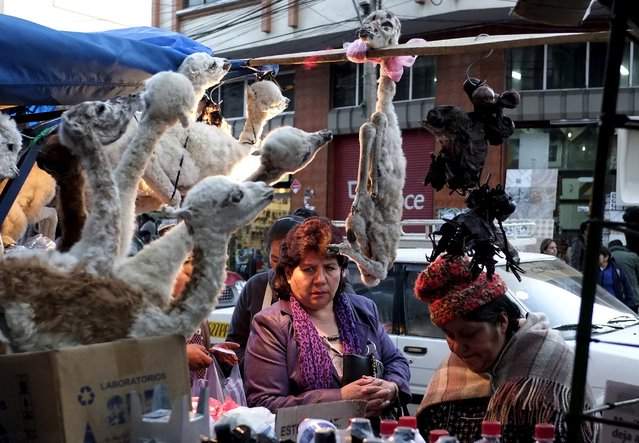
A woman (C) shops for an offering at the witch doctor's street in La Paz, July 31, 2015. According to Andean culture, the all the month of August is a time to give offerings to “Pachamama” to give thanks for their farms and health. The Aymaras use coca leaves, candies, animal fat, llama fetuses, some dried fruits, powdered minerals and alcohol during these rituals. (Photo by David Mercado/Reuters)
Details
02 Aug 2015 12:27:00

A refugee sits in front of a Greek riot police cordon during a protest at the Greek-Macedonian border, near the Greek village of Idomeni, March 1, 2016. (Photo by Alexandros Avramidis/Reuters)

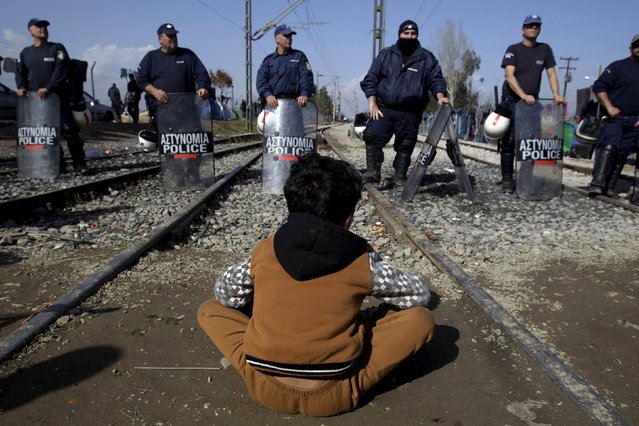
A refugee sits in front of a Greek riot police cordon during a protest at the Greek-Macedonian border, near the Greek village of Idomeni, March 1, 2016. (Photo by Alexandros Avramidis/Reuters)
Details
02 Mar 2016 13:19:00
In this photo taken October 12, 2019, a spiritual healer known as a “madrina” starts a ritual on Sorte Mountain where followers of indigenous goddess Maria Lionza gather annually in Venezuela's Yaracuy state. While her followers gather on the mountain for weeks at this time of the year, October 12 marks the biggest gathering, coinciding with Indigenous People's Day, known in Latin America as “Dia de la Raza”. (Photo by Ariana Cubillos/AP Photo)

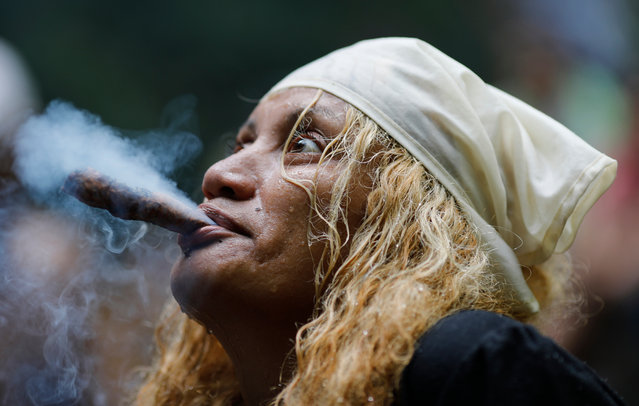
In this photo taken October 12, 2019, a spiritual healer known as a “madrina” starts a ritual on Sorte Mountain where followers of indigenous goddess Maria Lionza gather annually in Venezuela's Yaracuy state. While her followers gather on the mountain for weeks at this time of the year, October 12 marks the biggest gathering, coinciding with Indigenous People's Day, known in Latin America as “Dia de la Raza”. (Photo by Ariana Cubillos/AP Photo)
Details
17 Oct 2019 00:05:00


“The Greek Civil War was fought from 1945 to 1949 between the Greek governmental army, backed by the United Kingdom and United States, and the Democratic Army of Greece (ΔΣΕ) (Greek initials DSE), the military branch of the Greek Communist Party (KKE), backed by Bulgaria, Yugoslavia and Albania. It was the result of a highly polarized struggle between leftists and rightists which started in 1943 and targeted the power vacuum that the German-Italian occupation during World War II had created. One of the first conflicts of the Cold War, according to some analysts it represents the first example of a postwar Western interference in the internal politics of a foreign country, and for others, marked the first serious test of the theory of the so-called Churchill-Stalin percentages agreement. The first signs of the civil war occurred in 1942–1944, during the Occupation”. – Wikipedia

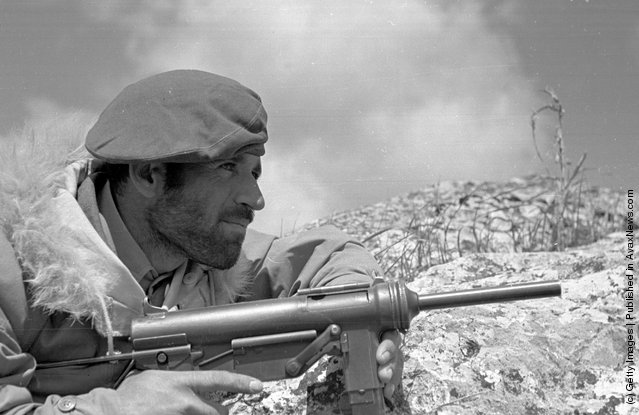
Photo: A Greek commando soldier, wearing a fur-collared jacket supplied by the Americans, waits for a guerrilla target to emerge during the Greek Civil War. (Photo by Bert Hardy/Picture Post/Getty Images). 22nd May 1948
Details
15 Aug 2013 15:47:00
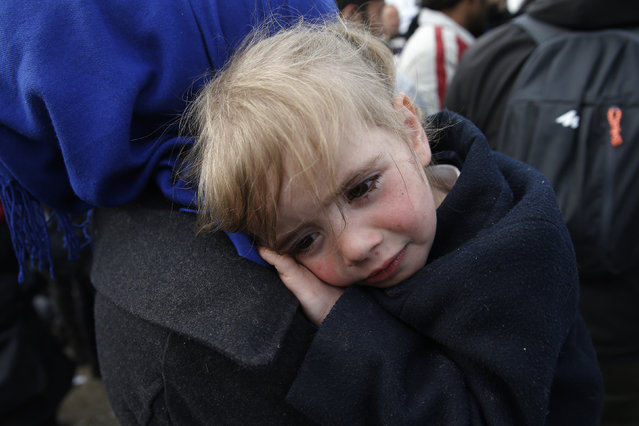
A young migrant cries as she waits to cross the Greek-Macedonian border, near the village of Idomeni, Greece March 3, 2016. (Photo by Marko Djurica/Reuters)

A young migrant cries as she waits to cross the Greek-Macedonian border, near the village of Idomeni, Greece March 3, 2016. Thousands of refugees and migrants wait on the border between Greece and Macedonia and about 30,000 refugees and other migrants are stranded in Greece, with 10,000 at the Idomeni border crossing to Macedonia. (Photo by Marko Djurica/Reuters)
Details
04 Mar 2016 11:42:00
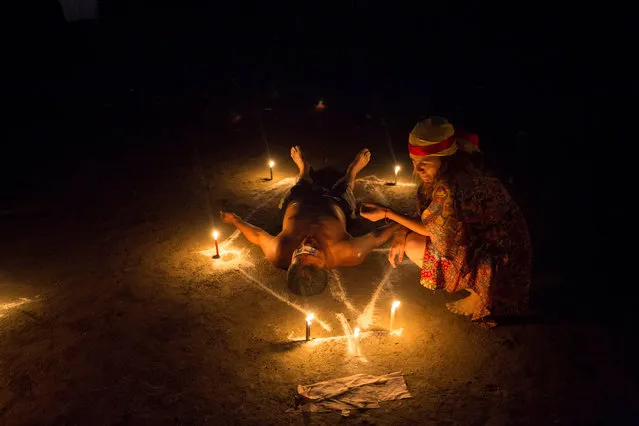
A man lies on the floor during a ritual at the Sorte Mountain on the outskirts of Chivacoa, in the state of Yaracuy, Venezuela October 10, 2015. (Photo by Marco Bello/Reuters)

A man lies on the floor during a ritual at the Sorte Mountain on the outskirts of Chivacoa, in the state of Yaracuy, Venezuela October 10, 2015. One long night every year in a mountainous rainforest in Venezuela, hundreds gather to dance on red-hot embers, enter trance-like states, and worship an ancient goddess known as Maria Lionza. Those who travel to the mountain known as Sorte in central Venezuela are practitioners of a cult that is built on local indigenous traditions. (Photo by Marco Bello/Reuters)
Details
08 Jul 2016 12:19:00
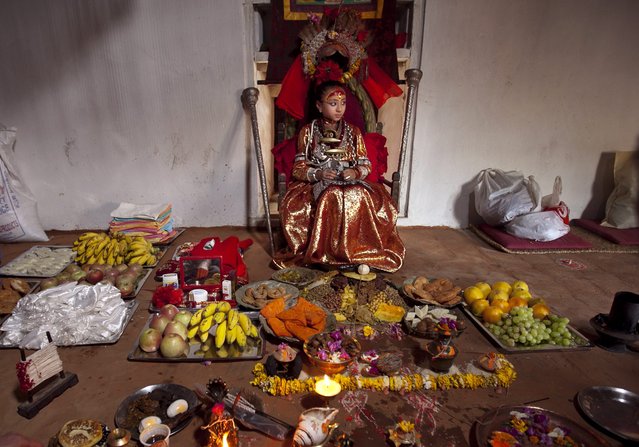
Kumari Samita Bajracharya sits in front of devotees offers during a special puja at Kumari Ghar in Patan, Nepal, 09 April 2011. It is believed that worshipping Kumari and receiving tika from her reduces illness and avoid problems. Kumari, or Kumari Devi, is a “living goddess”. The word literally means virgin in Nepali. The Living Goddesses are young pre-pubescent girls that are considered to be incarnations of the Hindu Goddess of Power, Kali. The Kumari retires when she reaches puberty. (Photo by Narendra Shrestha/EPA)

Kumari Samita Bajracharya sits in front of devotees offers during a special puja at Kumari Ghar in Patan, Nepal, 09 April 2011. It is believed that worshipping Kumari and receiving tika from her reduces illness and avoid problems. Kumari, or Kumari Devi, is a “living goddess”. The word literally means virgin in Nepali. The Living Goddesses are young pre-pubescent girls that are considered to be incarnations of the Hindu Goddess of Power, Kali. The Kumari retires when she reaches puberty. (Photo by Narendra Shrestha/EPA)
Details
18 Jun 2014 12:31:00