Loading...
Done
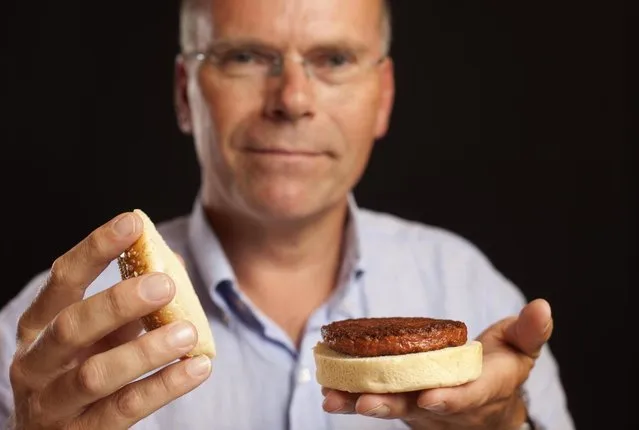
In this handout image provided by Ogilvy, a burger made from cultured beef, which has been developed by Professor Mark Post of Maastricht University in the Netherlands (pictured) is shown to the media during a press conference on August 5, 2013 in London, England. Cultured Beef could help solve the coming food crisis and combat climate change with commercial production of Cultured Beef beginning within ten to twenty years. (Photo by David Parry via Getty Images)

In this handout image provided by Ogilvy, a burger made from cultured beef, which has been developed by Professor Mark Post of Maastricht University in the Netherlands (pictured) is shown to the media during a press conference on August 5, 2013 in London, England. The in-vitro burger, cultured from cattle stem cells, the first example of what its creator says could provide an answer to global food shortages and help combat climate change, was fried in a pan and tasted by two volunteers. The burger is the result of years of research by Dutch scientist Mark Post, a vascular biologist at the University of Maastricht, who is working to show how meat grown in petri dishes might one day be a true alternative to meat from livestock.The meat in the burger has been made by knitting together around 20,000 strands of protein that has been cultured from cattle stem cells in Post's lab. (Photo by David Parry)
Details
06 Aug 2013 08:48:00
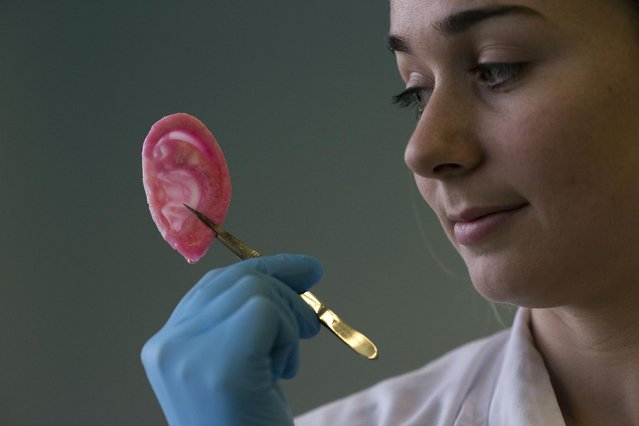
Dr Michelle Griffin, a plastic research fellow, poses for photographs with a synthetic polymer ear at her research facility in the Royal Free Hospital in London, Monday, March 31, 2014. (Photo by Matt Dunham/AP Photo)

In a north London hospital, scientists are growing noses, ears and blood vessels in the laboratory in a bold attempt to make body parts using stem cells. It is among several labs around the world, including in the U.S., that are working on the futuristic idea of growing custom-made organs in the lab. (Photo by Matt Dunham/AP Photo)
Details
10 Apr 2014 09:21:00
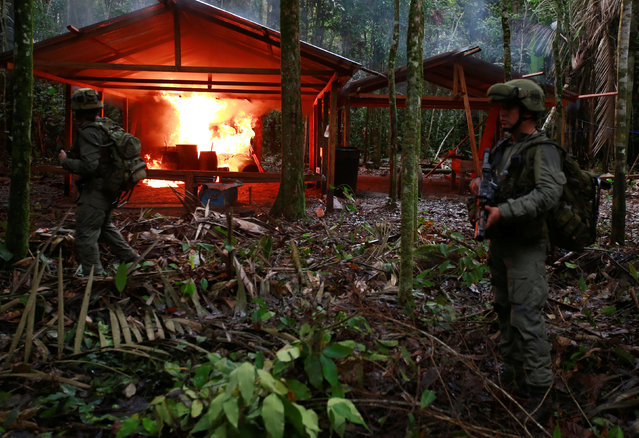
A Colombian anti-narcotics policeman stands guard after burning a cocaine lab, which police said belongs to criminal gangs, in a rural area of Calamar in Guaviare state, Colombia, August 2, 2016. (Photo by John Vizcaino/Reuters)

A Colombian anti-narcotics policeman stands guard after burning a cocaine lab, which police said belongs to criminal gangs, in a rural area of Calamar in Guaviare state, Colombia, August 2, 2016. Colombian law enforcement has destroyed 104 cocaine laboratories capable of producing some 100 tonnes of the drug annually, the head of the anti-narcotics police said on Tuesday. (Photo by John Vizcaino/Reuters)
Details
03 Aug 2016 11:28:00
Kim Goodman, from Chicago, Illinois, US, holds the record for the farthest eyeball protrusion, at 12mm. (Photo by Paul Michael Hughes/Guinness World Records/PA Wire Press Association)

Kim Goodman, from Chicago, Illinois, US, holds the record for the farthest eyeball protrusion, at 12mm. (Photo by Paul Michael Hughes/Guinness World Records/PA Wire Press Association)
Details
15 Oct 2025 03:12:00
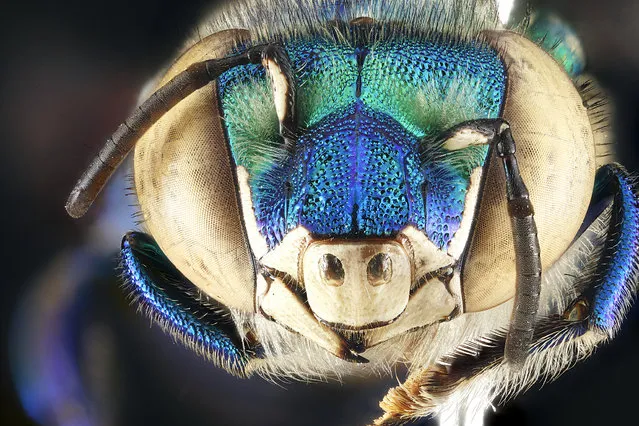
Eugloss dilemma, male, Florida, Biscayne National Monument. (Photo and caption by Sam Droege/USGS Bee Inventory and Monitoring Lab)

Eugloss dilemma, male, Florida, Biscayne National Monument. (Photo and caption by Sam Droege/USGS Bee Inventory and Monitoring Lab)
Details
16 Sep 2013 09:16:00
People walk past the Sleepwalker, a sculpture along the High Line in New York, US on May 10, 2016. The hyperrealistic work by Brooklyn artist Tony Matelli is part of the linear park’s Wanderlust exhibition. (Photo by Xinhua/Barcroft Images)

People walk past the Sleepwalker, a sculpture along the High Line in New York, US on May 10, 2016. The hyperrealistic work by Brooklyn artist Tony Matelli is part of the linear park’s Wanderlust exhibition. (Photo by Xinhua/Barcroft Images)
Details
11 May 2016 11:49:00
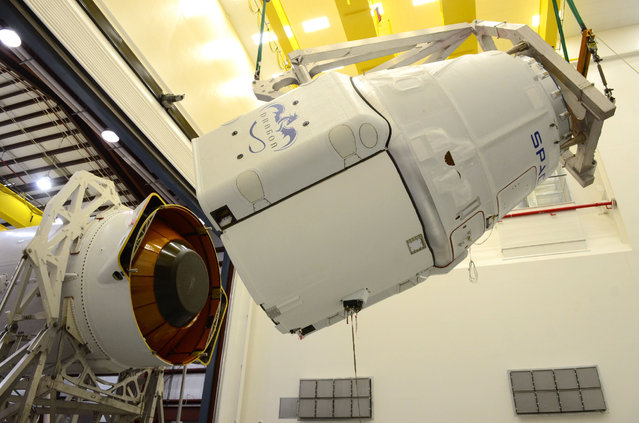
SpaceX’s Dragon spacecraft, March 6, 2014. SpaceX's Falcon 9 rocket and Dragon spacecraft launched from Launch Complex 40 at the Cape Canaveral Air Force Station, Florida, for their third official Commercial Resupply (CRS) mission to the orbiting lab on April 18, 2014. Dragon is the only operational spacecraft capable of returning a significant amount of supplies back to Earth, including experiments. (Photo by Ron Lin/SpaceX Photos)

SpaceX’s Dragon spacecraft, March 6, 2014. SpaceX's Falcon 9 rocket and Dragon spacecraft launched from Launch Complex 40 at the Cape Canaveral Air Force Station, Florida, for their third official Commercial Resupply (CRS) mission to the orbiting lab on April 18, 2014. Dragon returned to Earth with a parachute-assisted splashdown off the coast of southern California on May 14, 2014. Dragon is the only operational spacecraft capable of returning a significant amount of supplies back to Earth, including experiments. (Photo by Ron Lin/SpaceX Photos)
Details
30 Mar 2015 13:11:00
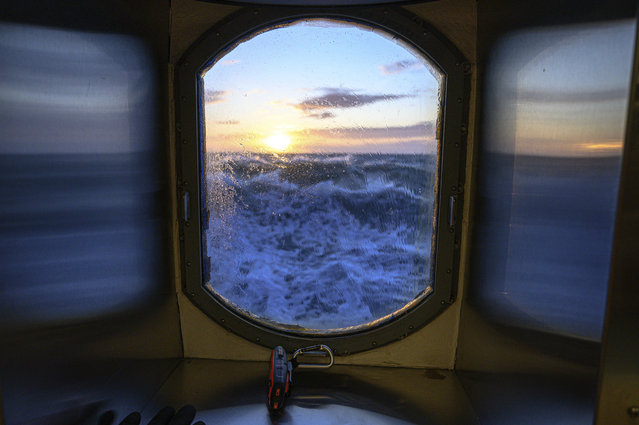
This November 8, 2019, photo provided by John Guillote shows a view from the main lab of the Sikuliaq in the Chukchi Sea. University of Washington scientists onboard the research vessel are studying the changes and how less sea ice will affect coastlines, which already are vulnerable to erosion because increased waves delivered by storms. More erosion would increase the chance of winter flooding in villages and danger to hunters in small boats. (Photo by John Guillote via AP Photo)

This November 8, 2019, photo provided by John Guillote shows a view from the main lab of the Sikuliaq in the Chukchi Sea. University of Washington scientists onboard the research vessel are studying the changes and how less sea ice will affect coastlines, which already are vulnerable to erosion because increased waves delivered by storms. More erosion would increase the chance of winter flooding in villages and danger to hunters in small boats. (Photo by John Guillote via AP Photo)
Details
26 Aug 2021 08:22:00