Loading...
Done
8. NEW ZEALAND: A woman dives from a platform into a giant air bed at a park in Palmerston North September 29, 2011. (Photo by Marcos Brindicci/Reuters)

The report, prepared by the Sustainable Development Solutions Network (SDSN) and the Earth Institute at Columbia University, showed Syria, Afghanistan and eight sub-Saharan countries as the 10 least happy places on earth to live. The top 10 this year were Denmark, Switzerland, Iceland, Norway, Finland, Canada, Netherlands, New Zealand, Australia, and Sweden. Denmark was in third place last year, behind Switzerland and Iceland. The bottom 10 were Madagascar, Tanzania, Liberia, Guinea, Rwanda, Benin, Afghanistan, Togo, Syria and Burundi. The United States came in at 13, the United Kingdom at 23, France at 32, and Italy at 50. Here: #8. NEW ZEALAND: A woman dives from a platform into a giant air bed at a park in Palmerston North September 29, 2011. (Photo by Marcos Brindicci/Reuters)
Details
26 Mar 2016 13:19:00


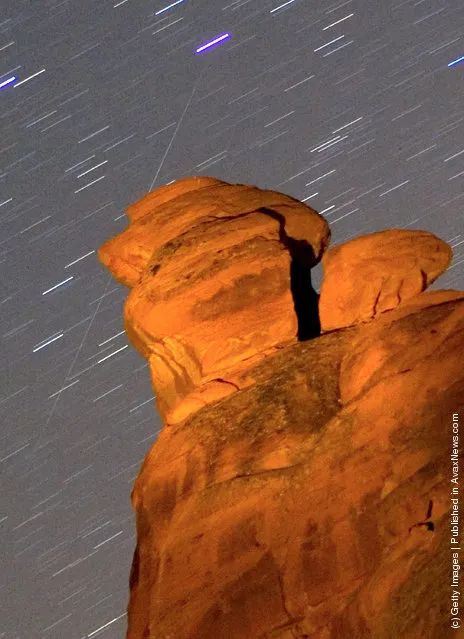
A Geminid meteor streaks diagonally across the sky against a field of star trails behind one of the peaks of the Seven Sisters rock formation in this long exposure early December 14, 2007 in the Valley of Fire State Park in Nevada. The meteor display, known as the Geminid meteor shower because it appears to radiate from near the star Castor in the constellation Gemini, is thought to be the result of debris cast off from an asteroid-like object called 3200 Phaethon. The shower is visible every December. (Photo by Ethan Miller/Getty Images)
Details
07 Jul 2011 10:34:00
Quokka The Happiest Animal in the World

The quokka the only member of the genus Setonix, is a small macropod about the size of a domestic cat. Like other marsupials in the macropod family (such as the kangaroos and wallabies), the quokka is herbivorous and mainly nocturnal.
Details
14 Oct 2014 10:30:00
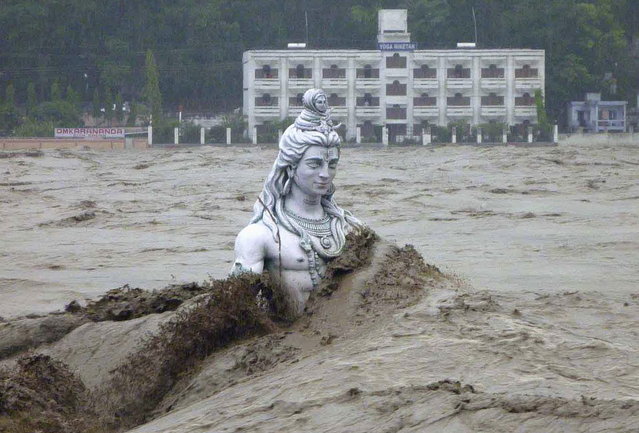
A submerged statue of the Hindu Lord Shiva stands amid the flooded waters of river Ganges at Rishikesh in the Himalayan state of Uttarakhand June 17, 2013. Early monsoon rains have swollen the Ganges, India's longest river, swept away houses, killed at least 60 people and left tens of thousands stranded, officials said on June 18, 2013. (Photo by Reuters/Stringer)

A submerged statue of the Hindu Lord Shiva stands amid the flooded waters of river Ganges at Rishikesh in the Himalayan state of Uttarakhand June 17, 2013. Early monsoon rains have swollen the Ganges, India's longest river, swept away houses, killed at least 60 people and left tens of thousands stranded, officials said on June 18, 2013. (Photo by Reuters/Stringer)
Details
21 Jun 2013 12:01:00
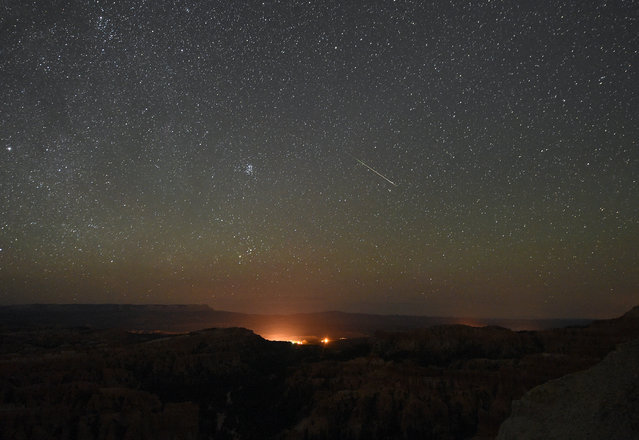
A Perseid meteor streaks across the sky above Inspiration Point early on August 12, 2016 in Bryce Canyon National Park, Utah. The annual display, known as the Perseid shower because the meteors appear to radiate from the constellation Perseus in the northeastern sky, is a result of Earth's orbit passing through debris from the comet Swift-Tuttle. (Photo by Ethan Miller/Getty Images)

A Perseid meteor streaks across the sky above Inspiration Point early on August 12, 2016 in Bryce Canyon National Park, Utah. The annual display, known as the Perseid shower because the meteors appear to radiate from the constellation Perseus in the northeastern sky, is a result of Earth's orbit passing through debris from the comet Swift-Tuttle. (Photo by Ethan Miller/Getty Images)
Details
13 Aug 2016 11:19:00
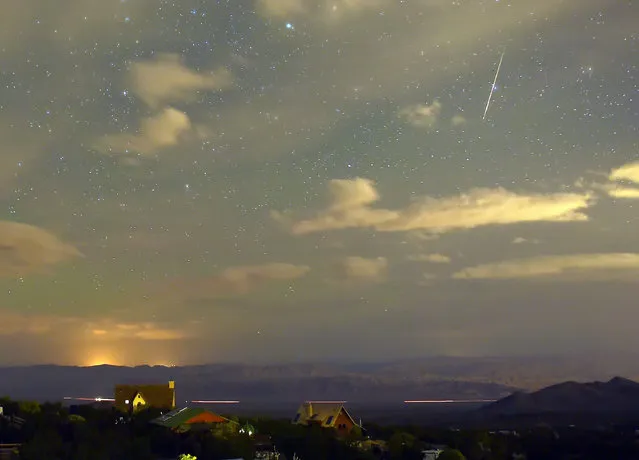
A Perseid meteor streaks across the sky over the community of Cold Creek on August 12, 2015 in the Spring Mountains National Recreation Area, Nevada. The annual display, known as the Perseid shower because the meteors appear to radiate from the constellation Perseus in the northeastern sky, is a result of Earth's orbit passing through debris from the comet Swift-Tuttle. (Photo by Ethan Miller/Getty Images)

A Perseid meteor streaks across the sky over the community of Cold Creek on August 12, 2015 in the Spring Mountains National Recreation Area, Nevada. The annual display, known as the Perseid shower because the meteors appear to radiate from the constellation Perseus in the northeastern sky, is a result of Earth's orbit passing through debris from the comet Swift-Tuttle. (Photo by Ethan Miller/Getty Images)
Details
13 Aug 2015 11:33:00
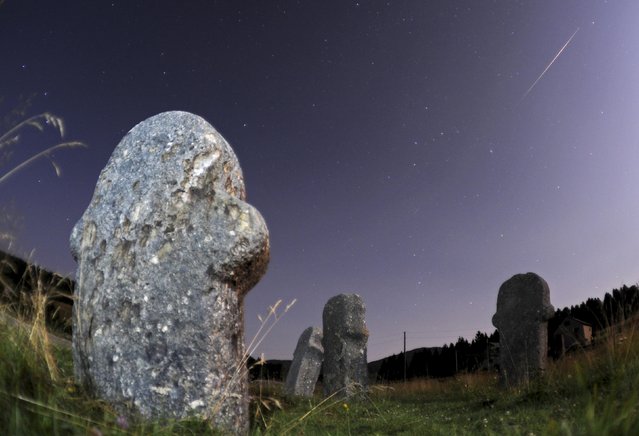
A meteor streaks over the sky during the Perseid meteor shower at the Maculje archaeological site near Novi Travnik August 12, 2014. According to NASA, the annual Perseid meteor shower reaches its peak on August 12 and 13 in Europe. The fireballs from the meteorites are fast and plentiful, although a nearly full moon (Supermoon) makes it difficult to view them this year, the agency adds. (Photo by Dado Ruvic/Reuters)

A meteor streaks over the sky during the Perseid meteor shower at the Maculje archaeological site near Novi Travnik August 12, 2014. According to NASA, the annual Perseid meteor shower reaches its peak on August 12 and 13 in Europe. The fireballs from the meteorites are fast and plentiful, although a nearly full moon (Supermoon) makes it difficult to view them this year, the agency adds. (Photo by Dado Ruvic/Reuters)
Details
14 Aug 2014 10:45:00
A worker lays rails across the bed of a drained area of a lake used for the production of salt at the Sasyk-Sivash lake near the city of Yevpatoria in Crimea, October 5, 2014. (Photo by Pavel Rebrov/Reuters)

A worker lays rails across the bed of a drained area of a lake used for the production of salt at the Sasyk-Sivash lake near the city of Yevpatoria in Crimea, October 5, 2014. The area has a long tradition of salt production, prepared from salt flats flooded with water from the Black Sea. (Photo by Pavel Rebrov/Reuters)
Details
07 Oct 2014 11:24:00