Loading...
Done
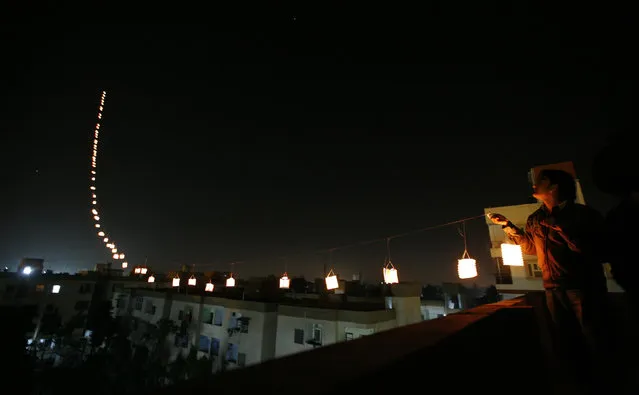
A man flies a kite made of 110 Tukkal or paper lanterns for the Hindu festival of “Makar Sankranti”, which marks the start of spring, in Ahmedabad January 13, 2011. (Photo by Amit Dave/Reuters)

A man flies a kite made of 110 Tukkal or paper lanterns for the Hindu festival of “Makar Sankranti”, which marks the start of spring, in Ahmedabad January 13, 2011. (Photo by Amit Dave/Reuters)
Details
28 Mar 2016 10:39:00
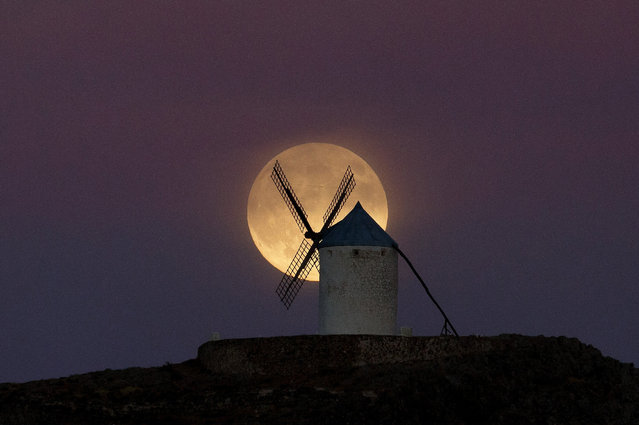
A moon appears behind a windmill a day before the supermoon is full on September 8, 2014 in Consuegra, in Toledo province, Spain. Consuegra belongs to a region made famous by the novel “Don Quijote de la Mancha” (Don Quixote) writed by Miguel De Cervantes. Some of the windmills belong to the 16th century. (Photo by Pablo Blazquez Dominguez/Getty Images)

A moon appears behind a windmill a day before the supermoon is full on September 8, 2014 in Consuegra, in Toledo province, Spain. Consuegra belongs to a region made famous by the novel “Don Quijote de la Mancha” (Don Quixote) writed by Miguel De Cervantes. Some of the windmills belong to the 16th century. (Photo by Pablo Blazquez Dominguez/Getty Images)
Details
10 Sep 2014 12:06:00
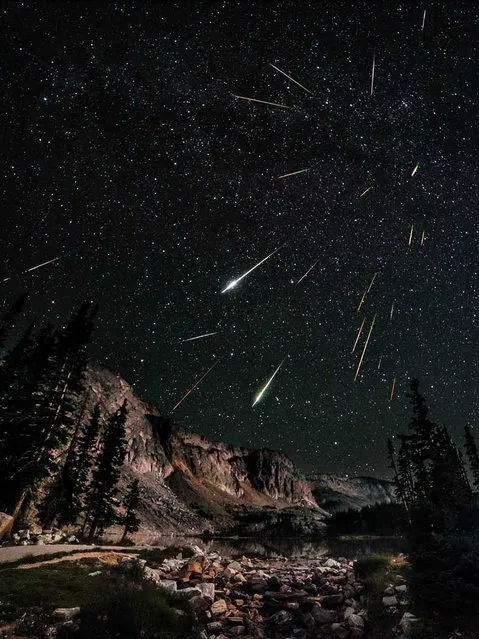
Photographer David Kingham created this composite image from 23 photos on August 12, 2012. He writes, “Last night I went out to Snowy Range in Wyoming in search of dark skies for the Perseid meteor shower.”. (Photo by David Kingham)

Starting on Monday, August 12, Perseid meteors will streak across the summer sky for a couple of nights, offering casual stargazers and serious nighttime photographers a chance to capture a glimpse of the annual meteor shower. Photo: Photographer David Kingham created this composite image from 23 photos on August 12, 2012. (Photo by David Kingham)
Details
08 Aug 2013 12:50:00
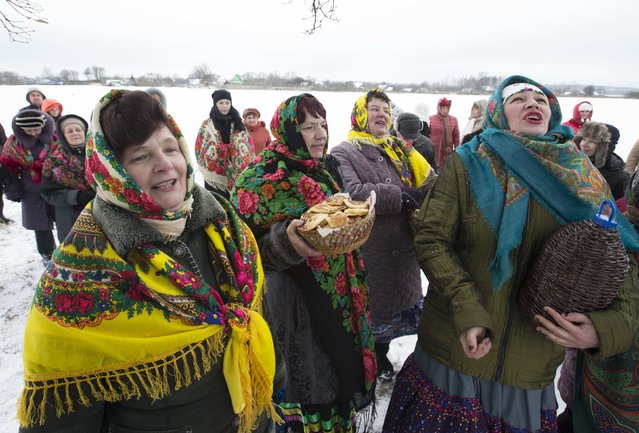
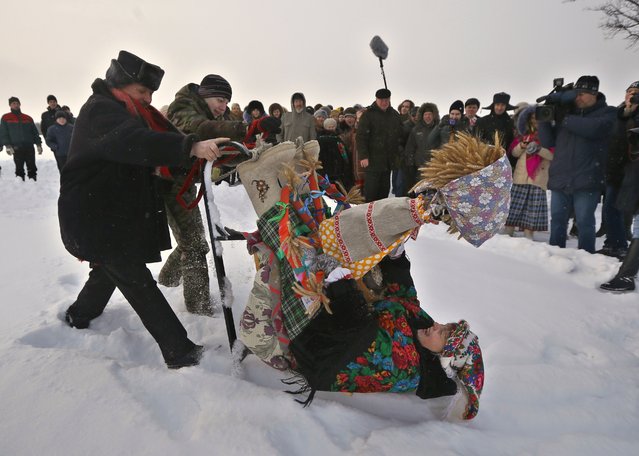
Belarusians wearing national costumes celebrate a Pull the Kolyada Up the Oak rite in the village of Martsiyanauka, some 77 km (48 miles) east of capital Minsk, Belarus, Thursday, January 21, 2016. (Photo by Sergei Grits/AP Photo)

Belarusians wearing national costumes celebrate a Pull the Kolyada Up the Oak rite in the village of Martsiyanauka, some 77 km (48 miles) east of capital Minsk, Belarus, Thursday, January 21, 2016. The merry ancient rite Pull the Kolyada Up the Oak marks the end of Orthodox Christmas celebrations in Belarus. On Jan. 21 a wheel, the so-called Kolyada, would be pulled up an oak or any old tree. The Belarusians believed that the ritual heralds a good harvest, luck and happiness for the entire year. (Photo by Sergei Grits/AP Photo)
Details
22 Jan 2016 10:13:00
Villagers take part in Kolyada holiday celebrations in the village of Martsiyanauka, east of the capital Minsk, January 21, 2015. Local residents took part in the celebrations to mark the end of a pagan winter holiday Kolyada, which over the centuries has merged with Orthodox Christmas celebrations. (Photo by Vasily Fedosenko/Reuters)

Villagers take part in Kolyada holiday celebrations in the village of Martsiyanauka, east of the capital Minsk, January 21, 2015. Local residents took part in the celebrations to mark the end of a pagan winter holiday Kolyada, which over the centuries has merged with Orthodox Christmas celebrations. (Photo by Vasily Fedosenko/Reuters)
Details
22 Jan 2015 13:48:00
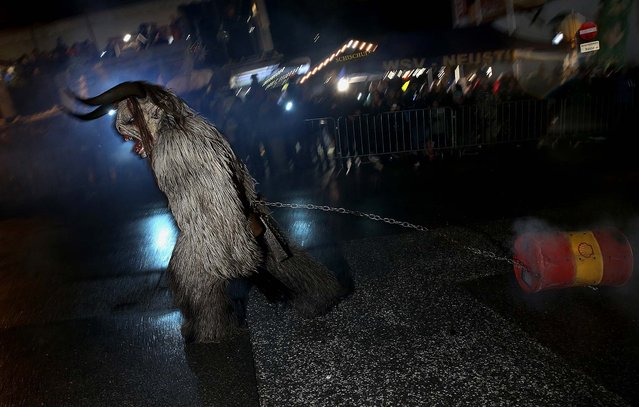
A participant dressed as the Krampus creature pulls a barrel of fire past onlookers during his search for delinquent children in Neustift im Stubaital. (Photo by Sean Gallup)

“Krampus is a beast-like creature from the folklore of Alpine countries thought to punish children during the Yule season who had misbehaved, in contrast with Saint Nicholas, who rewards well-behaved ones with gifts. Krampus is said to capture particularly naughty children in his sack and carry them away to his lair”. – Wikipedia. Photo: A participant dressed as the Krampus creature pulls a barrel of fire past onlookers during his search for delinquent children in Neustift im Stubaital. (Photo by Sean Gallup)
Details
05 Dec 2013 08:29:00
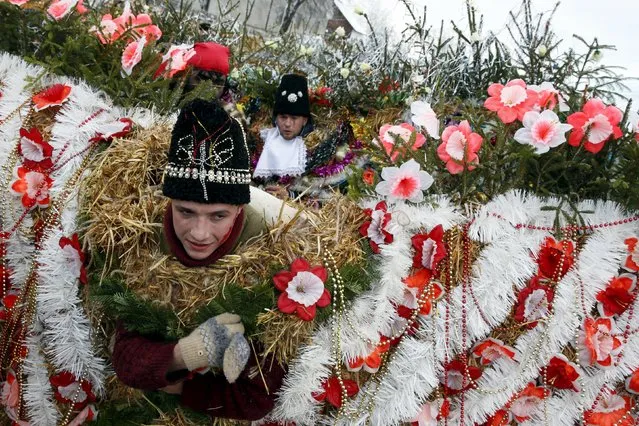
Local residents dressed in costumes perform during celebrations for the Malanka holiday in the village of Krasnoilsk in the Chernivtsi region of Ukraine, January 14, 2016. The Malanka traditional holiday is more popular in the western regions of the country and is also known as the Old New Year celebrated on January 13 and 14 - St. Basil's and St. Melania's Day, according to the old Julian calendar. During the celebrations, youngsters and adults wear traditional carnival costumes and masks, and visit local houses while singing carols, playing pranks or performing short plays. (Photo by Valentyn Ogirenko/Reuters)

Local residents dressed in costumes perform during celebrations for the Malanka holiday in the village of Krasnoilsk in the Chernivtsi region of Ukraine, January 14, 2016. The Malanka traditional holiday is more popular in the western regions of the country and is also known as the Old New Year celebrated on January 13 and 14 – St. Basil's and St. Melania's Day, according to the old Julian calendar. During the celebrations, youngsters and adults wear traditional carnival costumes and masks, and visit local houses while singing carols, playing pranks or performing short plays. (Photo by Valentyn Ogirenko/Reuters)
Details
16 Jan 2016 08:04:00
2013. A woman is visible through a narrow passageway between two buildings. Norilsk's urban spaces were designed to shorten distances around large developments and give residents maximum protection from arctic winds. (Photo by Elena Chernyshova)

Elena Chernyshova's vision of Norilsk, Russia, the northernmost city in the world, is a series of surprises by which she extracts otherworldly beauty from ugly realities. Here: 2013. A woman is visible through a narrow passageway between two buildings. Norilsk's urban spaces were designed to shorten distances around large developments and give residents maximum protection from arctic winds. (Photo by Elena Chernyshova)
Details
10 Jan 2016 08:03:00