Loading...
Done
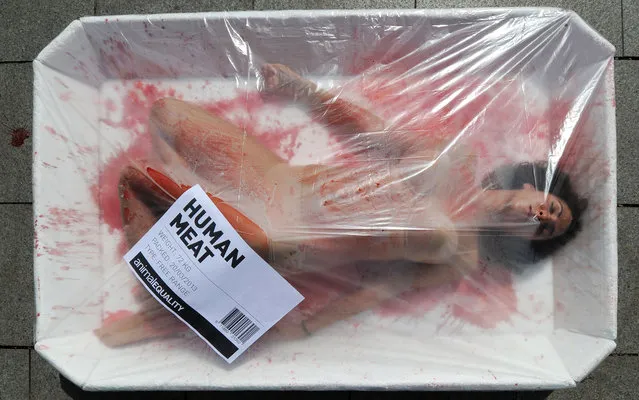
Ativista do grupo Igualdade Animal posa dentro de um enorme pacote de carne na Praça da Catedral, em Barcelona, Espanha. O ato marca uma campanha por um dia mundial sem carne. (Photo by Lluis Gene/AFP Photo)

Animal rights activists from the group “Animal Equality” are covered with plastic sheets to represent meat packaging as they stage a protest during “Day Without Meat” event in Barcelona, Spain, on March 20, 2013. (Photo by Lluis Gene/AFP Photo)
Details
21 Mar 2013 15:18:00


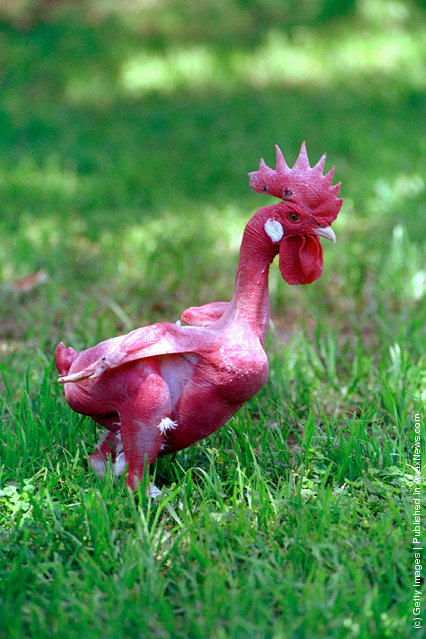
A genetically engineered featherless rooster struts around the campus of the Hebrew University of Jerusalem's Department of Agriculture May 22, 2002 in Rehovot, Israeli. After two years of research, departmental scientists announced the naked chicken, as it has been dubbed, as a low calorie bird because the lack of feathers means the chicken has less fat. It also matures earlier than its feathered counterparts. (Photo by Moshe Milner/GPO/Getty Images)
Details
29 Mar 2011 14:15:00
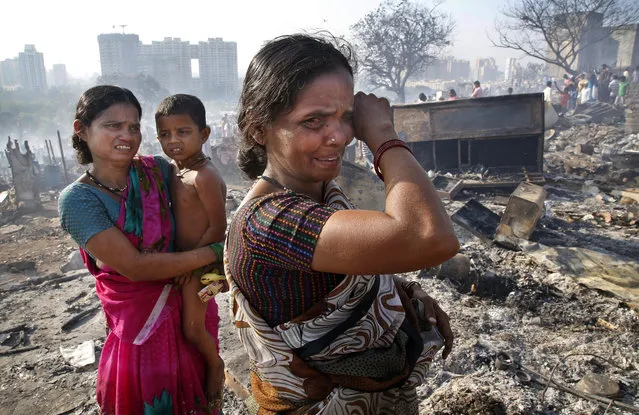
Women cry as they look for reusable household materials after fire broke at slums in Kadivali area of Mumbai, India, Monday, Dec. 7, 2015. Hundreds of homes were reportedly destroyed as fire tenders labored to reach the source in the heavily congested area. (AP Photo/Rajanish Kakade)

Women cry as they look for reusable household materials after fire broke at slums in Kadivali area of Mumbai, India, Monday, December 7, 2015. Hundreds of homes were reportedly destroyed as fire tenders labored to reach the source in the heavily congested area. (Photo by Rajanish Kakade/AP Photo)
Details
09 Dec 2015 08:01:00
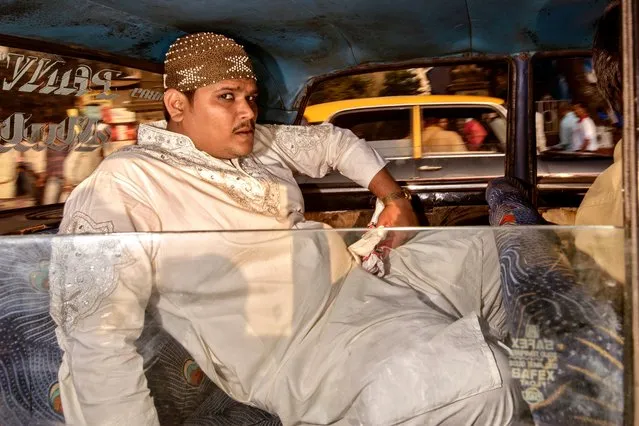
“I’m not scared of breaking the fourth wall”, Wallace has said of the photos where the subject is clearly aware of him taking the shot. “If they are looking at you in a photograph most photographers will think, oh, that’s not a good image. (But) people like to be involved and in the picture. You can see what they are thinking, see them talking”. (Photo by Dougie Wallace/The Guardian)

In Dougie Wallace’s photos of Mumbai taxis, the chatter, yelling, and constant horns of the city are almost audible. A selection of his images is on show at Gayfield Creative Spaces, Edinburgh, as part of the Retina photography festival until 30 July. For four years, the Glasgow-born Wallace focused his photos on one kind of taxi in particular: the Premier Padmini, a 1960s workhorse painted in black and yellow. Locally known as “Kaali-Peeli”, there were once more than 60,000 of them in the Indian city. But thanks to laws restricting pollution, the cars now are fast disappearing from Mumbai’s streets. (Photo by Dougie Wallace/The Guardian)

Details
13 Jul 2016 13:50:00
A model presents a creation by Indian designer Monisha Jaising during the grand finale of Lakme Fashion Week (LFW) Winter/Festive 2018, in Mumbai, India, 26 August 2018. (Photo by Divyakant Solanki/EPA/EFE)

A model presents a creation by Indian designer Monisha Jaising during the grand finale of Lakme Fashion Week (LFW) Winter/Festive 2018, in Mumbai, India, 26 August 2018. (Photo by Divyakant Solanki/EPA/EFE)
Details
31 Aug 2018 00:03:00
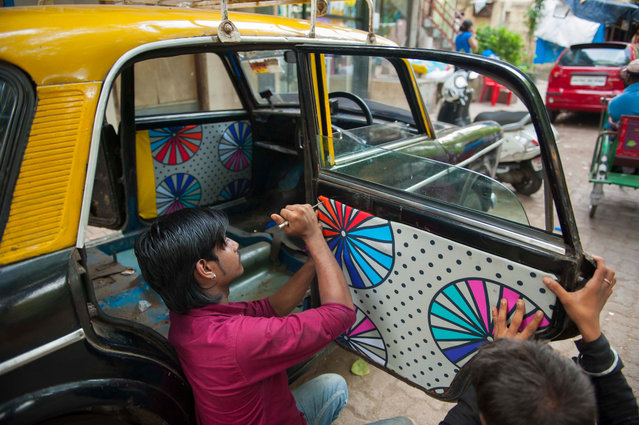
The designers are encouraged to speak to the driver they are designing for, develop a relationship and work from there: “One can’t tell the story of the other if they don’t know one-another”, they say. (Photo by Sandesh Parulkar/Taxi Fabric/The Guardian)

India’s classic Ambassador taxis and juddery auto rickshaws are iconic sights in the cities of the subcontinent. In Mumbai, one project has been using them as canvases for Indian graphic designers, giving them the opportunity to design new interiors for the vehicles. (Photo by Taxi Fabric/The Guardian)
Details
06 Feb 2016 12:50:00
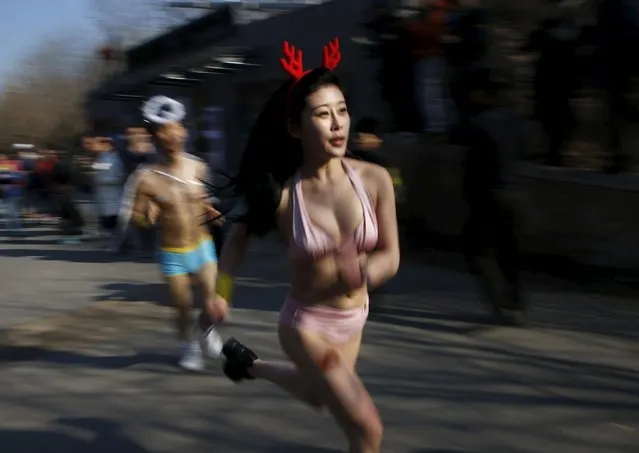
Participants run at the “Half-Naked Marathon” at Olympic Forest park in Beijing, China, February 28, 2016 (Photo by Kim Kyung-Hoon/Reuters)

Participants run at the “Half-Naked Marathon” at Olympic Forest park in Beijing, China, February 28, 2016. This annual running event which requires participants to run half-naked, was organized to promote environmentally friendly lifestyles. (Photo by Kim Kyung-Hoon/Reuters)
Details
29 Feb 2016 11:25:00
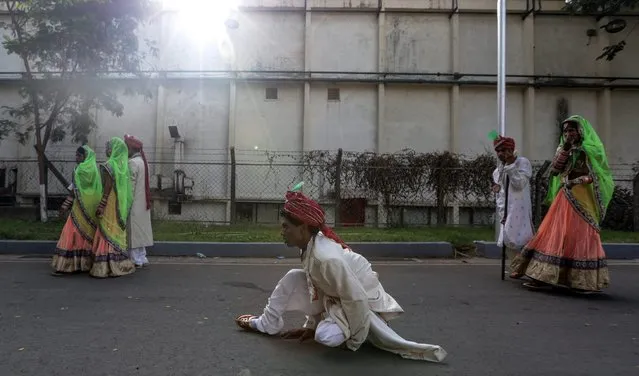
Indian underprivileged and specially abled grooms and brides in traditional marriage attire arrives to take part in a mass marriage ceremony in Mumbai, India, 29 May 2016. Around 51 couples got married during the ceremony which was organized by Narayan Seva Sansthan, for the underprivileged and specially abled people. From this 51 couples, both the partners are physically disabled in 22 couples, one partner is physically disabled in seven couples and 22 couples are from underprivileged circumstances. (Photo by Divyakant Solanki/EPA)

Indian underprivileged and specially abled grooms and brides in traditional marriage attire arrives to take part in a mass marriage ceremony in Mumbai, India, 29 May 2016. Around 51 couples got married during the ceremony which was organized by Narayan Seva Sansthan, for the underprivileged and specially abled people. From this 51 couples, both the partners are physically disabled in 22 couples, one partner is physically disabled in seven couples and 22 couples are from underprivileged circumstances. (Photo by Divyakant Solanki/EPA)
Details
31 May 2016 11:48:00