Loading...
Done
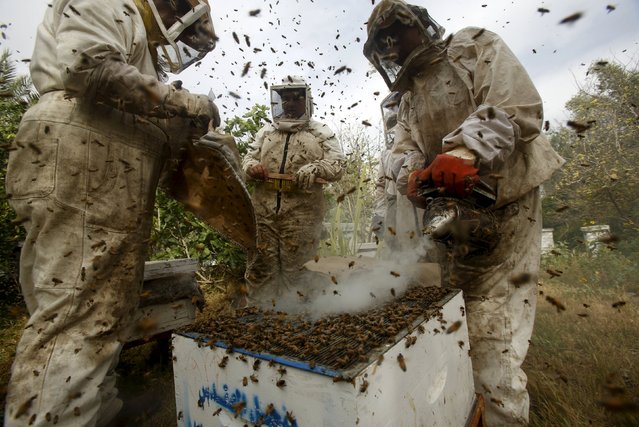
A Palestinian beekeeper uses smoke to calm bees in the process of collecting honey at a farm in Rafah, in the southern Gaza Strip April 11, 2016. (Photo by Suhaib Salem/Reuters)

A Palestinian beekeeper uses smoke to calm bees in the process of collecting honey at a farm in Rafah, in the southern Gaza Strip April 11, 2016. Rateb Samour sees 250 patients a day, whose complaints range from hair loss to cerebral palsy and cancer. He is not a doctor and has never worked in a hospital. Samour inherited the skill of bee-sting therapy from his father. From 2003 the agricultural engineer dedicated all his time to study and develop the alternative-medicine treatment of apitherapy, which uses bee-related products from honey, propolis – or bee glue used to build hives – to venom. (Photo by Suhaib Salem/Reuters)
Details
13 Apr 2016 09:14:00
Eugloss dilemma, male, Florida, Biscayne National Monument. (Photo and caption by Sam Droege/USGS Bee Inventory and Monitoring Lab)

Eugloss dilemma, male, Florida, Biscayne National Monument. (Photo and caption by Sam Droege/USGS Bee Inventory and Monitoring Lab)
Details
16 Sep 2013 09:16:00


Bees cover beekeeper Lu Kongjiang as he competes in a “bee bearding” contest on July 16, 2011 in Shaoyang, Hunan Province of China. Wang Dalin won the contest after attracting 26.86kg of bees onto his body, covered only by a pair of shorts and swimming goggles. (Photo by ChinaFotoPress/Getty Images)
Details
19 Jul 2011 10:44:00
Bee By Bad Art

Funny art "Bee" by Bad Art
Details
09 Aug 2013 12:31:00
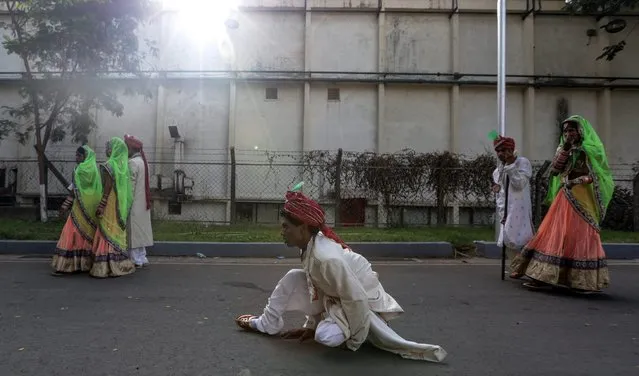
Indian underprivileged and specially abled grooms and brides in traditional marriage attire arrives to take part in a mass marriage ceremony in Mumbai, India, 29 May 2016. Around 51 couples got married during the ceremony which was organized by Narayan Seva Sansthan, for the underprivileged and specially abled people. From this 51 couples, both the partners are physically disabled in 22 couples, one partner is physically disabled in seven couples and 22 couples are from underprivileged circumstances. (Photo by Divyakant Solanki/EPA)

Indian underprivileged and specially abled grooms and brides in traditional marriage attire arrives to take part in a mass marriage ceremony in Mumbai, India, 29 May 2016. Around 51 couples got married during the ceremony which was organized by Narayan Seva Sansthan, for the underprivileged and specially abled people. From this 51 couples, both the partners are physically disabled in 22 couples, one partner is physically disabled in seven couples and 22 couples are from underprivileged circumstances. (Photo by Divyakant Solanki/EPA)
Details
31 May 2016 11:48:00
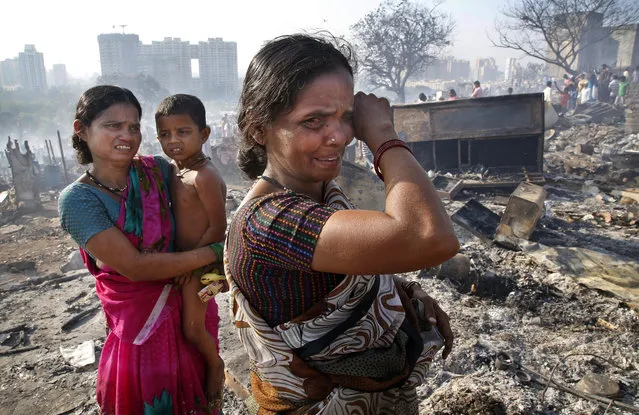
Women cry as they look for reusable household materials after fire broke at slums in Kadivali area of Mumbai, India, Monday, Dec. 7, 2015. Hundreds of homes were reportedly destroyed as fire tenders labored to reach the source in the heavily congested area. (AP Photo/Rajanish Kakade)

Women cry as they look for reusable household materials after fire broke at slums in Kadivali area of Mumbai, India, Monday, December 7, 2015. Hundreds of homes were reportedly destroyed as fire tenders labored to reach the source in the heavily congested area. (Photo by Rajanish Kakade/AP Photo)
Details
09 Dec 2015 08:01:00
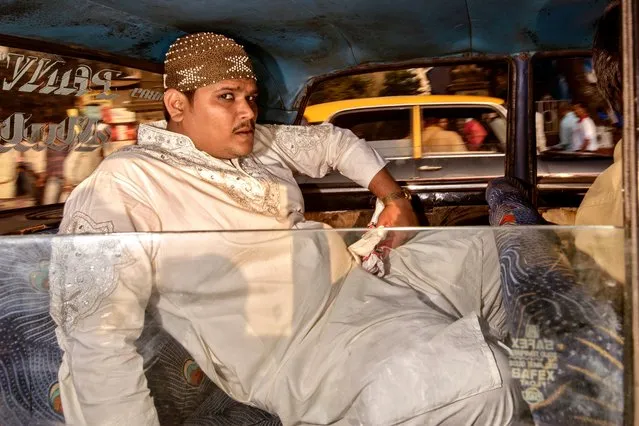
“I’m not scared of breaking the fourth wall”, Wallace has said of the photos where the subject is clearly aware of him taking the shot. “If they are looking at you in a photograph most photographers will think, oh, that’s not a good image. (But) people like to be involved and in the picture. You can see what they are thinking, see them talking”. (Photo by Dougie Wallace/The Guardian)

In Dougie Wallace’s photos of Mumbai taxis, the chatter, yelling, and constant horns of the city are almost audible. A selection of his images is on show at Gayfield Creative Spaces, Edinburgh, as part of the Retina photography festival until 30 July. For four years, the Glasgow-born Wallace focused his photos on one kind of taxi in particular: the Premier Padmini, a 1960s workhorse painted in black and yellow. Locally known as “Kaali-Peeli”, there were once more than 60,000 of them in the Indian city. But thanks to laws restricting pollution, the cars now are fast disappearing from Mumbai’s streets. (Photo by Dougie Wallace/The Guardian)
Details
13 Jul 2016 13:50:00
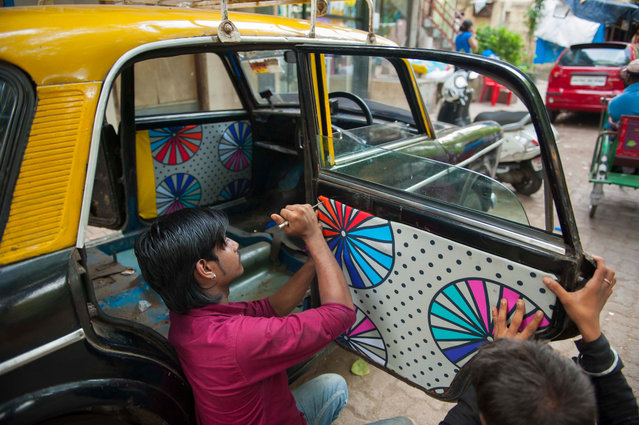
The designers are encouraged to speak to the driver they are designing for, develop a relationship and work from there: “One can’t tell the story of the other if they don’t know one-another”, they say. (Photo by Sandesh Parulkar/Taxi Fabric/The Guardian)

India’s classic Ambassador taxis and juddery auto rickshaws are iconic sights in the cities of the subcontinent. In Mumbai, one project has been using them as canvases for Indian graphic designers, giving them the opportunity to design new interiors for the vehicles. (Photo by Taxi Fabric/The Guardian)
Details
06 Feb 2016 12:50:00