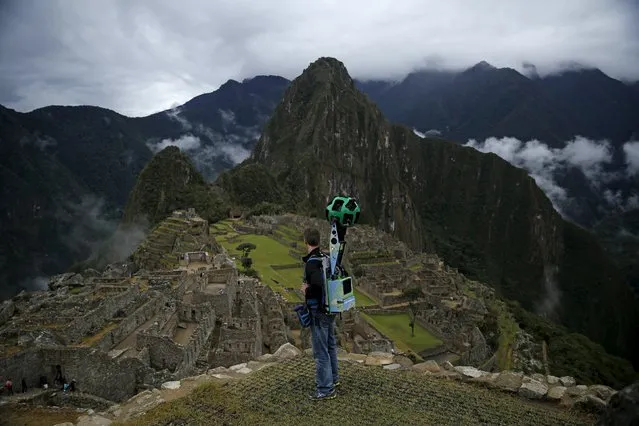
Daniel Filip, Tech Lead Manager for Google Maps, carries the Trekker, a 15-camera device, while mapping the Inca citadel of Machu Picchu for Google Street View in Cuzco, Peru, August 11, 2015. (Photo by Pilar Olivares/Reuters)
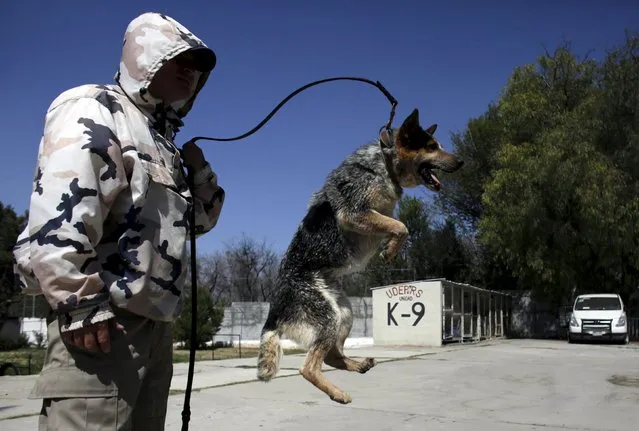
A dog trainer works with a previously abandoned dog at a police centre in Saltillo, Mexico March 4, 2016. Stray dogs are adopted by the police from a municipal anti-rabies centre and then trained to help the police patrol the streets, and search for drugs, explosives and weapons. (Photo by Daniel Becerril/Reuters)
Members of South Korean girl group Gfriend rehearse in Seoul December 23, 2014. Thousands of Korean children dream of becoming household names like rapper Psy, whose 2012 “Gangnam Style” video was a global YouTube hit, often putting up with punishing schedules in the hope of one day making it big in the music industry. A recent survey of pre-teens showed that 21 percent of respondents wanted to be K-pop (Korean pop) stars when they grow up, the most popular career choice. (Photo by Kim Hong-Ji/Reuters)
Metropolitan Transit Authority (MTA) Police Officer Keith Flood trains with his K-9 partner Doc, a German Shepherd, inside the “warehouse room” at the new MTA Police Department Canine Training Center in Stormville, New York, U.S., June 6, 2016. (Photo by Mike Segar/Reuters)
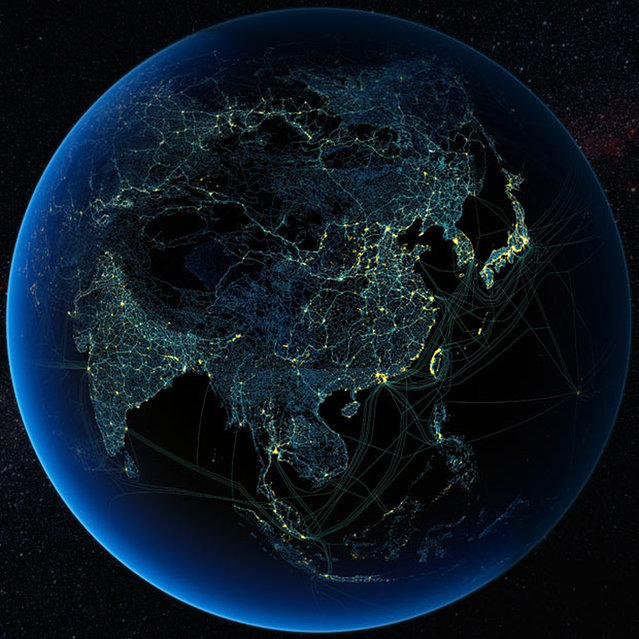
Defined according to wikipedia it is “a recent and informal geologic chronological term that serves to mark the evidence and extent of human activities that have had a significant global impact on the Earth’s ecosystems. The term was coined by ecologist Eugene Stoermer but has been widely popularized by the Nobel Prize-winning atmospheric chemist Paul Crutzen.”
The images here where created by Felix Pharand-Deschenes depicting how various human influences, from road and rail, to internet cables and airlines create significant patterns covering the Earth. What can we learn from these patterns in how they are influencing the environment