Loading...
Done
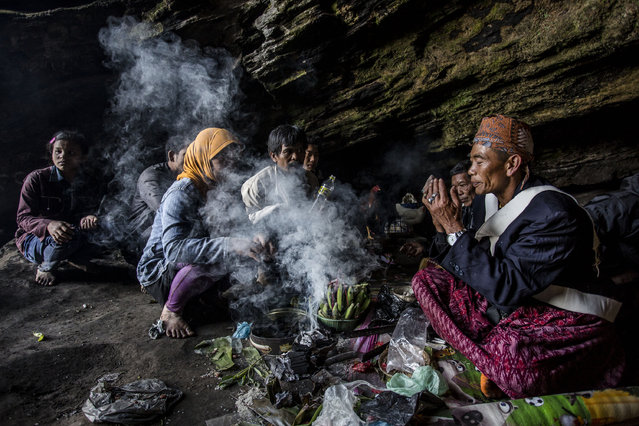
A Tenggerese shaman praying for worshippers at Widodaren cave during the Tenggerese Hindu Yadnya Kasada festival on July 31, 2015 in Probolinggo, East Java, Indonesia. The festival is the main festival of the Tenggerese people and lasts about a month. On the fourteenth day, the Tenggerese make the journey to Mount Bromo to make offerings of rice, fruits, vegetables, flowers and livestock to the mountain gods by throwing them into the volcano's caldera. (Photo by Ulet Ifansasti/Getty Images)

A Tenggerese shaman praying for worshippers at Widodaren cave during the Tenggerese Hindu Yadnya Kasada festival on July 31, 2015 in Probolinggo, East Java, Indonesia. The festival is the main festival of the Tenggerese people and lasts about a month. On the fourteenth day, the Tenggerese make the journey to Mount Bromo to make offerings of rice, fruits, vegetables, flowers and livestock to the mountain gods by throwing them into the volcano's caldera. The origin of the festival lies in the 15th century when a princess named Roro Anteng started the principality of Tengger with her husband Joko Seger, and the childless couple asked the mountain Gods for help in bearing children. The legend says the Gods granted them 24 children but on the provision that the 25th must be tossed into the volcano in sacrifice. The 25th child, Kesuma, was finally sacrificed in this way after initial refusal, and the tradition of throwing sacrifices into the caldera to appease the mountain Gods continues today. (Photo by Ulet Ifansasti/Getty Images)
Details
01 Aug 2015 12:07:00
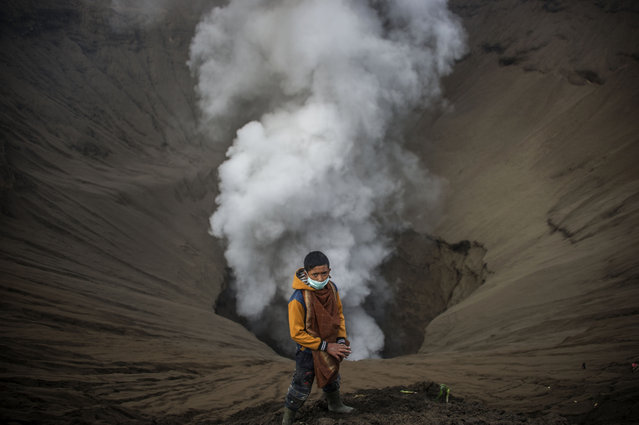
An Indonesian boy waits as he prepares to catch offerings released by Hindu devotees of the Tengger tribe during the Yadnya Kasada festival, on the crater of Mount Bromo in Probolinggo on July 21, 2016. During the annual Yadnya Kasada festival the Tenggerese climb Mount Bromo, an active volcano, and seek the blessing from the main deity Hyang Widi Wasa by presenting offerings of rice, fruit, livestock and other local produce. (Photo by Juni Kriswanto/AFP Photo)

An Indonesian boy waits as he prepares to catch offerings released by Hindu devotees of the Tengger tribe during the Yadnya Kasada festival, on the crater of Mount Bromo in Probolinggo on July 21, 2016. During the annual Yadnya Kasada festival the Tenggerese climb Mount Bromo, an active volcano, and seek the blessing from the main deity Hyang Widi Wasa by presenting offerings of rice, fruit, livestock and other local produce. (Photo by Juni Kriswanto/AFP Photo)
Details
22 Jul 2016 12:33:00
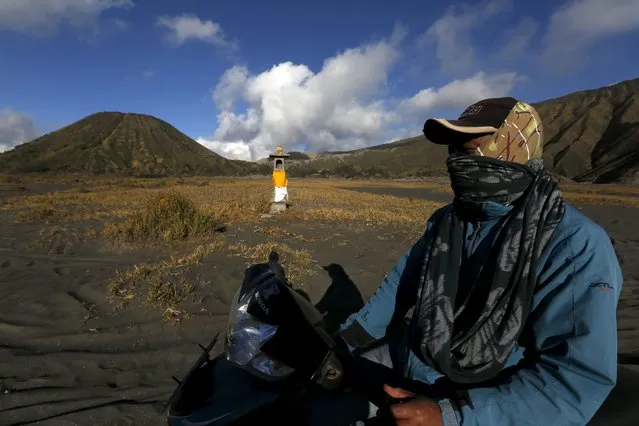
A Hindu villager rides a motorcycle past an altar ahead of the annual Kasada festival at the Mount Bromo in Indonesia's East Java province, July 30, 2015. (Photo by Reuters/Beawiharta)

A Hindu villager rides a motorcycle past an altar ahead of the annual Kasada festival at the Mount Bromo in Indonesia's East Java province, July 30, 2015. The Kasada festival will be held on August 1, when the worshippers throw offerings such as livestock and other crops into the volcanic crater of Mount Bromo to give thanks to the Hindu gods for ensuring their safety and prosperity. (Photo by Reuters/Beawiharta)
Details
31 Jul 2015 11:25:00
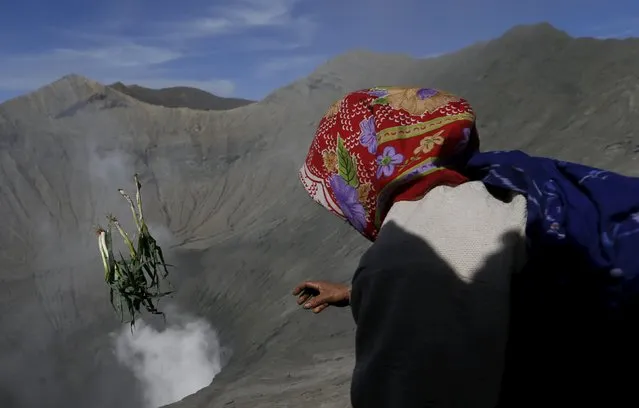
A Hindu worshipper throws vegetables into the crater as offerings during the Kasada Festival at Mount Bromo in Probolinggo, Indonesia's East Java province, August 1, 2015. (Photo by Reuters/Beawiharta)

A Hindu worshipper throws vegetables into the crater as offerings during the Kasada Festival at Mount Bromo in Probolinggo, Indonesia's East Java province, August 1, 2015. Every year people gather for the annual festival where offerings of rice, fruit, vegetables, livestock or money are made to Hindu gods at the active volcano to ask for blessings and assure a bountiful harvest. (Photo by Reuters/Beawiharta)
Details
02 Aug 2015 12:34:00
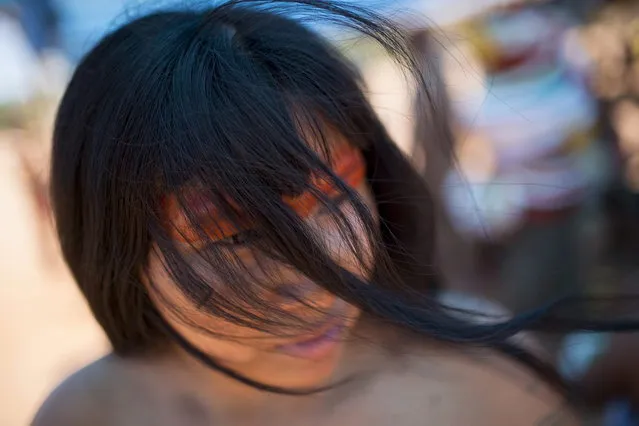
A Waura Indian woman watches the activities of this year's “quarup”, a ritual held over several days to honour in death a person of great importance to them, in Xingu National Park, Mato Grosso State, August 24, 2013. This year the Waura tribe is honouring their late cacique (chief) Atamai, who died in 2012 and helped created the Xingu Park, and his important contribution in facilitating communication between white Brazilians and Indians. (Photo by Ueslei Marcelino/Reuters)

A Waura Indian woman watches the activities of this year's “quarup”, a ritual held over several days to honour in death a person of great importance to them, in Xingu National Park, Mato Grosso State, August 24, 2013. This year the Waura tribe is honouring their late cacique (chief) Atamai, who died in 2012 and helped created the Xingu Park, and his important contribution in facilitating communication between white Brazilians and Indians. (Photo by Ueslei Marcelino/Reuters)
Details
04 Sep 2013 08:48:00
The Songkran festival

“The Songkran festival is celebrated in Thailand as the traditional New Year's Day from 13 to 15 April. It coincides with the New Year of many calendars of South and Southeast Asia. The most obvious celebration of Songkran is the throwing of water upon others. Thais roam the streets with containers of water or water guns. In addition, many Thais will have small bowls of beige colored talc sold cheaply and mixed with water which is then smeared on the faces and bodies of random passerbys as a blessing for the new year” – Wikipedia. (Photo by Seua Yai)
Details
23 Oct 2013 12:00:00
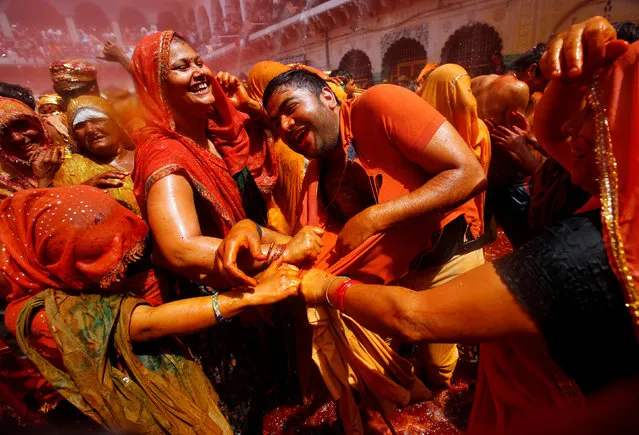
Women tear the shirt off a man during “Huranga”, a game played between men and women a day after Holi, at Dauji temple near Mathura, March 14, 2017. (Photo by Adnan Abidi/Reuters)

Women tear the shirt off a man during “Huranga”, a game played between men and women a day after Holi, at Dauji temple near Mathura, March 14, 2017. (Photo by Adnan Abidi/Reuters)
Details
17 Mar 2017 00:06:00
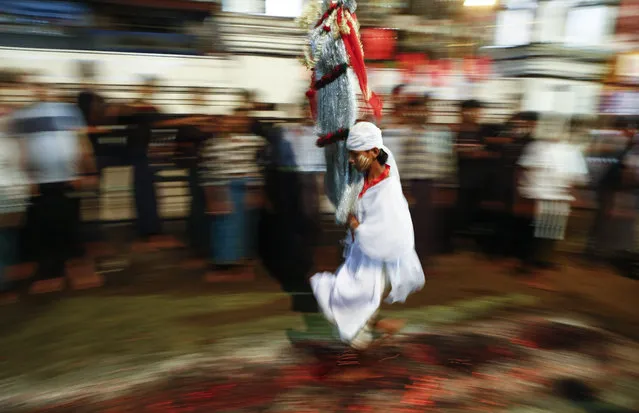
A Myanmar Shiite Muslim devotee runs  barefoot over a bed of burning coals as he takes part in a Muharram procession ahead of the Islamic holiday Ashura, in Yangon, Myanmar, October 22, 2015. Muslims across the world are observing Moharram, the first month of Islamic calender, the climax of Moharram is the Ashura festival commemorating the martyrdom of Imam Hussein, a grandson of the Prophet Mohammed in the Iraqi city of Karbala in the seventh century. (Lynn Bo Bo/EPA)

A Myanmar Shiite Muslim devotee runs barefoot over a bed of burning coals as he takes part in a Muharram procession ahead of the Islamic holiday Ashura, in Yangon, Myanmar, October 22, 2015. Muslims across the world are observing Moharram, the first month of Islamic calender, the climax of Moharram is the Ashura festival commemorating the martyrdom of Imam Hussein, a grandson of the Prophet Mohammed in the Iraqi city of Karbala in the seventh century. (Lynn Bo Bo/EPA)
Details
24 Oct 2015 09:30:00