Loading...
Done


“Kumbh Mela is a mass Hindu pilgrimage in which Hindus gather at the Ganges river. The normal Kumbh Mela is celebrated every 3 years, the Ardh (half) Kumbh Mela is celebrated every six years at Haridwar and Prayag, the Purna (complete) Kumbh takes place every twelve years, at four places (Prayag (Allahabad), Haridwar, Ujjain, and Nashik). The Maha (great) Kumbh Mela which comes after 12 “Purna Kumbh Melas”, or 144 years, is held at Allahabad.

The last Ardh Kumbh Mela was held over a period of 45 days beginning in January 2007, more than 70 million Hindu pilgrims took part in the Ardh Kumbh Mela at Prayag, and on January 15, the most auspicious day of the festival of Makar Sankranti, more than 5 million participated. The previous Maha Kumbh Mela, held in 2001, was attended by around 60 million people, making it at the time the largest gathering anywhere in the world in recorded history”. – Wikipedia

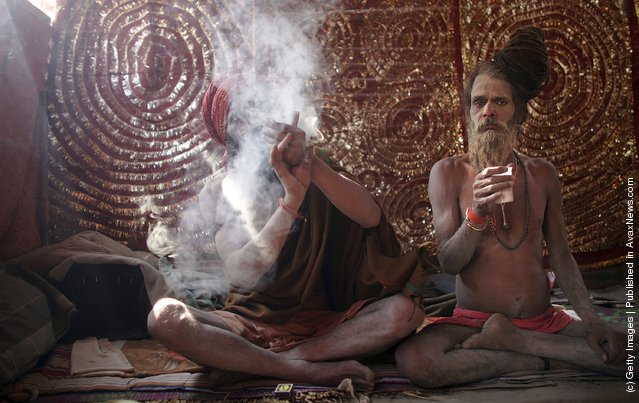
Photo: Sadhus (holy men) smoke at their camp near the ritual site at Sangam, the confluence of the Ganges, Yamuna and mythical Saraswati rivers during the Ardh Kumbh Mela festival (Half Pitcher festival) January 18, 2007 in Allahabad, India. Millions of Hindu pilgrims have flocked to the largest religious gathering in the world which lasts for 45 days in northern India. The festival commemorates the mythical conflict between gods and demons over a pitcher filled with the “nectar of immortality”. Devotees believe that taking a holy dip in the Ganges at this time washes away their sins and paves the path to salvation. (Photo by Mario Tama/Getty Images)
Details
30 Jun 2011 10:27:00
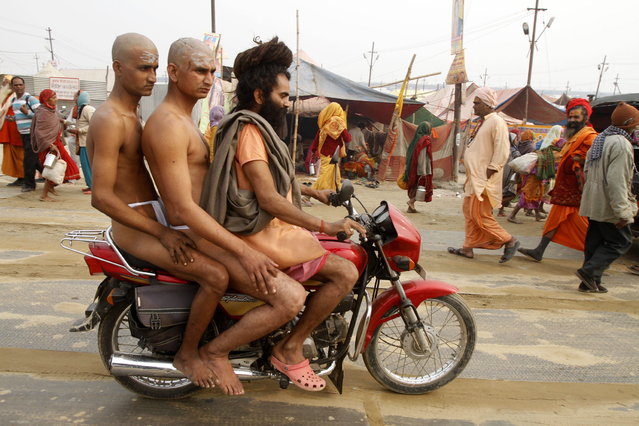
Two Hindu holy men of the Juna Akhara sect  are being take on a motorcycle by their teacher as they got delayed for a rituals that are believed to rid them of all ties in this life and dedicate themselves to serving God as a “Naga” or naked holy men, at Sangam, the confluence of the Ganges and Yamuna River during the Maha Kumbh festival in Allahabad, India, Wednesday, February 6, 2013. (Photo by Rajesh Kumar Singh/AP Photo)

Two Hindu holy men of the Juna Akhara sect are being take on a motorcycle by their teacher as they got delayed for a rituals that are believed to rid them of all ties in this life and dedicate themselves to serving God as a “Naga” or naked holy men, at Sangam, the confluence of the Ganges and Yamuna River during the Maha Kumbh festival in Allahabad, India, Wednesday, February 6, 2013. The significance of nakedness is that they will not have any worldly ties to material belongings, even something as simple as clothes. This ritual that transforms selected holy men to Naga can only be done at the Kumbh festival. (Photo by Rajesh Kumar Singh/AP Photo)
Details
07 Feb 2013 10:11:00
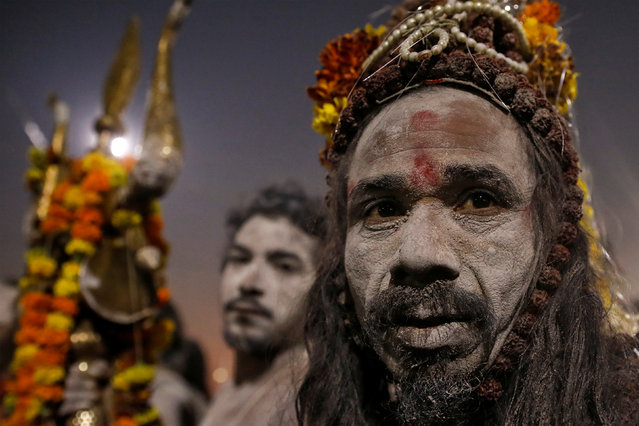
Naga Sadhus or Hindu Holy men leave after taking a dip during the first "Shahi Snan" (grand bath) at “Kumbh Mela” or the Pitcher Festival, in Prayagraj, previously known as Allahabad, India, January 15, 2019. (Photo by Danish Siddiqui/Reuters)

Naga Sadhus or Hindu Holy men leave after taking a dip during the first "Shahi Snan" (grand bath) at “Kumbh Mela” or the Pitcher Festival, in Prayagraj, previously known as Allahabad, India, January 15, 2019. (Photo by Danish Siddiqui/Reuters)
Details
17 Jan 2019 00:03:00
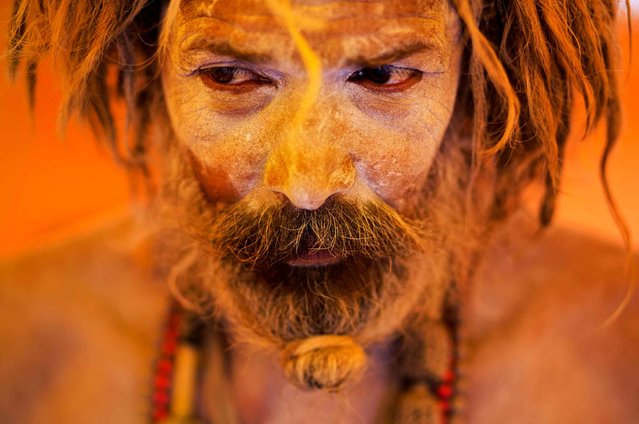
A Naga sadhu, or naked Hindu holy man, pauses inside a tent during Kumbh Mela, or Pitcher festival, at Trimbakeshwar, India, Thursday, August 27, 2015. Hindus believe taking a dip in the waters of a holy river during the festival will cleanse them of their sins. The festival is held four times every 12 years. (Photo by Bernat Armangue/AP Photo)

A Naga sadhu, or naked Hindu holy man, pauses inside a tent during Kumbh Mela, or Pitcher festival, at Trimbakeshwar, India, Thursday, August 27, 2015. Hindus believe taking a dip in the waters of a holy river during the festival will cleanse them of their sins. The festival is held four times every 12 years. (Photo by Bernat Armangue/AP Photo)
Details
27 Aug 2015 11:24:00
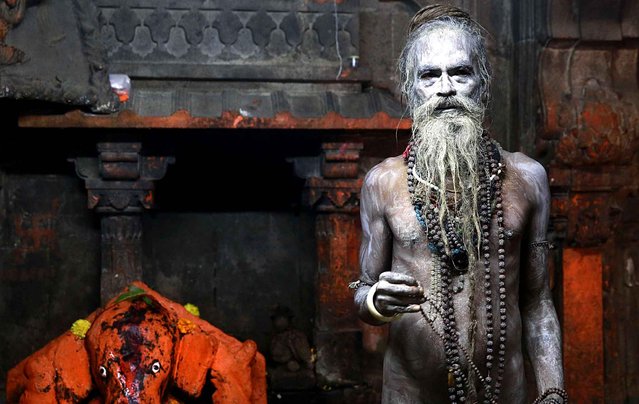
A Naga sadhu, or naked Hindu holy man, poses for a picture after taking a holy dip in the Godavari River during Kumbh Mela, or Pitcher Festival, at Trimbakeshwar in Nasik, India, Sunday, September 13, 2015. Hindus believe taking a dip in the waters of a holy river during the festival, will cleanse them of their sins. (Photo by Rafiq Maqbool/AP Photo)

A Naga sadhu, or naked Hindu holy man, poses for a picture after taking a holy dip in the Godavari River during Kumbh Mela, or Pitcher Festival, at Trimbakeshwar in Nasik, India, Sunday, September 13, 2015. Hindus believe taking a dip in the waters of a holy river during the festival, will cleanse them of their sins. According to Hindu mythology, the Kumbh Mela celebrates the victory of gods over demons in a furious battle over a nectar that would give them immortality. (Photo by Rafiq Maqbool/AP Photo)
Details
14 Sep 2015 13:31:00
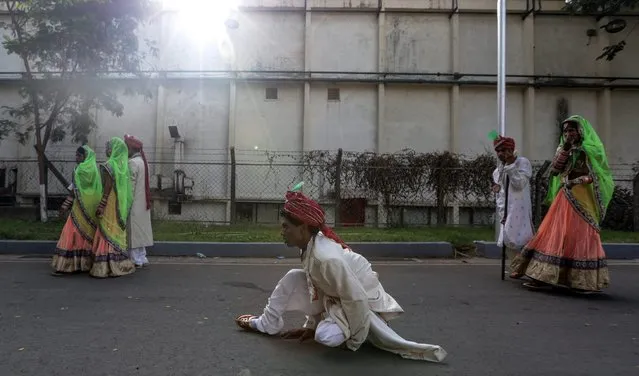
Indian underprivileged and specially abled grooms and brides in traditional marriage attire arrives to take part in a mass marriage ceremony in Mumbai, India, 29 May 2016. Around 51 couples got married during the ceremony which was organized by Narayan Seva Sansthan, for the underprivileged and specially abled people. From this 51 couples, both the partners are physically disabled in 22 couples, one partner is physically disabled in seven couples and 22 couples are from underprivileged circumstances. (Photo by Divyakant Solanki/EPA)

Indian underprivileged and specially abled grooms and brides in traditional marriage attire arrives to take part in a mass marriage ceremony in Mumbai, India, 29 May 2016. Around 51 couples got married during the ceremony which was organized by Narayan Seva Sansthan, for the underprivileged and specially abled people. From this 51 couples, both the partners are physically disabled in 22 couples, one partner is physically disabled in seven couples and 22 couples are from underprivileged circumstances. (Photo by Divyakant Solanki/EPA)
Details
31 May 2016 11:48:00
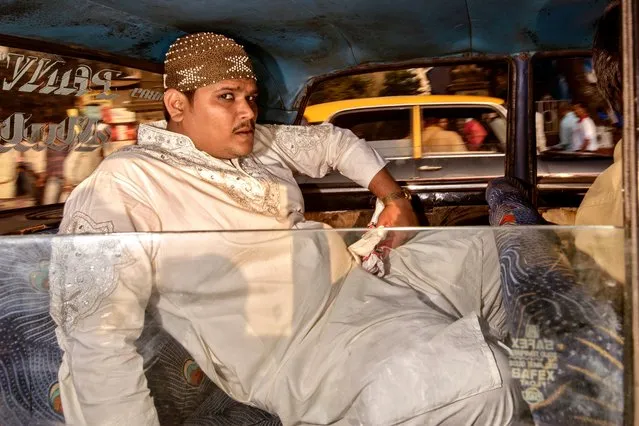
“I’m not scared of breaking the fourth wall”, Wallace has said of the photos where the subject is clearly aware of him taking the shot. “If they are looking at you in a photograph most photographers will think, oh, that’s not a good image. (But) people like to be involved and in the picture. You can see what they are thinking, see them talking”. (Photo by Dougie Wallace/The Guardian)

In Dougie Wallace’s photos of Mumbai taxis, the chatter, yelling, and constant horns of the city are almost audible. A selection of his images is on show at Gayfield Creative Spaces, Edinburgh, as part of the Retina photography festival until 30 July. For four years, the Glasgow-born Wallace focused his photos on one kind of taxi in particular: the Premier Padmini, a 1960s workhorse painted in black and yellow. Locally known as “Kaali-Peeli”, there were once more than 60,000 of them in the Indian city. But thanks to laws restricting pollution, the cars now are fast disappearing from Mumbai’s streets. (Photo by Dougie Wallace/The Guardian)
Details
13 Jul 2016 13:50:00
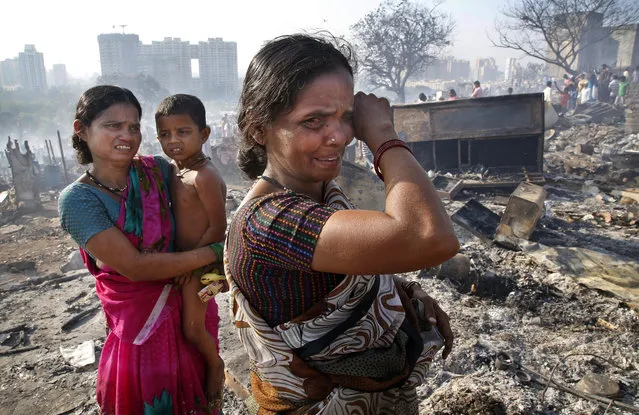
Women cry as they look for reusable household materials after fire broke at slums in Kadivali area of Mumbai, India, Monday, Dec. 7, 2015. Hundreds of homes were reportedly destroyed as fire tenders labored to reach the source in the heavily congested area. (AP Photo/Rajanish Kakade)

Women cry as they look for reusable household materials after fire broke at slums in Kadivali area of Mumbai, India, Monday, December 7, 2015. Hundreds of homes were reportedly destroyed as fire tenders labored to reach the source in the heavily congested area. (Photo by Rajanish Kakade/AP Photo)
Details
09 Dec 2015 08:01:00