Loading...
Done
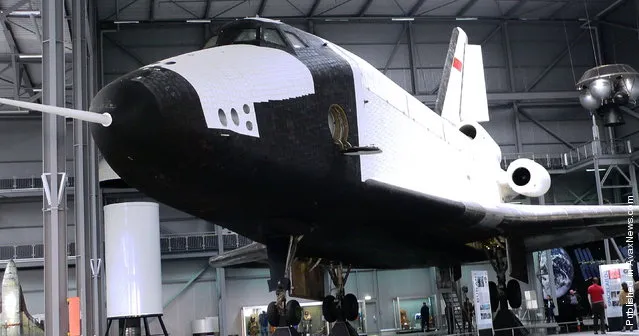
Buran

“The Buran program was a Soviet and later Russian reusable spacecraft project that began in 1974 at TsAGI and was formally suspended in 1993. It was a response to the United States Space Shuttle program”. – Wikipedia

Photo by: These Pictures are Entirely Bad ; Source: Flickr
Details
17 Sep 2011 12:00:00
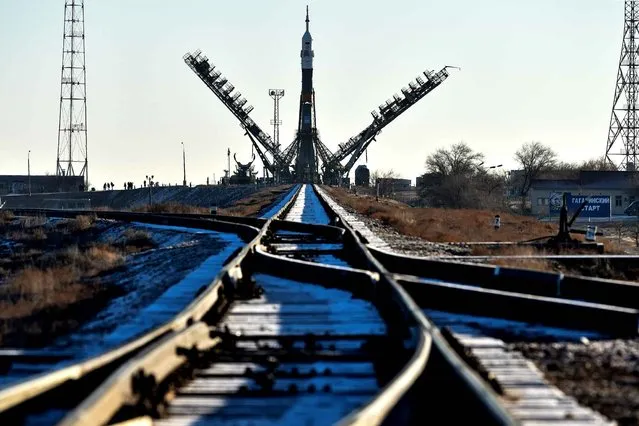
The Soyuz TMA-19M spacecraft is mounted on a launch pad at the Russian-leased Baikonur cosmodrome in Kazakhstan early on December 13, 2015. Russia's Soyuz TMA-19M spacecraft carrying the International Space Station (ISS) Expedition 46/47 crew of Britain's astronaut Tim Peake, Russian cosmonaut Yuri Malenchenko and US astronaut Tim Kopra is scheduled to blast off to the ISS on December 15, 2015. (Photo by Kirill Kudryavtsev/AFP Photo)

The Soyuz TMA-19M spacecraft is mounted on a launch pad at the Russian-leased Baikonur cosmodrome in Kazakhstan early on December 13, 2015. Russia's Soyuz TMA-19M spacecraft carrying the International Space Station (ISS) Expedition 46/47 crew of Britain's astronaut Tim Peake, Russian cosmonaut Yuri Malenchenko and US astronaut Tim Kopra is scheduled to blast off to the ISS on December 15, 2015. (Photo by Kirill Kudryavtsev/AFP Photo)
Details
14 Dec 2015 10:13:00
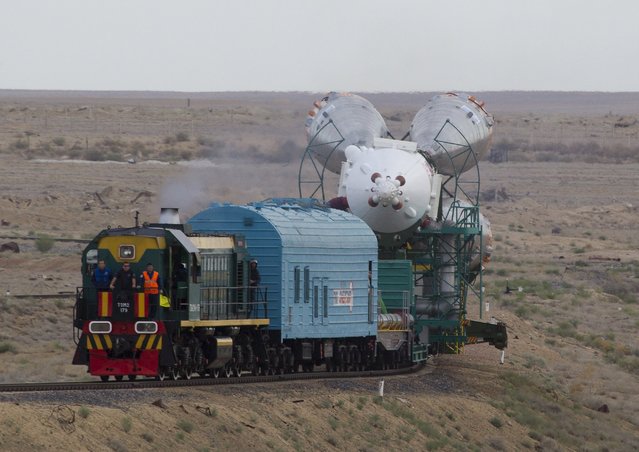
The Soyuz TMA-18M spacecraft is transported from an assembling hangar to its launch pad at the Baikonur cosmodrome, Kazakhstan, August 31, 2015. (Photo by Shamil Zhumatov/Reuters)

The Soyuz TMA-18M spacecraft is transported from an assembling hangar to its launch pad at the Baikonur cosmodrome, Kazakhstan, August 31, 2015. The Soyuz is scheduled to blast off with Aidyn Aimbetov of Kazakhstan, Sergei Volkov of Russia and Andreas Mogensen of Denmark to the International Space Station (ISS) on September 2, 2015. (Photo by Shamil Zhumatov/Reuters)
Details
01 Sep 2015 14:45:00
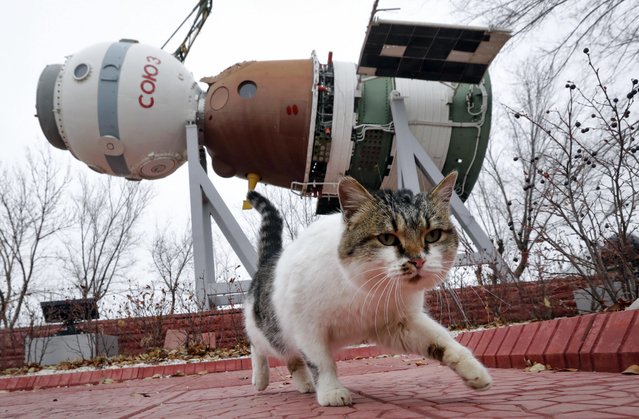
A cat walks past a Soyuz space ship installed at a museum, at the Russian leased Baikonur cosmodrome, Kazakhstan, Tuesday, November 15, 2016. The start of the new Soyuz mission to the International Space Station (ISS) is scheduled on early Friday, Nov. 18 local time. The Russian rocket will carry French astronaut Thomas Pesquet, Russian cosmonaut Oleg Novitsky and U.S. astronaut Peggy Annette Whitson. (Photo by Dmitri Lovetsky/AP Photo)

A cat walks past a Soyuz space ship installed at a museum, at the Russian leased Baikonur cosmodrome, Kazakhstan, Tuesday, November 15, 2016. The start of the new Soyuz mission to the International Space Station (ISS) is scheduled on early Friday, Nov. 18 local time. The Russian rocket will carry French astronaut Thomas Pesquet, Russian cosmonaut Oleg Novitsky and U.S. astronaut Peggy Annette Whitson. (Photo by Dmitri Lovetsky/AP Photo)
Details
16 Nov 2016 11:25:00
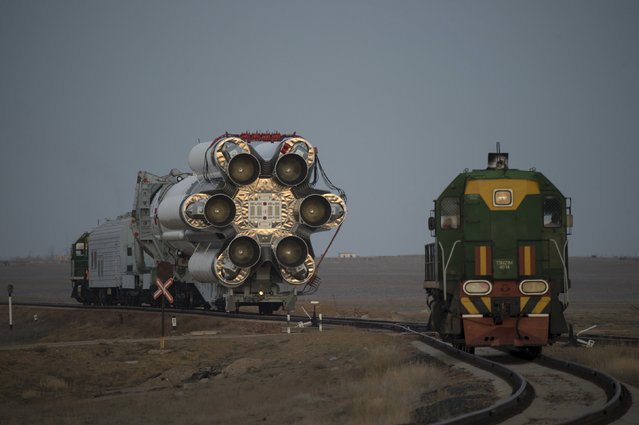
The Proton rocket, that will launch the ExoMars 2016 spacecraft to Mars, is transfered to the launchpad at the Baikonur cosmodrome, Kazakhstan, in this handout photo released by European Space Agency (ESA) on March 11, 2016. (Photo by Stephane Corvaja/Reuters/ESA)

The Proton rocket, that will launch the ExoMars 2016 spacecraft to Mars, is transfered to the launchpad at the Baikonur cosmodrome, Kazakhstan, in this handout photo released by European Space Agency (ESA) on March 11, 2016. (Photo by Stephane Corvaja/Reuters/ESA)
Details
12 Mar 2016 14:38:00
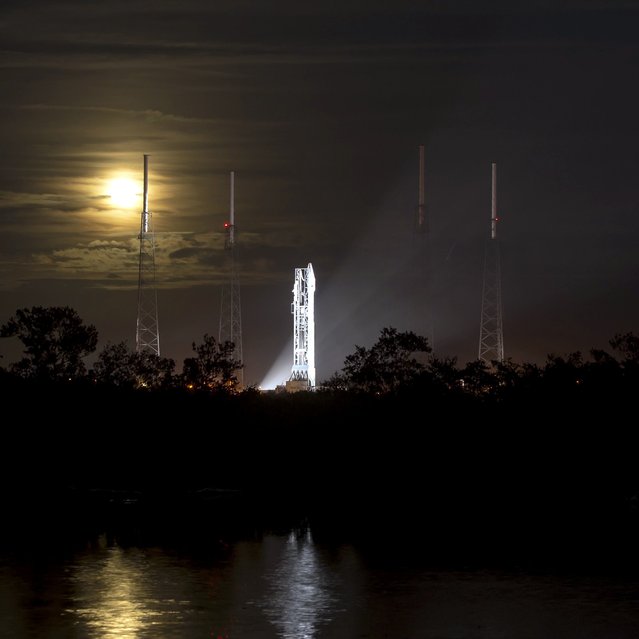
This photo provided by NASA shows a full moon rising behind the United Launch Alliance Atlas V rocket with NASA's Mars Atmosphere and Volatile Evolution (MAVEN) spacecraft onboard at the Cape Canaveral Air Force Station Space Launch Complex 41, Sunday, Nov. 17, 2013, Cape Canaveral, Florida. NASA's next Mars-bound spacecraft, the Mars Atmosphere and Volatile Evolution, or MAVEN, is the first spacecraft devoted to exploring and understanding the Martian upper atmosphere. (AP Photo/NASA, Bill Ingalls)

This photo provided by NASA shows a full moon rising behind the United Launch Alliance Atlas V rocket with NASA's Mars Atmosphere and Volatile Evolution (MAVEN) spacecraft onboard at the Cape Canaveral Air Force Station Space Launch Complex 41, Sunday, November 17, 2013, Cape Canaveral, Florida. NASA's next Mars-bound spacecraft, the Mars Atmosphere and Volatile Evolution, or MAVEN, is the first spacecraft devoted to exploring and understanding the Martian upper atmosphere. (Photo by Bill Ingalls/AP Photo/NASA)
Details
19 Nov 2013 06:42:00
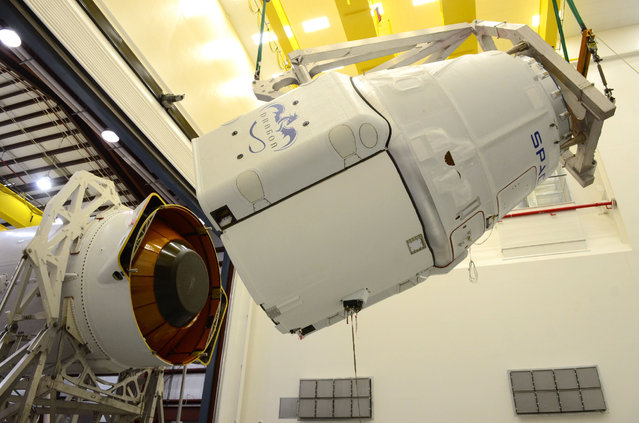
SpaceX’s Dragon spacecraft, March 6, 2014. SpaceX's Falcon 9 rocket and Dragon spacecraft launched from Launch Complex 40 at the Cape Canaveral Air Force Station, Florida, for their third official Commercial Resupply (CRS) mission to the orbiting lab on April 18, 2014. Dragon is the only operational spacecraft capable of returning a significant amount of supplies back to Earth, including experiments. (Photo by Ron Lin/SpaceX Photos)

SpaceX’s Dragon spacecraft, March 6, 2014. SpaceX's Falcon 9 rocket and Dragon spacecraft launched from Launch Complex 40 at the Cape Canaveral Air Force Station, Florida, for their third official Commercial Resupply (CRS) mission to the orbiting lab on April 18, 2014. Dragon returned to Earth with a parachute-assisted splashdown off the coast of southern California on May 14, 2014. Dragon is the only operational spacecraft capable of returning a significant amount of supplies back to Earth, including experiments. (Photo by Ron Lin/SpaceX Photos)
Details
30 Mar 2015 13:11:00
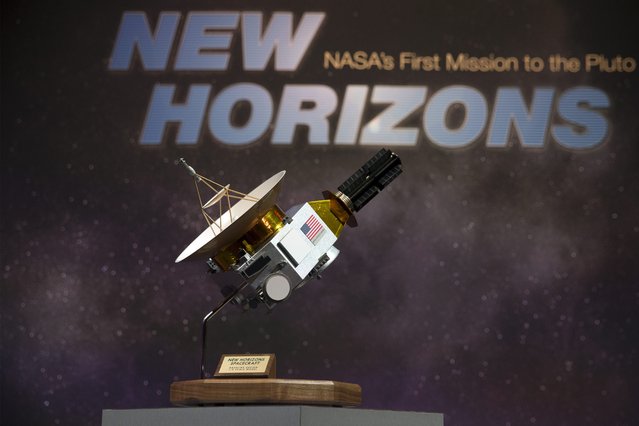
A model of the New Horizons spacecraft is seen at a live television program on NASA television celebrating the spacecraft's closest proximity to Pluto, at Johns Hopkins University Applied Physics Laboratory, site of the mission operations center, in Laurel, Maryland, USA, 14 July 2015. (Photo by Michael Reynolds/EPA)

A model of the New Horizons spacecraft is seen at a live television program on NASA television celebrating the spacecraft's closest proximity to Pluto, at Johns Hopkins University Applied Physics Laboratory, site of the mission operations center, in Laurel, Maryland, USA, 14 July 2015. At approximately 7:49 am ET (11:49 am GMT), 14 July, New Horizons was scheduled to be as close to Pluto as the spacecraft will get; about 7,800 miles (12,500 kilometers) above the surface, following a journey of more than nine years and three billion miles. This is the first mission to the Pluto System and the Kuiper Belt. (Photo by Michael Reynolds/EPA)
Details
15 Jul 2015 10:08:00