Loading...
Done


Sushi chef Mitsuru Tamura uses a radiation detector on seafood before it is prepared in Manhattan's Sushi Yasuda restaurant April 8, 2011 in New York City. The restaurant has begun using the detector as a precautionary measure due to consumer concerns over possible radiation contamination in seafood from the nuclear emergency in Japan. Health officials believe contamination is unlikely to threaten the food supply chain and none has been found in this restaurant. (Photo by Mario Tama/Getty Images)
Details
09 Apr 2011 08:52:00
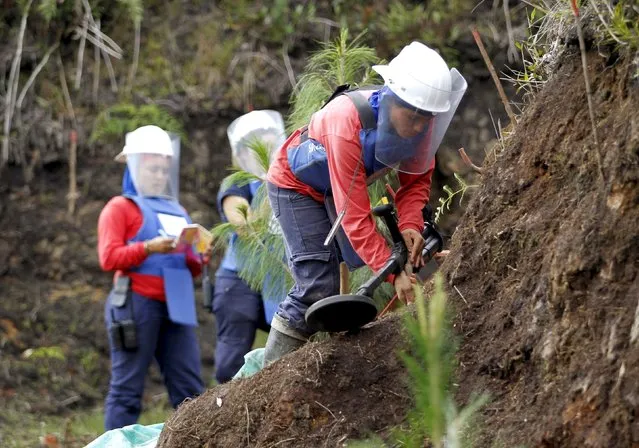
Natalia Arango works with her mine detector in a zone of landmines planted by rebels groups near Sonson in Antioquia province, November 19, 2015. (Photo by Fredy Builes/Reuters)

Natalia Arango works with her mine detector in a zone of landmines planted by rebels groups near Sonson in Antioquia province, November 19, 2015. Women's work takes on a nontraditional meaning for fifteen Colombian women who work to rid the Antioquia Mountains of deadly landmines as the country edges closer to a peace agreement with Marxist rebels to end over a decade of conflict which has claimed 220,000 lives. (Photo by Fredy Builes/Reuters)
Details
27 Nov 2015 04:44:00
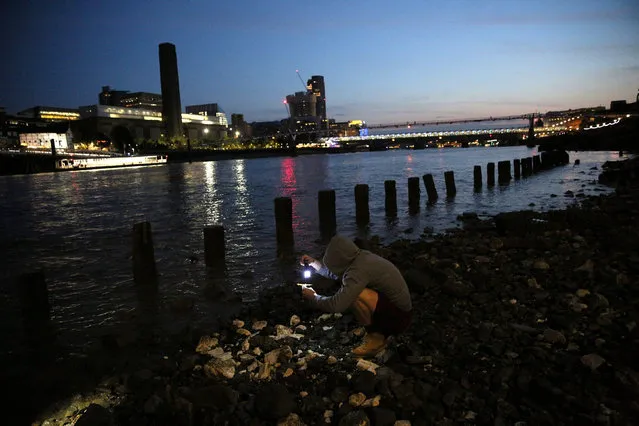
A mudlark uses a torch to look for items on the bank of the River Thames in London, Britain June 06, 2016. Mudlarking is believed to trace its origins to the 18th and 19th century, when scavengers searched the Thames' shores for items to sell. These days, history and archaeology fans are the ones hoping to find old relics such as coins, ceramics, artifacts or everyday items from across centuries. They wait for the low tide and then scour specific areas of exposed shores. "If you're in a field you could be out all day long, with the river you're restricted to about two or three hours," mudlark Nick Stevens said. While many just use the naked eye for their searches, others rely on metal detectors for which a permit from the Port of London Authority is needed. Digging also requires consent. (Photo by Neil Hall/Reuters)

A mudlark uses a torch to look for items on the bank of the River Thames in London, Britain June 06, 2016. Mudlarking is believed to trace its origins to the 18th and 19th century, when scavengers searched the Thames' shores for items to sell. These days, history and archaeology fans are the ones hoping to find old relics such as coins, ceramics, artifacts or everyday items from across centuries. their finds with the Portable Antiquities Scheme. Any item over 300 years old must be recorded. (Photo by Neil Hall/Reuters)
Details
27 Aug 2016 10:43:00
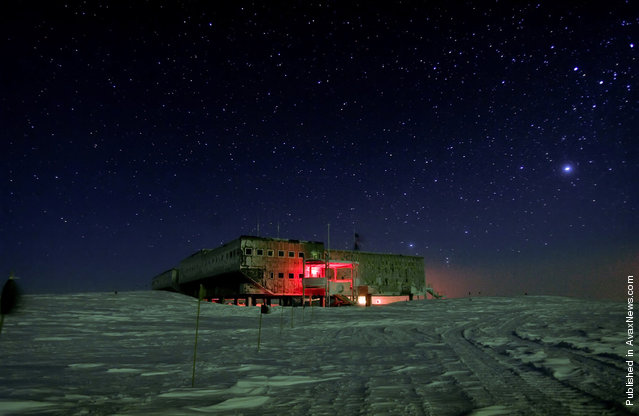
Amundsen-Scott South Pole Station experiences months of darkness. The sun dips below the horizon on March 21, after which follows several weeks of twilight before complete darkness results

Amundsen-Scott South Pole Station experiences months of darkness. The sun dips below the horizon on March 21, after which follows several weeks of twilight before complete darkness results. Photo taken on June 25, 2009. (National Science Foundation/Jeremy Johnson)
Details
08 Apr 2012 13:07:00
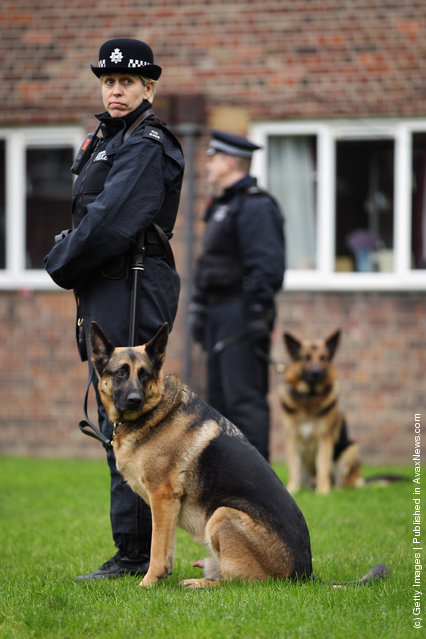
Police dog

Police dog handlers wait outside the Loftus Road stadium after FA Cup Fourth Round between Queens Park Rangers and Chelsea on January 28, 2012 in London, England. Security has been stepped up after QPR player Anton Ferdinand recieved a package containing a bullet. (Photo by Dan Kitwood/Getty Images)
Details
29 Jan 2012 12:25:00
In this Monday, July 24, 2017 photo, a police officer walks in front of a mural during a protest demanding an end to the current pension fund system, in Santiago, Chile. Protesters say the government pension system robs retirees of fair pension payments, and are demanding a new social security system with higher payments. (Photo by Esteban Felix/AP Photo)

In this Monday, July 24, 2017 photo, a police officer walks in front of a mural during a protest demanding an end to the current pension fund system, in Santiago, Chile. Protesters say the government pension system robs retirees of fair pension payments, and are demanding a new social security system with higher payments. (Photo by Esteban Felix/AP Photo)
Details
09 Aug 2017 07:37:00
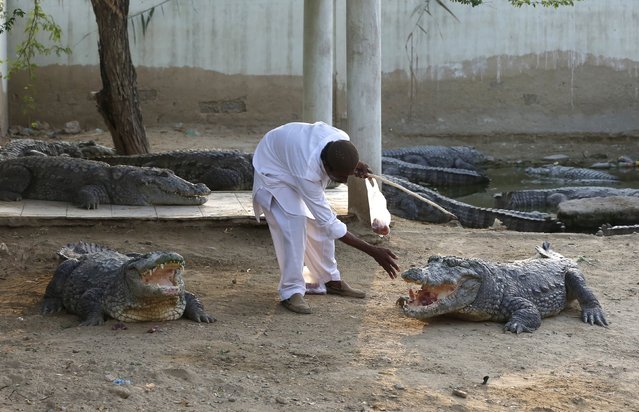
Caretaker Khalifa Sajad feeds crocodiles at the Sufi shrine of Hasan-al-Maroof Sultan Manghopir, better known as the Crocodile Shrine, on the outskirts of Karachi, Pakistan October 11, 2015. Pakistani Sheedi pilgrims are once again flocking to the shrine in Karachi that has been shunned for years amid fears of Taliban attacks. (Photo by Akhtar Soomro/Reuters)

Caretaker Khalifa Sajad feeds crocodiles at the Sufi shrine of Hasan-al-Maroof Sultan Manghopir, better known as the Crocodile Shrine, on the outskirts of Karachi, Pakistan October 11, 2015. Pakistani Sheedi pilgrims are once again flocking to the shrine in Karachi that has been shunned for years amid fears of Taliban attacks. (Photo by Akhtar Soomro/Reuters)
Details
18 Oct 2015 08:00:00
A Munduruku Indian child is pictured at the Planalto Palace, where a meeting with Minister of the General Secretariat of the Presidency of Brazil Gilberto Carvalho was being held with other Munduruku Indians, in Brasilia, June 4, 2013. (Photo by Ueslei Marcelino/Reuters)

A Munduruku Indian child is pictured at the Planalto Palace, where a meeting with Minister of the General Secretariat of the Presidency of Brazil Gilberto Carvalho was being held with other Munduruku Indians, in Brasilia, June 4, 2013. President Dilma Rousseff's government sought on Tuesday to defuse mounting conflicts with indigenous groups over its decision to stop setting aside farm land for Indians and plans to build more hydroelectric dams in the Amazon. The government flew 144 Munduruku Indians to Brasilia for talks to end a week-long occupation of the controversial Belo Monte dam on the Xingu river, a huge project aimed at feeding Brazil's fast-growing demand for electricity. (Photo by Ueslei Marcelino/Reuters)
Details
06 Jun 2013 09:25:00