Loading...
Done
A reveller covered in tomato pulp participates in the annual “Tomatina” festival in the eastern town of Bunol, on August 28, 2019. The iconic fiesta, which is billed at “the world's biggest food fight” has become a major draw for foreigners, in particular from Britain, Japan and the United States. (Photo by Jaime Reina/AFP Photo)

A reveller covered in tomato pulp participates in the annual “Tomatina” festival in the eastern town of Bunol, on August 28, 2019. The iconic fiesta, which is billed at “the world's biggest food fight” has become a major draw for foreigners, in particular from Britain, Japan and the United States. (Photo by Jaime Reina/AFP Photo)
Details
30 Aug 2019 00:01:00
The World's Biggest Tomato Fight At Tomatina Festival 2011

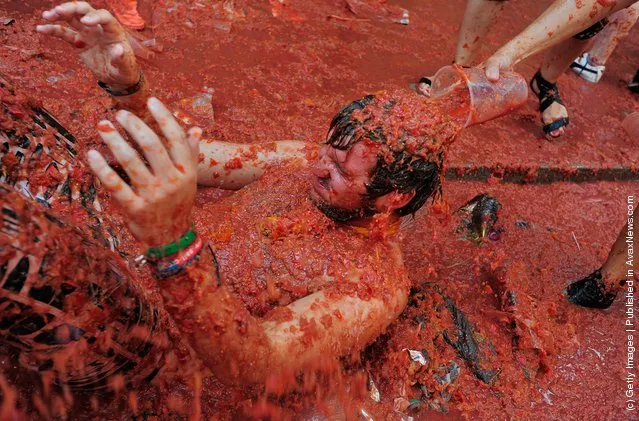
A reveller is covered in tomato pulp and juice while participating in the annual Tomatina festival on August 31, 2011 in Bunol, Spain. An estimated 35,000 people threw 120 tons of ripe tomatoes in the world's biggest tomato fight held annually in this Spanish Mediterranean town. (Photo by Denis Doyle/Getty Images)
Details
01 Sep 2011 11:38:00
A woman lays in a puddle of tomato juice during the annual “Tomatina” tomato fight fiesta in the village of Bunol, 50 kilometers outside Valencia, Spain, Wednesday, August 27, 2014. The streets of an eastern Spanish town are awash with red pulp as thousands of people pelt each other with tomatoes in the annual “Tomatina” battle that has become a major tourist attraction. (Photo by Alberto Saiz/AP Photo)

A woman lays in a puddle of tomato juice during the annual “Tomatina” tomato fight fiesta in the village of Bunol, 50 kilometers outside Valencia, Spain, Wednesday, August 27, 2014. The streets of an eastern Spanish town are awash with red pulp as thousands of people pelt each other with tomatoes in the annual “Tomatina” battle that has become a major tourist attraction. At the annual fiesta in Bunol on Wednesday, trucks dumped 125 tons of ripe tomatoes for some 22,000 participants, many from abroad to throw during the hour-long morning festivities. (Photo by Alberto Saiz/AP Photo)
Details
28 Aug 2014 11:03:00
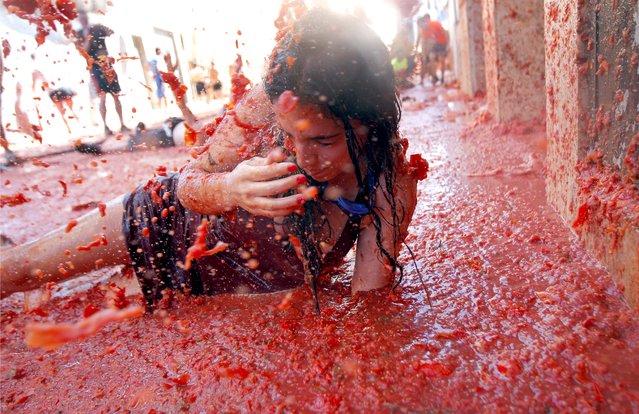
A young girl makes a “tomato angel” on a tomato covered street during the traditional tomato fight “Tomatina” during the fiestas in Bunol, Spain, 28 August 2013. This year's Tomatina is the first pay festival after Bunol's City Hall sold 15,000 tickets to take part in the tomato throwing. A total of 20,000 people, including 5,000 residents, will throw over 130,000 kg tomatoes. Local authorities decided to sell tickets this year to avoid the overcrowding in previous years in which over 50,000 people took part in the event. (Photo by Biel Alino/EPA)

A young girl makes a “tomato angel” on a tomato covered street during the traditional tomato fight “Tomatina” during the fiestas in Bunol, Spain, 28 August 2013. This year's Tomatina is the first pay festival after Bunol's City Hall sold 15,000 tickets to take part in the tomato throwing. A total of 20,000 people, including 5,000 residents, will throw over 130,000 kg tomatoes. Local authorities decided to sell tickets this year to avoid the overcrowding in previous years in which over 50,000 people took part in the event. (Photo by Biel Alino/EPA)
Details
29 Aug 2013 11:24:00
Revellers battle with tomato pulp during the annual “Tomatina” (tomato fight) festival in Bunol near Valencia, Spain, August 31, 2016. (Photo by Heino Kalis/Reuters)

Revellers battle with tomato pulp during the annual “Tomatina” (tomato fight) festival in Bunol near Valencia, Spain, August 31, 2016. (Photo by Heino Kalis/Reuters)
Details
01 Sep 2016 11:25:00
A Waura Indian woman watches the activities of this year's “quarup”, a ritual held over several days to honour in death a person of great importance to them, in Xingu National Park, Mato Grosso State, August 24, 2013. This year the Waura tribe is honouring their late cacique (chief) Atamai, who died in 2012 and helped created the Xingu Park, and his important contribution in facilitating communication between white Brazilians and Indians. (Photo by Ueslei Marcelino/Reuters)

A Waura Indian woman watches the activities of this year's “quarup”, a ritual held over several days to honour in death a person of great importance to them, in Xingu National Park, Mato Grosso State, August 24, 2013. This year the Waura tribe is honouring their late cacique (chief) Atamai, who died in 2012 and helped created the Xingu Park, and his important contribution in facilitating communication between white Brazilians and Indians. (Photo by Ueslei Marcelino/Reuters)
Details
04 Sep 2013 08:48:00
The Songkran festival

“The Songkran festival is celebrated in Thailand as the traditional New Year's Day from 13 to 15 April. It coincides with the New Year of many calendars of South and Southeast Asia. The most obvious celebration of Songkran is the throwing of water upon others. Thais roam the streets with containers of water or water guns. In addition, many Thais will have small bowls of beige colored talc sold cheaply and mixed with water which is then smeared on the faces and bodies of random passerbys as a blessing for the new year” – Wikipedia. (Photo by Seua Yai)
Details
23 Oct 2013 12:00:00
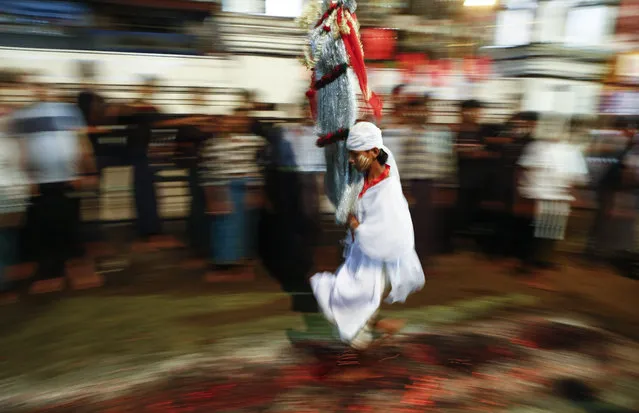
A Myanmar Shiite Muslim devotee runs  barefoot over a bed of burning coals as he takes part in a Muharram procession ahead of the Islamic holiday Ashura, in Yangon, Myanmar, October 22, 2015. Muslims across the world are observing Moharram, the first month of Islamic calender, the climax of Moharram is the Ashura festival commemorating the martyrdom of Imam Hussein, a grandson of the Prophet Mohammed in the Iraqi city of Karbala in the seventh century. (Lynn Bo Bo/EPA)

A Myanmar Shiite Muslim devotee runs barefoot over a bed of burning coals as he takes part in a Muharram procession ahead of the Islamic holiday Ashura, in Yangon, Myanmar, October 22, 2015. Muslims across the world are observing Moharram, the first month of Islamic calender, the climax of Moharram is the Ashura festival commemorating the martyrdom of Imam Hussein, a grandson of the Prophet Mohammed in the Iraqi city of Karbala in the seventh century. (Lynn Bo Bo/EPA)
Details
24 Oct 2015 09:30:00