Members of an American landing party assist troops whose landing craft was sunk by enemy fire off Omaha beach, near Colleville sur Mer, France, June 6, 1944. REUTERS/Weintraub/US National Archives
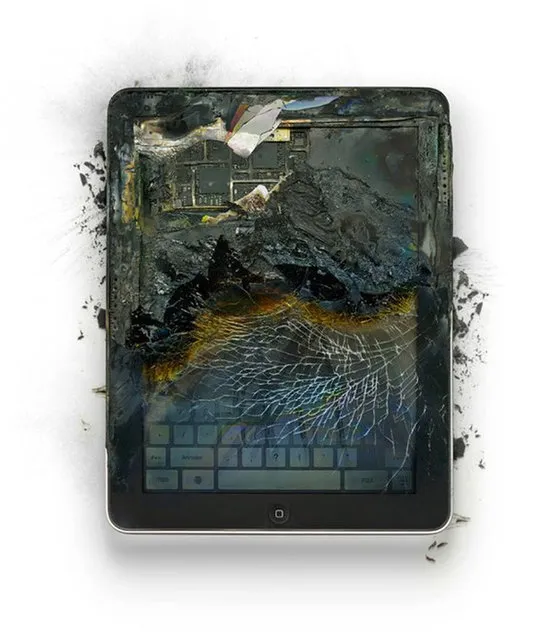
Artist Michael Tompert, a former graphic designer at Apple, is putting on an exhibition showing Apple products which he has destroyed in various ways – burned with blowtorches, smashed with sledgehammers, chopped up with handsaws or shot with a handgun.
The results are then photographed in the typically fetishistic style of Tompert’s former employer, all close-up and against a plain white background.
Presumably the image editing was done elsewhere, what with all his own gear being smashed up all over the studio and all.
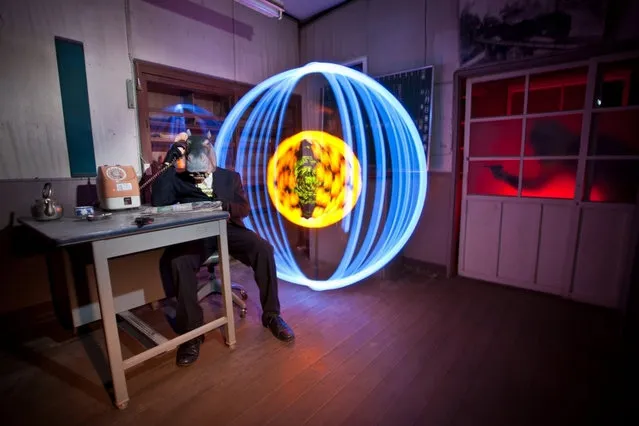
Light painting photographer Trevor Williams, also known as TDUB303, is a present day light painting pioneer. He creates some of his light painting imagery alone and also works with the group Fiz-iks, which he founded. Trevor is from Canada, he has lived in Japan since 2002 which is where he creates the majority of his work. His light painting images are produced with special attention to location, Trevor says, ““If you want to take an epic picture you need to go to an epic location.”
Split Apple Rock is a geological rock formation in The Tasman Bay off the northern coast of the South Island of New Zealand. Made of granite, it is in the shape of an apple which has been cut in half. It is a popular tourist attraction in the waters of the Tasman Sea approximately 50 metres off the coast between Kaiteriteri and Marahau. The rock sits in shallow water at low tide and is accessible by wading. It is also a point of interest for the many tourist boats and pleasure craft which operate along the shores of the Abel Tasman National Park. The cleft to produce two sides of the 'apple' was a natural occurrence. It is unknown when this happened and therefore the cleaving of the rock has attracted mythological explanations.
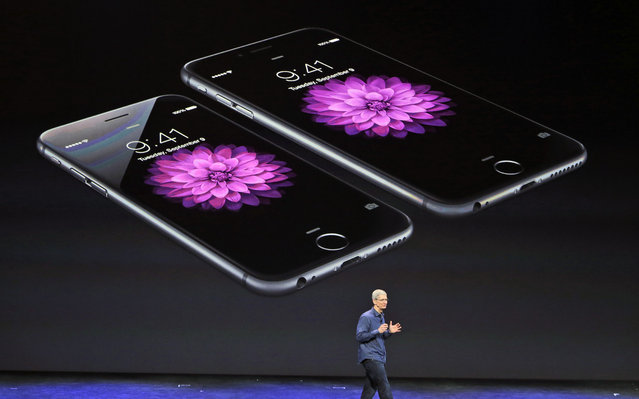
Apple CEO Tim Cook discusses the new iPhone 6 and iPhone 6 plus on Tuesday, September 9, 2014, in Cupertino, Calif. The iPhone 6 will have a screen measuring 4.7 inches, while the iPhone 6 Plus will be 5.5 inches. (Photo by Marcio Jose Sanchez/AP Photo)