Loading...
Done
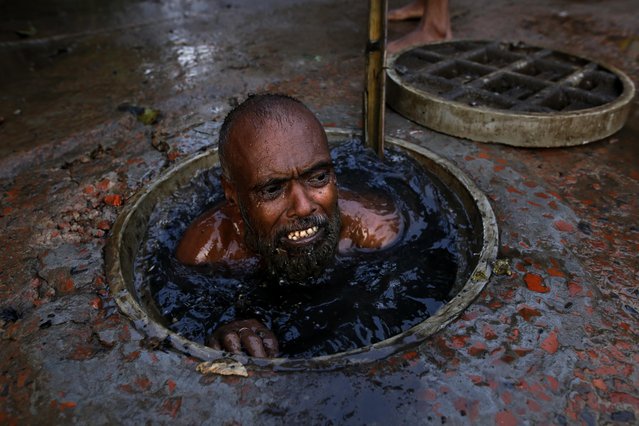
Men are sent down into the sludge to clear the sewers in the Bangladeshi capital Dhaka on May 23, 2018. One man holds his nose as he goes under to scoop blockages out for no more than $10a day. (Photo by Rehman Asad/Barcroft Media)

Men are sent down into the sludge to clear the sewers in the Bangladeshi capital Dhaka on May 23, 2018. The people who do the work aren’t even given any protective clothing or goggles and have to dig out the clogged-up muck with a stick or their bare hands. (Photo by Rehman Asad/Barcroft Media)
Details
26 May 2018 00:05:00


Guiyu, China is known as the “Town of E-waste.” Thousands of its residents depend on processing electronic waste for a living. Guiyu receives its e-waste from China and from abroad, including places like Japan, Europe and America. Under Chinese law, most of the e-waste imported from overseas is illegal.
Details
01 Apr 2013 11:45:00
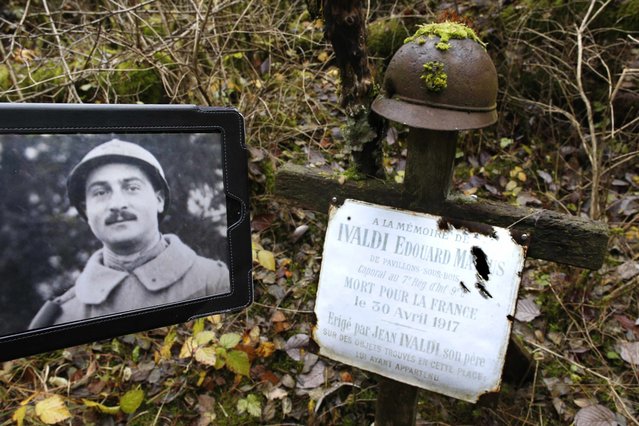
A portrait of French WWI soldier Edouard Marius Ivaldi is displayed on a tablet, in this illustration picture, alongside his battlefield grave memorial, a wooden cross with a battlefield helmet in Champagne, eastern France, November 3, 2015. (Photo by Charles Platiau/Reuters)

A portrait of French WWI soldier Edouard Marius Ivaldi is displayed on a tablet, in this illustration picture, alongside his battlefield grave memorial, a wooden cross with a battlefield helmet in Champagne, eastern France, November 3, 2015. (Photo by Charles Platiau/Reuters)
Details
09 Nov 2015 08:02:00
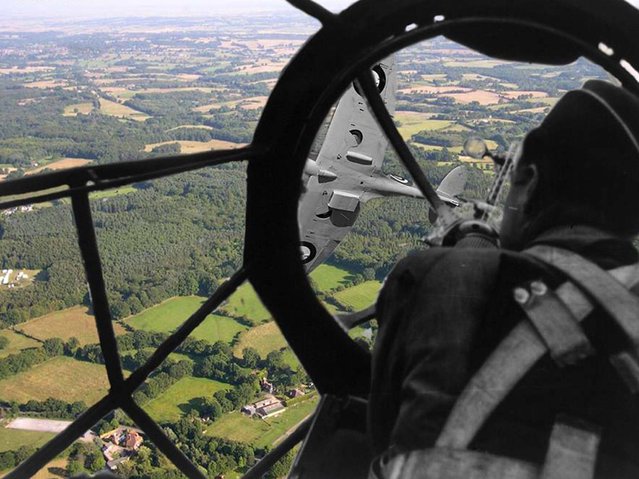
View of a Spitfire from the cockpit of an He111,somewhere over Southern England 1941 – 2014. (Photo by Adam Surrey)

View of a Spitfire from the cockpit of an He111,somewhere over Southern England 1941 – 2014. (Photo by Adam Surrey)
Details
23 May 2014 08:55:00
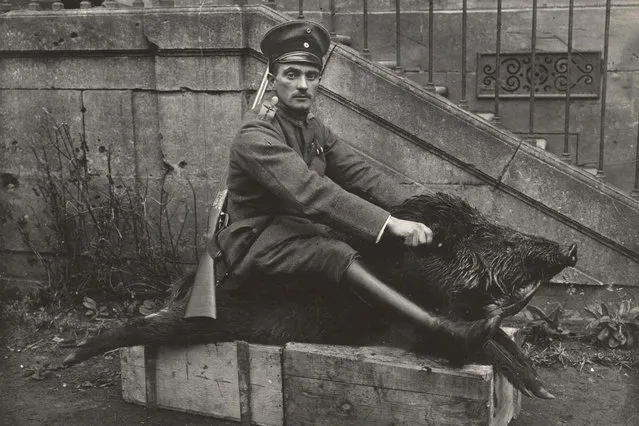
A German Air Force Officer sits astride a dead boar outside a house where he is stationed near the Western Front, in this 1918 handout picture. This picture is part of a previously unpublished set of World War One (WWI) images from a private collection. The pictures offer an unusual view of varied and contrasting aspects of the conflict, from high tech artillery to mobile pigeon lofts, and from officers partying in their headquarters to the grim reality of life and death in the trenches. The year 2014 marks the centenary of the start of the war. (Photo by Reuters/Archive of Modern Conflict London)

A German Air Force Officer sits astride a dead boar outside a house where he is stationed near the Western Front, in this 1918 handout picture. This picture is part of a previously unpublished set of World War One (WWI) images from a private collection. The pictures offer an unusual view of varied and contrasting aspects of the conflict, from high tech artillery to mobile pigeon lofts, and from officers partying in their headquarters to the grim reality of life and death in the trenches. The year 2014 marks the centenary of the start of the war. (Photo by Reuters/Archive of Modern Conflict London)
Details
26 Jun 2014 12:13:00
Dani tribeswoman smokes a cigarette and shows her amputated fingers in, Western New Guinea, Indonesia, August 2016. (Photo by Teh Han Lin/Barcroft Images)

Dani tribeswoman smokes a cigarette and shows her amputated fingers in, Western New Guinea, Indonesia, August 2016. Deep in the highlands of Western New Guinea, Indonesia, lives one of the world’s most isolated tribes. Known as the Dani people, the tribe was unwittingly discovered by American philanthropist, Richard Archbold, after an expedition in 1938. (Photo by Teh Han Lin/Barcroft Images)
Details
18 Nov 2016 11:03:00
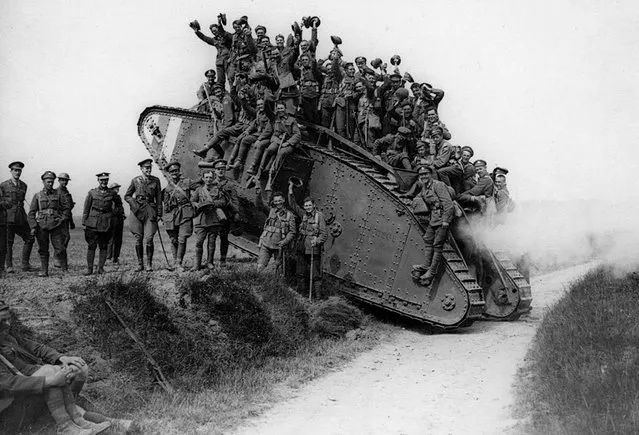
These black-and-white photos are taken from the new book “Armoured Warfare in the First World War 1916 – 1918” by Anthony Tucker-Jones and published by Pen & Sword Military. “Interestingly the British, French and Germans took completely different approaches with varying results”. The British military produced “Little Willie” in Autumn 1915 weighing 18 tonnes, which had a crew of two plus four gunners. “Inspired by a tracked artillery tractor “Little Willie” was referred to as a water tank – hence the name tank – to ensure secrecy”, said Anthony. “This led to the strange looking Mark I with its peculiar rhomboid shape, designed to cross trenches with guns in sponsons on either side. The Germans saw the tank as unchivalrous and were slow to grasp its utility. They favoured the Stormtrooper (specialist soldiers used to infiltrate enemy trenches) and artillery, not the tank”, said Anthony. “However, they didn’t hesitate to make use of captured British tanks. Although the tank helped secure victory and German soldiers dubbed it “Germany’s Downfall” the country was ultimately brought to its knees by the Allies blockade”. Here: British troops hitch a ride on a Mark IV after the massed tank fleet spearheading attack at Cambrai on November 20, 1917. (Photo by Anthony Tucker-Jones/Mediadrumworld.com)

These black-and-white photos are taken from the new book “Armoured Warfare in the First World War 1916 – 1918” by Anthony Tucker-Jones and published by Pen & Sword Military. Here: British troops hitch a ride on a Mark IV after the massed tank fleet spearheading attack at Cambrai on November 20, 1917. (Photo by Anthony Tucker-Jones/Mediadrumworld.com)
Details
23 Feb 2017 00:02:00
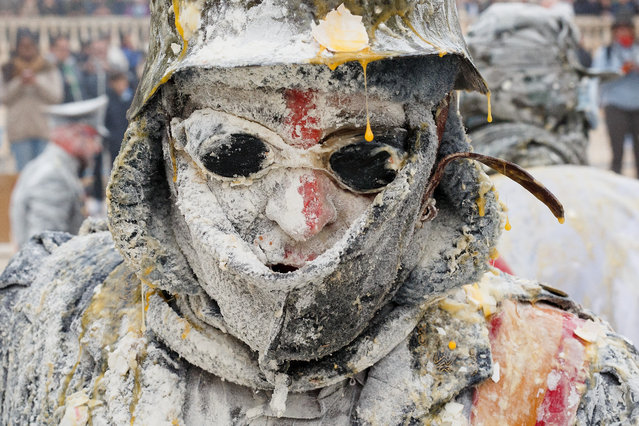
A reveller takes part in the battle of “Enfarinats”, a flour fight in celebration of the Els Enfarinats festival on December 28, 2015 in Ibi, Spain. (Photo by Pablo Blazquez Dominguez/Getty Images)

A reveller takes part in the battle of “Enfarinats”, a flour fight in celebration of the Els Enfarinats festival on December 28, 2015 in Ibi, Spain. Citizens of Ibi annually celebrate the festival with a battle using flour, eggs and firecrackers. (Photo by Pablo Blazquez Dominguez/Getty Images)
Details
30 Dec 2015 08:04:00