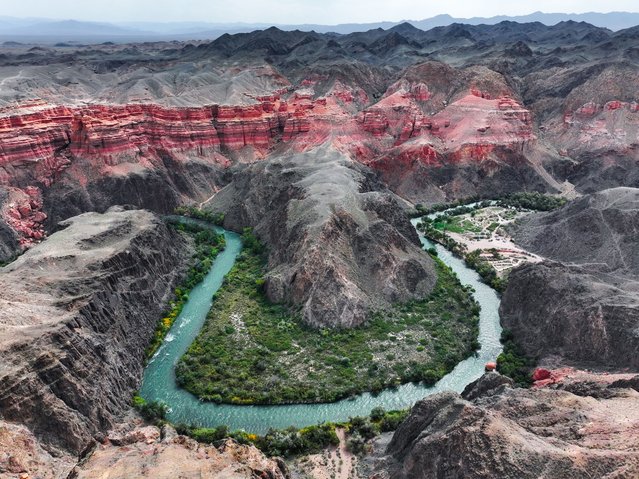
An aerial view of Charyn Canyon located about 200 kilometers east of Almaty city in Kazakhstan on September 22, 2024. The canyon, visited by more than 50,000 people each year, was placed under protection in 1964 and became part of the Charyn National Park, established on February 23, 2004. (Photo by Muhammed Enes Yildirim/Anadolu via Getty Images)
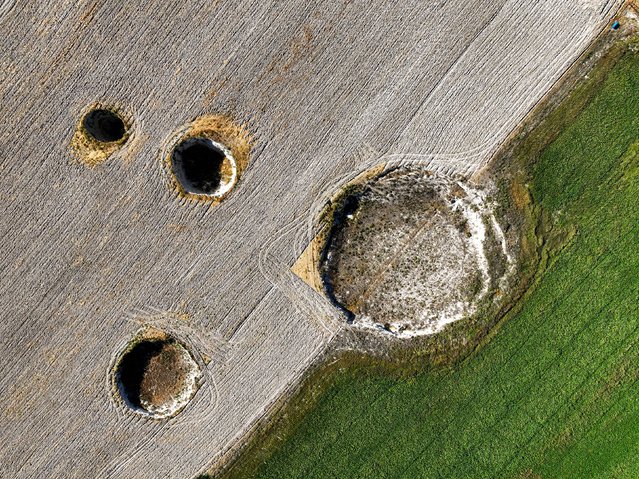
An aerial view of sinkholes (obruk), caused by some form of collapse of the surface layer, in Konya, Turkiye on September 17, 2024. Many sinkholes are observed in the fields of Eseli Plateau located within the borders of Resadiye Neighborhood in the north-west of Karapinar district, where sinkhole formation has increased rapidly in recent years. (Photo by Serhat Cetinkaya/Anadolu via Getty Images)
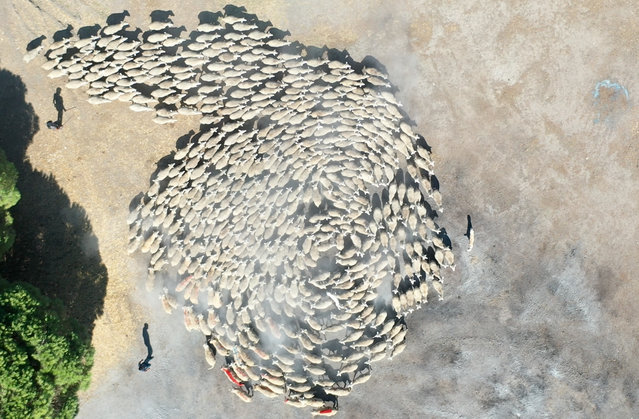
An aerial view of lambs as General Directorate of Agricultural Enterprises of Turkish Ministry of Agriculture and Forestry expects lamb births to increase in winter period, compared to previous years, in Karacabey facilities of Bursa, Turkiye on September 16, 2024. (Photo by Mustafa Yilmaz/Anadolu via Getty Images)
Hundreds of flamingos take flight in the Rift Valley in East Africa early September 2024. The birds gather in the region’s saline lakes to eat the blue-green algae that grows in abundance. The red-orange pigment in the algae is what gives them their distinctive pink plumage. They also use the site to breed. (Photo by Alexandre and Chloe Bes/Naturagency/Solent News)
Aerial view of villagers drying chili peppers at a rural cooperative on August 21, 2024 in Bozhou, Anhui Province of China. (Photo by Yang Zhongqin/VCG via Getty Images)
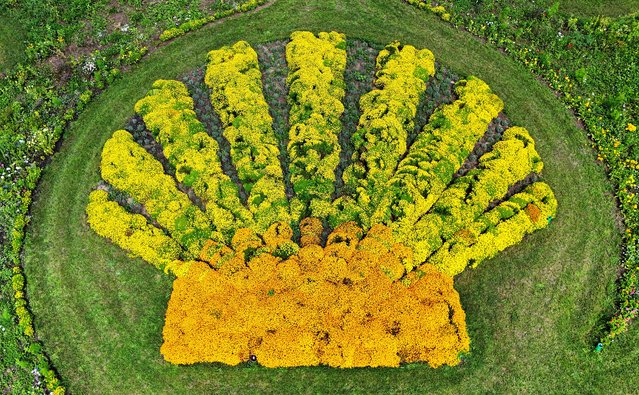
A picture taken with a drone shows a huge work of art created with various flowers and flowering plants in Jacobsdorf, Germany, 29 July 2024. Artist Michael Uy has transformed a piece of fallow land into an insect paradise for bees, bumblebees and butterflies. Using plants, the artist has planted and sown oversized images in the shape of a shell and a winding path of life on a large meadow in Jacobsdorf. (Photo by Hannibal Hanschke/EPA/EFE)
Groundsman Darren Cordingley on his way out of the maze on July 11, 2024. Gardeners have had their work cut out after spending a whopping 520 hours trimming one of the world's biggest hedge mazes. It has taken a team of 13 working eight hours a day for five days to tackle the enormous maze at the Longleat estate in Wiltshire, UK. (Photo by Max Willcock/Bournemouth News)