Loading...
Done


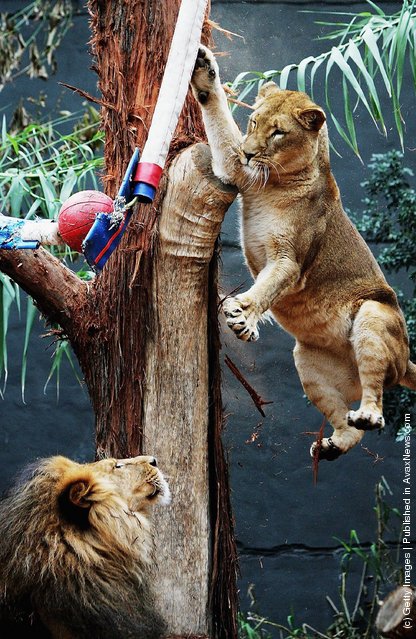
Young African lion Asali (R) jumps for a bungee-ball toy as her father Jambo or “Bruiser” looks on at the opening of a savannah-themed makeover of the lion enclosure at Taronga Zoo August 29, 2006 in Sydney, Australia. The renovation includes sandstone rock features, a wading pool, and red ochre crushed granite substrate in a move to make the enclosure more closely resemble the natural habitat of the African savannah. (Photo by Ian Waldie/Getty Images)
Details
15 Apr 2011 10:12:00


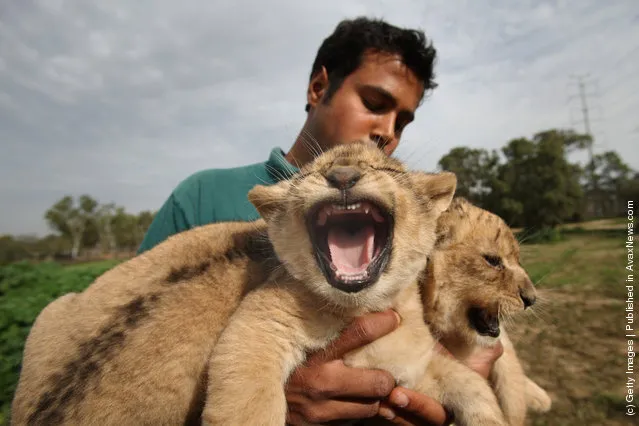
Three one-month-old lioness cubs are held by a keeper as they take their first outing on February 21, 2010 at the Ramat Gan Safari Park near Tel Aviv, Israel. The still unnamed cubs are the first triplet females to be born at the safari park and officials say their birth will ensure the continuity of the park's pride of lions. (Photo by David Silverman/Getty Images)
Details
06 Apr 2011 08:42:00


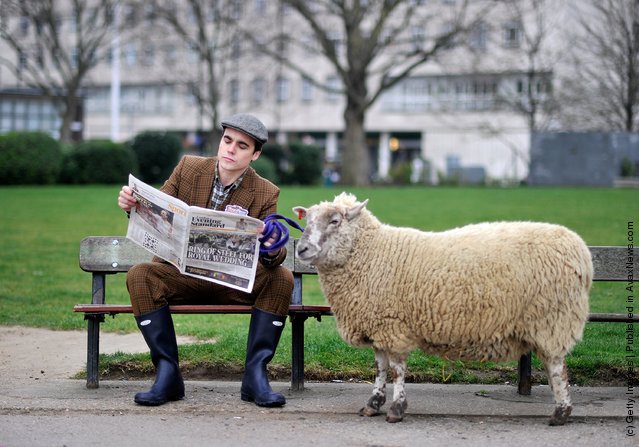
A sheep and a gentleman farmer take to the streets of London today to mark the launch the new English Countryside chapter of Farmville, Zynga's global social gaming phenomenon on March 29, 2011 in London, England. Farmville English Countryside gives players all-new crops, buildings and decorations located in the beautiful English Countryside. (Photo by Gareth Cattermole/Getty Images for Farmville)
Details
30 Mar 2011 11:04:00


A Galapagos Tortoise shell is used as a foot rest at Heathrow Airport's Animal Reception Centre on January 25, 2011 in London, England. Many animals pass through the centre's doors ranging from exotic animals such as snow leopards and elephants, snakes and crocodiles, to the more common such as cats and dogs. In 2010 alone the centre processed approximately 10,500 cats and dogs, 1,300 birds, 105,000 day old chicks, 246,000 reptiles, 230 horses and 29 million fish. Most animals are part of zoo transfer schemes, the pet trade, or are pets in transit. (Photo by Dan Kitwood/Getty Images)
Details
21 Mar 2011 12:30:00


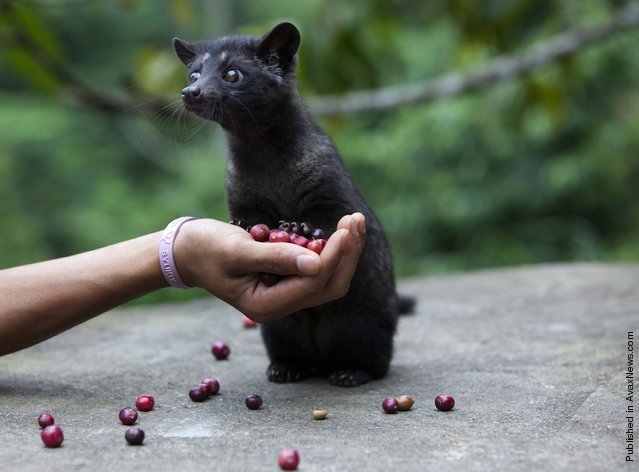
“Kopi luwak (Malay pronunciation), or civet coffee, is one of the world's most expensive and low-production coffee. It is made from the beans of coffee berries which have been eaten by the Asian Palm Civet (Paradoxurus hermaphroditus) and other related civets, then passed through its digestive tract. ...
Details
19 Mar 2011 18:41:00