Loading...
Done
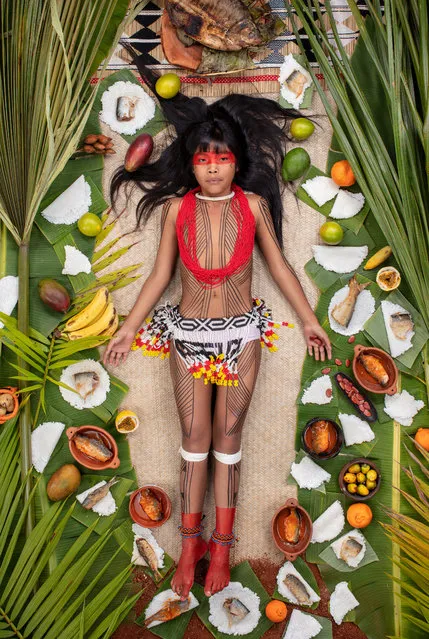
Kawakanih Yawalapiti, 9, Upper Xingu region of Mato Grosso, Brazil, 2018: Kawakanih lives with her tribe, the Yawalapiti, in Xingu national park, a preserve in the Amazon basin of Brazil. The Yawalapiti collect seeds to preserve species unique to their ecosystem, which lies between the rain forest and savannah. Kawakanih’s diet is simple, consisting mainly of fish, cassava, porridge, fruit and nuts. “It takes five minutes to catch dinner”, says Kawakanih. “When you’re hungry, you just go to the river with your net”. (Photo by Gregg Segal/The Guardian)

Photographer Gregg Segal travelled the world to document children and the food they eat in a week. Partly inspired by the increasing problems of childhood obesity, he tracked traditional regional diets as yet unaffected by globalisation, and ironically, found that the healthiest diets were often eaten by the least well off. (Photo by Gregg Segal/The Guardian)
Details
03 Jul 2019 00:03:00
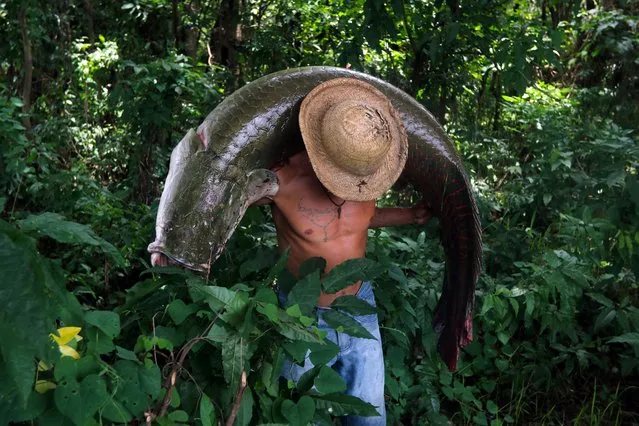
A fisherman carries a large Pirarucu (Arapaima gigas) at the Piagacu-Purus Sustainable Development Reserve in Amazonas state, Brazil, on October 24, 2019. The pirarucu -a giant fish of the Amazon, that had been on the verge of extinction- can measure up to three meters and weigh more than 200 kilos. The soft and tasty white meat fish is nowadays served in renowned restaurants in Rio de Janeiro. (Photo by Ricardo Oliveira/AFP Photo)

A fisherman carries a large Pirarucu (Arapaima gigas) at the Piagacu-Purus Sustainable Development Reserve in Amazonas state, Brazil, on October 24, 2019. The pirarucu -a giant fish of the Amazon, that had been on the verge of extinction- can measure up to three meters and weigh more than 200 kilos. The soft and tasty white meat fish is nowadays served in renowned restaurants in Rio de Janeiro. (Photo by Ricardo Oliveira/AFP Photo)
Details
31 Oct 2019 00:07:00
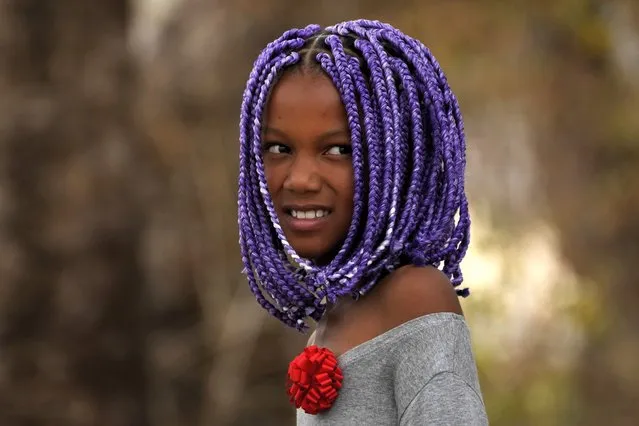
Sophia Fernandes, a member of the Kalunga quilombo, the descendants of runaway slaves, dons traditional afro braids, during the culmination of the week-long pilgrimage and celebration for the patron saint “Nossa Senhora da Abadia” or Our Lady of Abadia, in the rural area of Cavalcante in Goias state, Brazil, Saturday, August 13, 2022.  Devotees celebrate Our Lady of Abadia at this time of the year with weddings, baptisms and by crowning distinguished community members, as they maintain cultural practices originating from Africa that mix with Catholic traditions. (Photo by Eraldo Peres/AP Photo)

Sophia Fernandes, a member of the Kalunga quilombo, the descendants of runaway slaves, dons traditional afro braids, during the culmination of the week-long pilgrimage and celebration for the patron saint “Nossa Senhora da Abadia” or Our Lady of Abadia, in the rural area of Cavalcante in Goias state, Brazil, Saturday, August 13, 2022. Devotees celebrate Our Lady of Abadia at this time of the year with weddings, baptisms and by crowning distinguished community members, as they maintain cultural practices originating from Africa that mix with Catholic traditions. (Photo by Eraldo Peres/AP Photo)
Details
21 Aug 2022 03:48:00
Costume details featuring Joao Candido, a black sailor who led a revolt against the physical punishment of Brazilian Navy soldiers at the beginning of the 20th century, lie inside the Paraíso do Tuiuti Samba school at the Samba City complex in Rio de Janeiro, Brazil, Tuesday, January 16, 2024. Samba schools are gearing up for this year's Carnival, scheduled from Feb. 9-17. (Photo by Bruna Prado/AP Photo)

Costume details featuring Joao Candido, a black sailor who led a revolt against the physical punishment of Brazilian Navy soldiers at the beginning of the 20th century, lie inside the Paraíso do Tuiuti Samba school at the Samba City complex in Rio de Janeiro, Brazil, Tuesday, January 16, 2024. Samba schools are gearing up for this year's Carnival, scheduled from Feb. 9-17. (Photo by Bruna Prado/AP Photo)
Details
05 Apr 2025 02:24:00
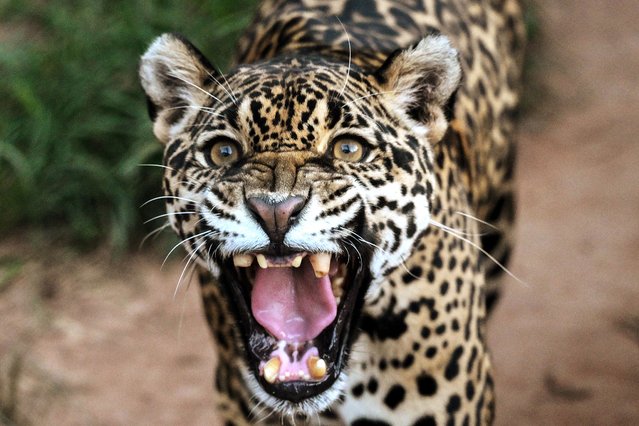
A jaguar (Panthera onca) growls at the Mata Ciliar association, an organization for the conservation of biodiversity, in Jundiai, Sao Paulo state, Brazil on May 29, 2025. Twenty-five pumas and ten jaguars are currently recovering at the Brazilian Center for the Conservation of Neotropical Felines at Mata Ciliar, a site as large as 40 football fields where monkeys, wild dogs, maned wolves, ocelots, and other regional animals are also rehabilitated. (Photo by Nelson Almeida/AFP Photo)

A jaguar (Panthera onca) growls at the Mata Ciliar association, an organization for the conservation of biodiversity, in Jundiai, Sao Paulo state, Brazil on May 29, 2025. Twenty-five pumas and ten jaguars are currently recovering at the Brazilian Center for the Conservation of Neotropical Felines at Mata Ciliar, a site as large as 40 football fields where monkeys, wild dogs, maned wolves, ocelots, and other regional animals are also rehabilitated. (Photo by Nelson Almeida/AFP Photo)
Details
22 Jun 2025 02:21:00
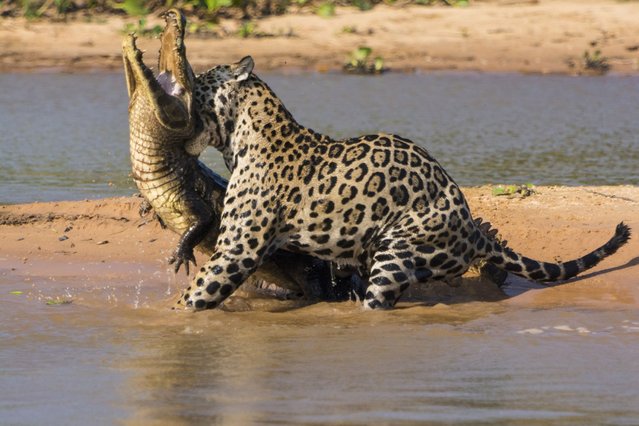
Jaguar attacks a Yacare Caiman. (Photo by Barcroft Media)

These stunning images show the 20-stone cat striking with lightning speed while the eight-foot reptile basks on a river island. The scene unfolded by the Cuiabá River in the Pantanal Wetlands of western Brazil. Photo: Jaguar attacks a Yacare Caiman. (Photo by Barcroft Media)
Details
28 Oct 2013 10:17:00
Members of the Legio X Fretensis (Malta) re-enactment group take part in a display of ancient Roman army life at Fort Rinella in Kalkara, outside Valletta, March 22, 2015. The event “Romanus”, organised by the Malta Heritage Trust, consisted of talks, hands-on displays, static exhibitions of weapons and equipment, food and wine tasting and large-scale re-enactments depicting different forms of Roman warfare in the field. (Photo by Darrin Zammit Lupi/Reuters)

Members of the Legio X Fretensis (Malta) re-enactment group take part in a display of ancient Roman army life at Fort Rinella in Kalkara, outside Valletta, March 22, 2015. The event “Romanus”, organised by the Malta Heritage Trust, consisted of talks, hands-on displays, static exhibitions of weapons and equipment, food and wine tasting and large-scale re-enactments depicting different forms of Roman warfare in the field. (Photo by Darrin Zammit Lupi/Reuters)
Details
23 Mar 2015 10:20:00
The following “Utopian Tours” drawings are conceptual images of what tourism in North Korea might one day look like, created by North Korean architects. The images, curated by Nick Bonner, are on view as part of the exhibition at the Venice Architecture Biennale in the Korean Pavilion. Bonner runs the Beijing-based Koryo Tours – a company that organizes tours of outsiders into North Korea. (Photo by Nick Bonner/Kyle Vanhemert/Venice Architecture Biennale)

At this year’s Venice Bienniale in Italy, the Korean pavilion has a curious exhibit called “Commissions for Utopia”. It includes renderings from North Korea’s top architects and artists (all anonymous), many of whom studied at the Paekho Institute of Architecture, North Korea’s state-run architectural college, and none of whom have ever left the country. They were asked to create a vision of North Korea’s future sustainable architecture for its expanding tourism industry. Their final products are a glimpse into what it would be like to envision the future after being entirely cut off from the present for almost 70 years. (Photo by Nick Bonner/Kyle Vanhemert/Venice Architecture Biennale)
Details
08 Aug 2014 11:03:00