Loading...
Done
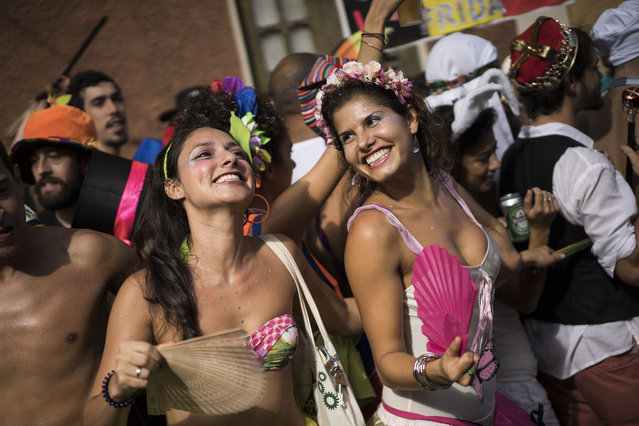
Revelers dance during the “Ceu na Terra”, or Heaven on earth, carnival parade in Rio de Janeiro, Brazil, Saturday, February 7, 2015. Rio's over-the-top Carnival is the highlight of the year for many local residents. Hundreds of thousands of merrymakers are beginning to take to the streets in open-air “blocos” parties. (Photo by Felipe Dana/AP Photo)

Revelers dance during the “Ceu na Terra”, or Heaven on earth, carnival parade in Rio de Janeiro, Brazil, Saturday, February 7, 2015. Rio's over-the-top Carnival is the highlight of the year for many local residents. Hundreds of thousands of merrymakers are beginning to take to the streets in open-air “blocos” parties. (Photo by Felipe Dana/AP Photo)
Details
10 Feb 2015 12:33:00
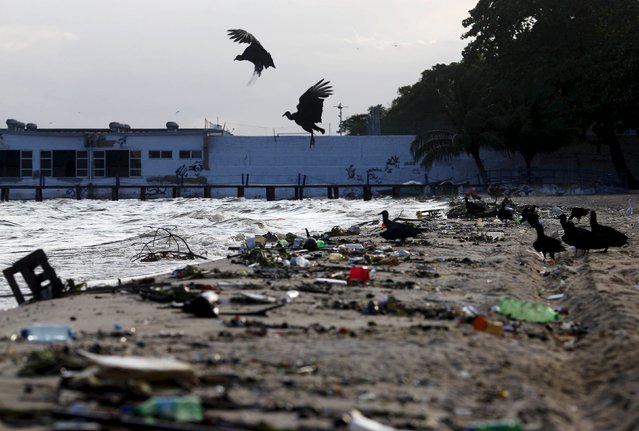
Vultures gather to eat waste in Bica beach, on the banks of the Guanabara Bay, with the Sugar Loaf mountain in background, 500 days ahead the Rio 2016 Olympic Games in Rio de Janeiro March 24, 2015. (Photo by Ricardo Moraes/Reuters)

Vultures gather to eat waste in Bica beach, on the banks of the Guanabara Bay, with the Sugar Loaf mountain in background, 500 days ahead the Rio 2016 Olympic Games in Rio de Janeiro March 24, 2015. As part of its Olympic bid, Rio promised to clean up 80 percent of the bay for the games. But local government officials have already admitted that a cleanup by 2016 is not achievable. Despite millions of dollars of investment over the years, the bay still stinks of sewage. Sailors who visited the city for test events complained of a floating sofa and a dead dog in the water. (Photo by Ricardo Moraes/Reuters)
Details
26 Mar 2015 12:16:00
A child plays in front of “Etnias”, a large graffiti wall by Brazilian graffiti artist Eduardo Kobra created ahead of the Rio 2016 Olympic Games at Porto Maravilha in Rio de Janeiro, Brazil, 30 July 2016. The Olympics start on 05 August. Eduardo Kobra hopes to set a Guinness World Record for the largest graffiti created by a single artist. (Photo by Lukas Coch/EPA)

A child plays in front of “Etnias”, a large graffiti wall by Brazilian graffiti artist Eduardo Kobra created ahead of the Rio 2016 Olympic Games at Porto Maravilha in Rio de Janeiro, Brazil, 30 July 2016. The Olympics start on 05 August. Eduardo Kobra hopes to set a Guinness World Record for the largest graffiti created by a single artist. (Photo by Lukas Coch/EPA)
Details
01 Aug 2016 10:35:00
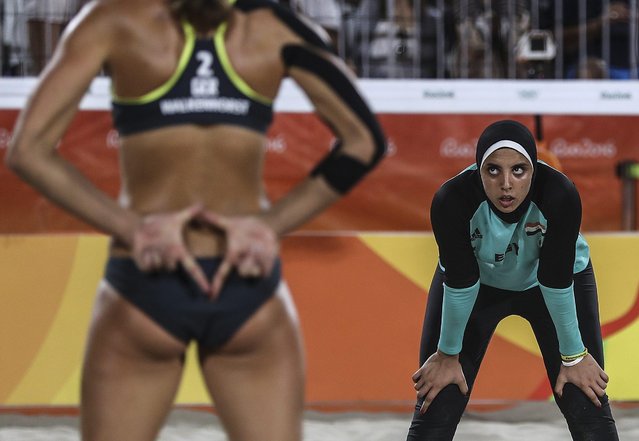
Kira Walkenhorst of Germany (L) signals as Doaa Elghobashy of Egypt (R) watches during the women's Beach Volleyball preliminary pool D game between Ludwig/Walkenhors of Germany and Elghobashy/Nada of Egypt the Rio 2016 Olympic Games at the Beach Volleyball Arena on Copacabana Beach in Rio de Janeiro, Brazil, 07 August 2016. (Photo by Antonio Lacerda/ANSA)

Kira Walkenhorst of Germany (L) signals as Doaa Elghobashy of Egypt (R) watches during the women's Beach Volleyball preliminary pool D game between Ludwig/Walkenhors of Germany and Elghobashy/Nada of Egypt the Rio 2016 Olympic Games at the Beach Volleyball Arena on Copacabana Beach in Rio de Janeiro, Brazil, 07 August 2016. (Photo by Antonio Lacerda/ANSA)
Details
09 Aug 2016 12:54:00
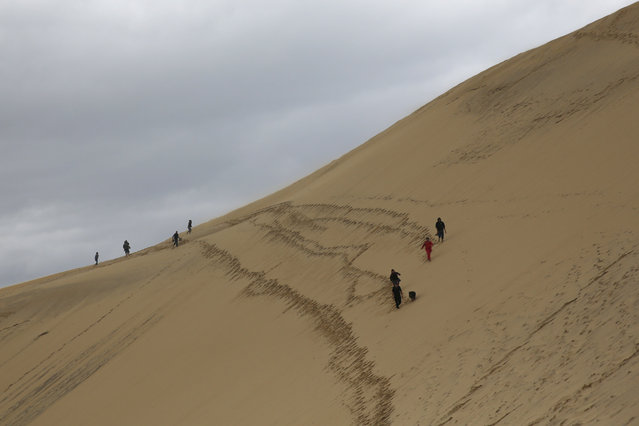
People walk along the Dune du Pilat (Dune of Pilat), the tallest sand dune in Europe, in La Teste de Buch, near Bordeaux, France, June 15, 2016. The dune has a volume of about 60,000,000 m³, measuring around 500 m wide from east to west and 2.7 km in length from north to south. Its height is currently 110 meters above sea level. The dune is a famous tourist destination with more than one million visitors per year. (Photo by Sergio Perez/Reuters)

People walk along the Dune du Pilat (Dune of Pilat), the tallest sand dune in Europe, in La Teste de Buch, near Bordeaux, France, June 15, 2016. The dune has a volume of about 60,000,000 m³, measuring around 500 m wide from east to west and 2.7 km in length from north to south. Its height is currently 110 meters above sea level. (Photo by Sergio Perez/Reuters)
Details
17 Jun 2016 13:38:00
Prints of R$ 50 Brazilian reais bills sit on a table for inspection at at the Casa da Moeda, the national mint, in the Santa Cruz suburb of Rio de Janeiro, Brazil, on Tuesday, March 5, 2013. Brazil is likely to keep its key interest rate at a record low for the third straight meeting, as policy makers are caught between a fragile economic recovery and faster-than-expected inflation. (Photo by Dado Galdieri/Bloomberg)

Prints of R$ 50 Brazilian reais bills sit on a table for inspection at at the Casa da Moeda, the national mint, in the Santa Cruz suburb of Rio de Janeiro, Brazil, on Tuesday, March 5, 2013. Brazil is likely to keep its key interest rate at a record low for the third straight meeting, as policy makers are caught between a fragile economic recovery and faster-than-expected inflation. (Photo by Dado Galdieri/Bloomberg)
Details
08 Mar 2013 06:41:00
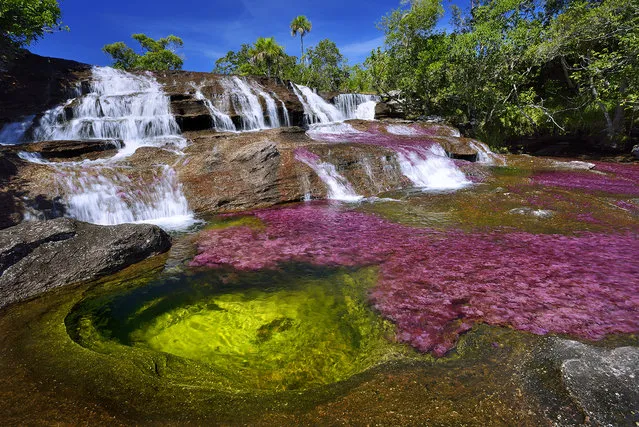
A waterfall is seen at the end of the rainy season, in August, when the water level finally decreases, in the Cano Cristales RIver in the Sierra de la Macarena in Colombia. It has become covered with a bright pink endemic aquatic plant, Macarenia Clavigera. (Photo by Olivier Grunewald)

“El rio mas bonito del Mundo”, the most beautiful river of the world, the “River of five colors”, the “Rainbow River”, or even the “Escaped from Paradise”, are the shimmering appellations that Colombians give to Cano Cristales, a small stream located in the heart of the Macarena National Park, 150 km (93 miles) south of Bogota. Photo: A waterfall is seen at the end of the rainy season, in August, when the water level finally decreases, in the Cano Cristales RIver in the Sierra de la Macarena in Colombia. It has become covered with a bright pink endemic aquatic plant, Macarenia Clavigera. (Photo by Olivier Grunewald)
Details
25 Mar 2014 15:15:00
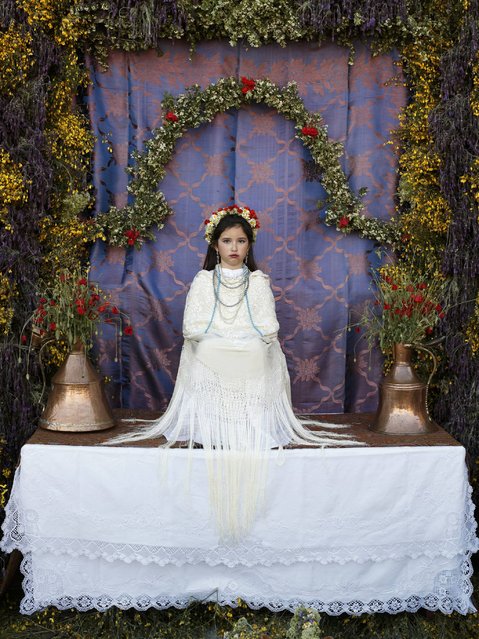
A “Maya” girl sits in an altar during the traditional celebration of “Las Mayas” on the streets in Colmenar Viejo, near Madrid, Spain, Friday, May 2, 2014. (Photo by Daniel Ochoa de Olza/AP Photo)

A “Maya” girl sits in an altar during the traditional celebration of “Las Mayas” on the streets in Colmenar Viejo, near Madrid, Spain, Friday, May 2, 2014. The festivity of the Maya comes from pagan rites and dates from the medieval age, appearing in ancient documents, it takes place every year in the beginning of May and celebrates the beginning off the spring. A girl between 7 and 11years is chosen as “Maya” and should sit still, serious, and quiet for a couple of hours in an altar on the street decorated with flowers and plants, afterwards they walk to the church with their family where they attend a ceremony. (Photo by Daniel Ochoa de Olza/AP Photo)
Details
13 May 2014 10:17:00