Loading...
Done
A man applies colored powder on his friend's face during celebrations marking Holi, the Hindu festival of colors, in Mumbai, India, Tuesday, March 7, 2023. The festival heralds the arrival of spring. (Photo by Rajanish Kakade/AP Photo)

A man applies colored powder on his friend's face during celebrations marking Holi, the Hindu festival of colors, in Mumbai, India, Tuesday, March 7, 2023. The festival heralds the arrival of spring. (Photo by Rajanish Kakade/AP Photo)
Details
23 Jul 2024 04:35:00
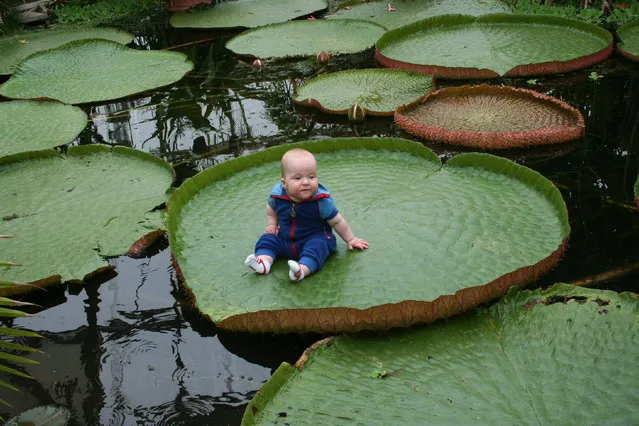
Victoria amazonica

The species has very large leaves, up to 3 m in diameter, that float on the water's surface on a submerged stalk, 7–8 m in length. The species was once called Victoria regia after Queen Victoria, but the name was superseded. V. amazonica is native to the shallow waters of the Amazon River basin, such as oxbow lakes and bayous. It is depicted in the Guyanese coat of arms. The flowers are white the first night they are open and become pink the second night. They are up to 40 cm in diameter, and are pollinated by beetles.
Details
03 Sep 2012 06:58:00
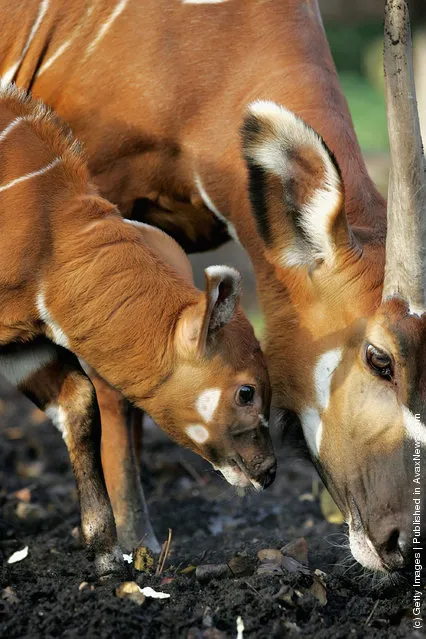
The one month old newborn Bongo Antelope

“The western or lowland bongo is a herbivorous, mostly nocturnal forest ungulate and among the largest of the African forest antelope species. Bongos are characterised by a striking reddish-brown coat, black and white markings, white-yellow stripes and long slightly spiralled horns”. – Wikipedia

Photo: The one month old newborn Bongo Antelope Calf ventures out in the cold with his mother in their enclosure at London Zoo on December 9, 2005 in London, England. (Photo by Christopher Lee/Getty Images)
Details
21 Feb 2012 12:17:00
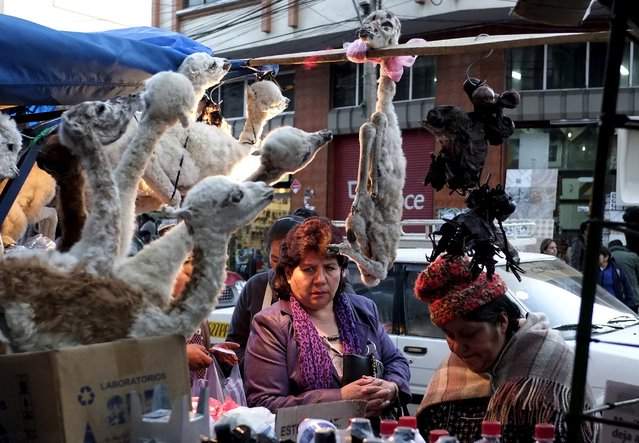
A woman (C) shops for an offering at the witch doctor's street in La Paz, July 31, 2015. (Photo by David Mercado/Reuters)

A woman (C) shops for an offering at the witch doctor's street in La Paz, July 31, 2015. According to Andean culture, the all the month of August is a time to give offerings to “Pachamama” to give thanks for their farms and health. The Aymaras use coca leaves, candies, animal fat, llama fetuses, some dried fruits, powdered minerals and alcohol during these rituals. (Photo by David Mercado/Reuters)
Details
02 Aug 2015 12:27:00
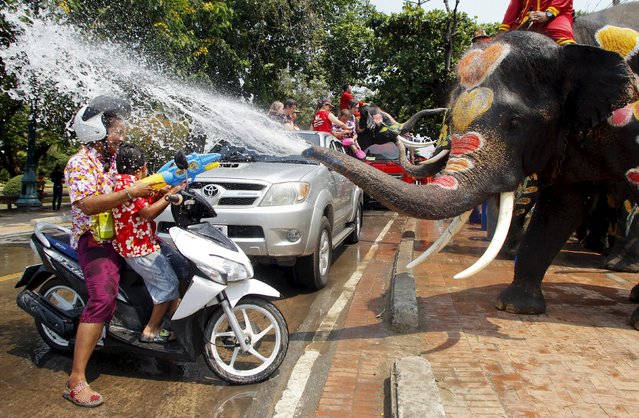
Elephants spray villagers with water in celebration of the Songkran water festival in Thailand's Ayutthaya province, north of Bangkok, April 10, 2015. (Photo by Chaiwat Subprasom/Reuters)

Elephants spray villagers with water in celebration of the Songkran water festival in Thailand's Ayutthaya province, north of Bangkok, April 10, 2015. The annual elephant Songkran is held to promote the tourism industry prior the Songkran Festival which is celebrated with splashing water and putting powder on each others faces as a symbolic sign of cleansing and washing away the sins from the old year. (Photo by Chaiwat Subprasom/Reuters)
Details
11 Apr 2015 10:37:00
A reveller reacts during a water fight at Songkran Festival celebrations in Bangkok April 13, 2016. (Photo by Jorge Silva/Reuters)

A reveller reacts during a water fight at Songkran Festival celebrations in Bangkok April 13, 2016. The three-day Songkran Festival starts on 13-15 April annually and is celebrated with splashing water and putting powder on each others faces as a symbolic sign of cleansing and washing away the sins from the old year. (Photo by Jorge Silva/Reuters)
Details
14 Apr 2016 12:18:00
The shuttle never got its final coat of paint and was left unfinished. (Photo by Ralph Mirebs/Exclusivepix Media)

Ralph Mirebs, an urban explorer and photographer in Russia, has revealed extraordinary photos of Soviet space shuttle prototypes gathering dust in an abandoned hangar. The abandoned hangar is located at the Baikonur Cosmodrome in Kazakhstan, which is still in operation today (with the close of NASA’s shuttle program, Russian Soyuz shuttles are the only way for astronauts to reach the International Space Station). The Buran prototype shuttles found by Mirebs, however, are from an earlier era – they are the last remnants of a space program that began in 1974 and was finally shuttered in 1993. (Photo by Ralph Mirebs/Exclusivepix Media)
Details
12 Mar 2017 00:05:00
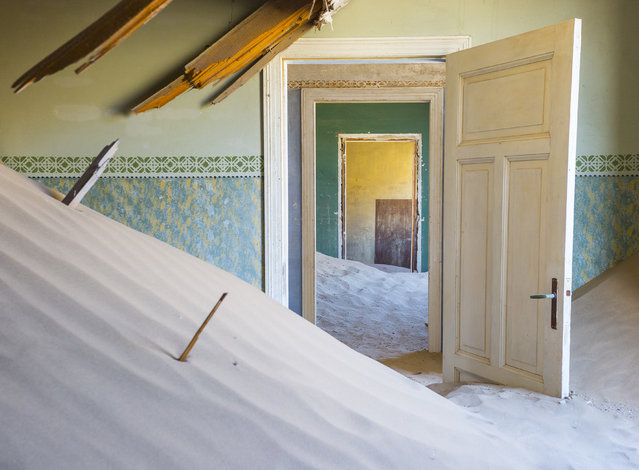
Kolmankop, an abandoned mining town in Namibia. (Photo by David Ogden/Caters News)

These sand-swept images show the ghostly remains of what was once a mineral-rich mining community. In its heyday, the town of Kolmanskop, Namibia, was home to about 700 families. Now all that remains are empty homes filled with sand, while cast-off items such as bathtubs are scattered about the surrounding area. Over time, the sand of the stunning dunes that encircle the town of Kolmanskop has been blown towards the abandoned residences, coating everything from streets to the interiors of houses and workshops. Here: Kolmankop, an abandoned mining town in Namibia. (Photo by David Ogden/Caters News)
Details
13 Mar 2016 09:31:00