Loading...
Done
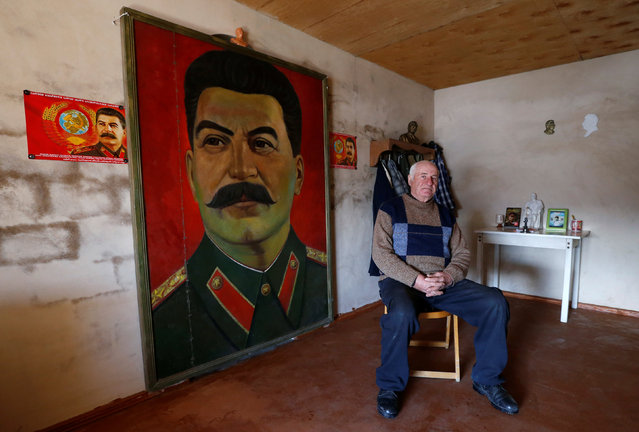
Retired builder Vasili Sidamonidze, 70, poses for a portrait at his home in Gori, Georgia, December 6, 2016. “Unfortunately, Stalin is not popular nowadays. Our people don't respect him. Only we, members of the (Communist) Party, respect him”, Sidamonidze said. “I always try to attend Stalin's birthday anniversaries in Gori. Unfortunately many people don't want to join us even if they live nearby. They look at us from their windows”. Stalin, who was born in Gori in 1878 and died in 1953, is largely reviled today in Georgia, which regained its independence during the 1991 collapse of the Soviet Union. Over the years, his memorials have been dismantled, most recently in 2010 when authorities removed a statue of the dictator from Gori's central square. But Stalin is still revered by a small group of mainly elderly supporters who stress his role in the industrialisation of the Soviet Union and in defeating Nazi Germany in World War Two. Each Dec. 21, a few dozen people mark his birthday by gathering outside a Gori museum dedicated to Stalin, where they make speeches and walk to the square where a 6-meter-high bronze statue of him once stood, calling for it to be reinstated. Opponents say it was a symbol of Moscow's still lingering shadow. In 2008, Russia fought a brief war with Georgia and recognised its breakaway regions of Abkhazia and South Ossetia as independent states. (Photo by David Mdzinarishvili/Reuters)

Retired builder Vasili Sidamonidze, 70, poses for a portrait at his home in Gori, Georgia, December 6, 2016. “Unfortunately, Stalin is not popular nowadays. Our people don't respect him. Only we, members of the (Communist) Party, respect him”, Sidamonidze said. “I always try to attend Stalin's birthday anniversaries in Gori. Unfortunately many people don't want to join us even if they live nearby. They look at us from their windows”. (Photo by David Mdzinarishvili/Reuters)
Details
17 Dec 2016 07:59:00
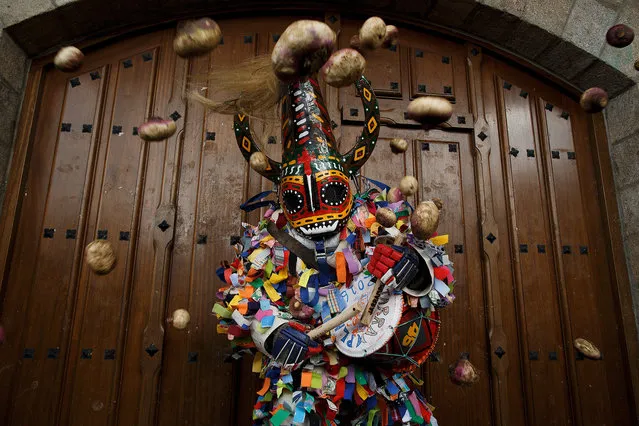
People throw turnips at the Jarramplas as he comes out from the church beating his drum during the Jarramplas Festival on January 20, 2016 in Piornal, Caceres province, Spain. The centuries old Jarramplas festival takes place annually every January 19-20 on Saint Sebastian Day and this year they expect to use more than 20 thousand kilogrames of turnips. Even though the exact origins of the festival are not known, various theories exist including the mythological punishment of Caco by Hercules. (Photo by Pablo Blazquez Dominguez/Getty Images)

People throw turnips at the Jarramplas as he comes out from the church beating his drum during the Jarramplas Festival on January 20, 2016 in Piornal, Caceres province, Spain. The centuries old Jarramplas festival takes place annually every January 19-20 on Saint Sebastian Day and this year they expect to use more than 20 thousand kilogrames of turnips. Even though the exact origins of the festival are not known, various theories exist including the mythological punishment of Caco by Hercules, a relation to ceremonies celebrated by the American Indians that were seen by the first conquerors, to a cattle thief ridiculed and expelled by his village neighbours. It is generally believed to symbolize the expulsion of everything bad. (Photo by Pablo Blazquez Dominguez/Getty Images)
Details
21 Jan 2016 13:21:00
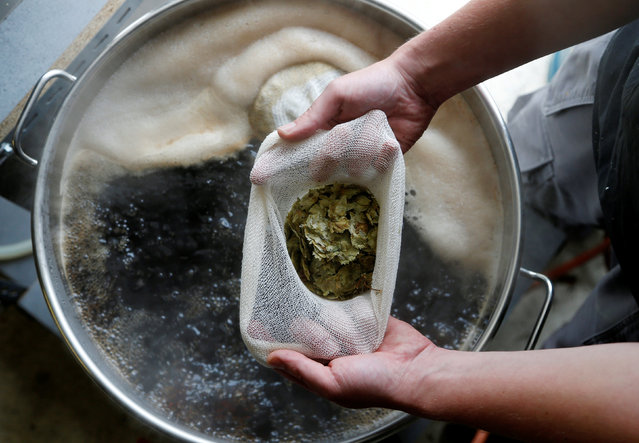
Arnaud Laloy, member of the Belgian Homebrewers association, adds hop in the brewing process to create his own beer in the garage of his house in Neufchateau, Belgium, August 11, 2016. (Photo by Francois Lenoir/Reuters)

In a country where some 200 breweries produce well over 1,000 different beers, surely no one is considering brewing their own? Wrong. Here: Arnaud Laloy, member of the Belgian Homebrewers association, adds hop in the brewing process to create his own beer in the garage of his house in Neufchateau, Belgium, August 11, 2016. (Photo by Francois Lenoir/Reuters)
Details
20 Aug 2016 11:30:00
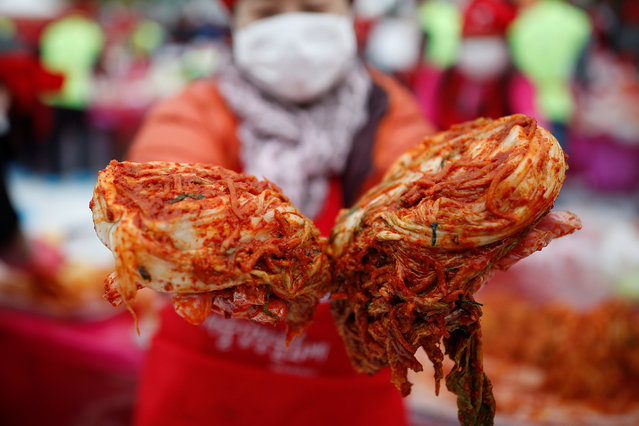
A woman poses for photographs with traditional side dish Kimchi during the Seoul Kimchi Festival in central Seoul, South Korea, November 4, 2016. (Photo by Kim Hong-Ji/Reuters)

A woman poses for photographs with traditional side dish Kimchi during the Seoul Kimchi Festival in central Seoul, South Korea, November 4, 2016. Kimchi made with cabbage, other vegetables and chili sauce and kimchi is the most popular traditional food in Korea. (Photo by Kim Hong-Ji/Reuters)
Details
05 Nov 2016 12:36:00
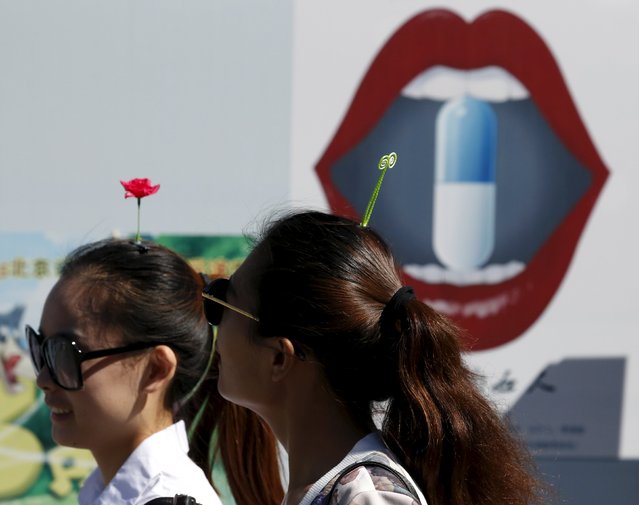
Women wearing flower and sprout-like hairpins walk past an advertisement board in Beijing, China, September 25, 2015. (Photo by Kim Kyung-Hoon/Reuters)

Women wearing flower and sprout-like hairpins walk past an advertisement board in Beijing, China, September 25, 2015. Wearing antenna styled hairpins in the shape of various flowers and plants at scenic spots has become a new trend in Beijing. (Photo by Kim Kyung-Hoon/Reuters)
Details
28 Sep 2015 08:02:00
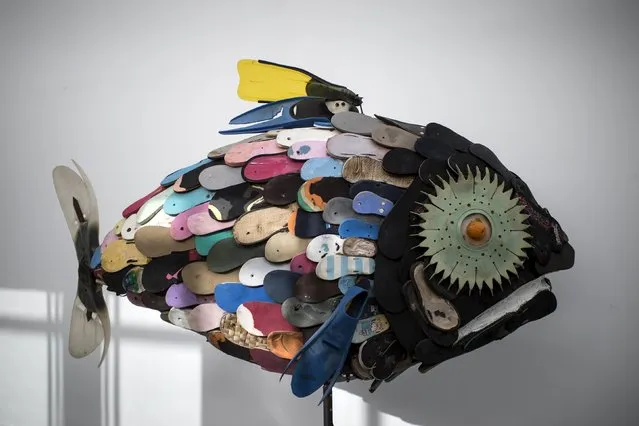
A sculpture of a fish made from waste products collected from the sea is displayed during the exhibition Keep The Oceans Clean by art collective Skeleton Sea, at the Torre Madariaga Biodiversity Centre in Busturia, Spain, May 17, 2015. (Photo by Vincent West/Reuters)

A sculpture of a fish made from waste products collected from the sea is displayed during the exhibition Keep The Oceans Clean by art collective Skeleton Sea, at the Torre Madariaga Biodiversity Centre in Busturia, Spain, May 17, 2015. Skeleton Sea, a group of surfers and artists, recycle waste collected from the world's oceans to create artworks and draw attention to the dangers faced from overfishing, pollution and oil spills. (Photo by Vincent West/Reuters)
Details
19 May 2015 11:16:00
Models present makeup creations during a show by Maybelline New York at the Berlin Fashion Week Autumn/Winter 2016 in Berlin, Germany, January 18, 2016. (Photo by Fabrizio Bensch/Reuters)

Models present makeup creations during a show by Maybelline New York at the Berlin Fashion Week Autumn/Winter 2016 in Berlin, Germany, January 18, 2016. (Photo by Fabrizio Bensch/Reuters)
Details
20 Jan 2016 08:06:00
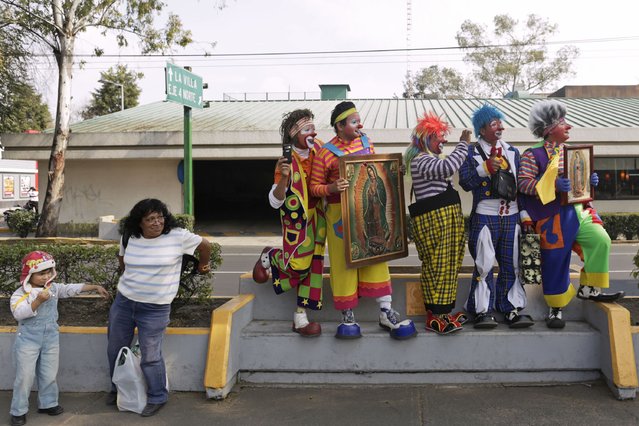
Clowns take part in the annual pilgrimage to the Basilica of Our Lady Guadalupe to pay homage to the Virgin of Guadalupe in Mexico City December 16, 2014. Dressed in colourful costumes, hundreds of clowns from all over Mexico walked towards the Basilica to give thanks to the virgin for the work they have received. (Photo by Carlos Jasso/Reuters)

Clowns take part in the annual pilgrimage to the Basilica of Our Lady Guadalupe to pay homage to the Virgin of Guadalupe in Mexico City December 16, 2014. Dressed in colourful costumes, hundreds of clowns from all over Mexico walked towards the Basilica to give thanks to the virgin for the work they have received. (Photo by Carlos Jasso/Reuters)
Details
18 Dec 2014 14:52:00