Loading...
Done
Ocean voyage

Do you think that history is a science? Well, not exactly. First, and foremost, history is the state's “legend of wars”, it’s official regalia. Of course, public historians are not interested in scientific truth – quite the opposite. In this respect, any attempt to present a state’s history as altruistic and benevolent as possible is welcomed and encouraged – as opposed to any revisionism attempts that may be more accurate. In this matter, Chinese have surpassed us all – they revised in highly creative manner (but rather shamelessly) the technology already invented by Europeans, a process that resulted in oldest state on the planet. Here is an interesting paradox: ask any sinologist about the Middle Kingdom during second century B.C., and he will describe it to you in such a vivid manner as if he has been living there all his life – but as soon as you will ask him to describe Chinese history in the 19-20th centuries… let's say, his eagerness will be greatly diminished. However, we will discuss China in a different article, and in the meantime we will try to understand how exactly historic “legend of wars” is formed and functions – based on a specific and well-known example. A great example is Ferdinand Magellan's first voyage around the world.
Details
14 Nov 2011 09:11:00
Carlos Cure holds packets of corn flour made in Colombia as he poses for a picture at a stall that sells food and staple items at a market in La Fria, Venezuela, June 2, 2016. (Photo by Carlos Garcia Rawlins/Reuters)

Carlos Cure holds packets of corn flour made in Colombia as he poses for a picture at a stall that sells food and staple items at a market in La Fria, Venezuela, June 2, 2016. (Photo by Carlos Garcia Rawlins/Reuters)
Details
09 Jun 2016 09:09:00
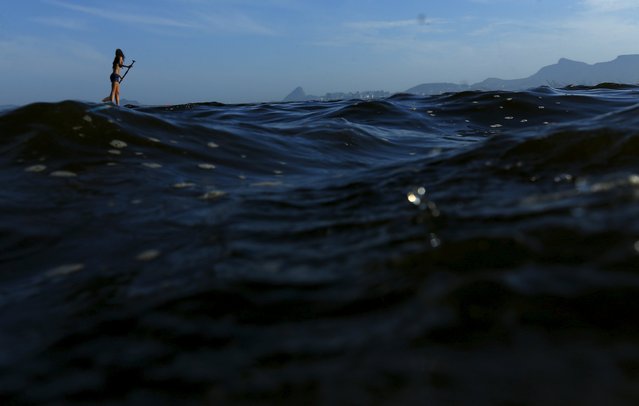
A girl paddles on her stand-up board on the waters of Guanabara bay at Bica beach in Rio de Janeiro Brazil, January 10, 2016. (Photo by Ricardo Moraes/Reuters)

A girl paddles on her stand-up board on the waters of Guanabara bay at Bica beach in Rio de Janeiro Brazil, January 10, 2016. Few features capture the beauty, or the problems, of one of the world's most dramatic urban landscapes like Guanabara Bay - the finger-like inlet that forms the shoreline and harbor for Rio de Janeiro. The bay, which carves into southeast Brazil from the Atlantic Ocean, literally gave Rio its name when Portuguese mariners mistook it for a “rio”, or “river”. Four centuries later, the bay is preparing to welcome another sort of seafarer – Olympic sailors, who will navigate the bay when the 2016 Rio Olympics kick off in August. (Photo by Ricardo Moraes/Reuters)
Details
28 Apr 2016 12:13:00
Yuanlei Liao, the singer of hardcore band called Thank Ray wears a read scarf after performing on the stage of Mao Live House during the club's last public concert night in central Beijing, China April 23, 2016. Mao Live House, a prominent live rock music venue in Beijing, shut its doors on the weekend, the latest closure to hit China's rock music scene. Owner Li Chi said the club, popular among fans of punk, metal and alternative rock since it opened nine years ago, was forced to close due to tighter rules on live performances. (Photo by Damir Sagolj/Reuters)

Yuanlei Liao, the singer of hardcore band called Thank Ray wears a read scarf after performing on the stage of Mao Live House during the club's last public concert night in central Beijing, China April 23, 2016. Mao Live House, a prominent live rock music venue in Beijing, shut its doors on the weekend, the latest closure to hit China's rock music scene. Owner Li Chi said the club, popular among fans of punk, metal and alternative rock since it opened nine years ago, was forced to close due to tighter rules on live performances. (Photo by Damir Sagolj/Reuters)
Details
04 May 2016 12:13:00
Carlos Melendez prepares to feed his pet squirrel “Colita” in downtown San Salvador January 29, 2015. (Photo by Jose Cabezas/Reuters)

Carlos Melendez prepares to feed his pet squirrel “Colita” in downtown San Salvador January 29, 2015. (Photo by Jose Cabezas/Reuters)
Details
31 Jan 2015 13:35:00
A participant in the Crazy Races extreme sports game competes in the cross-country obstacle race in Ufa, Russia on September 21, 2015. (Photo by TASS/Barcroft Media)

A participant in the Crazy Races extreme sports game competes in the cross-country obstacle race in Ufa, Russia on September 21, 2015. (Photo by TASS/Barcroft Media)
Details
23 Sep 2015 11:47:00
Polling station officials dressed as traditional Balinese performers vote in Badung regency on the Indonesian island of  Bali December 9, 2015 in this photo taken by Antara Foto. Around 100 million Indonesians were expected to go to the polls on Wednesday in many parts of the country to elect heads of local government. (Photo by Wira Suryantala/Reuters/Antara Foto)

Polling station officials dressed as traditional Balinese performers vote in Badung regency on the Indonesian island of Bali December 9, 2015 in this photo taken by Antara Foto. Around 100 million Indonesians were expected to go to the polls on Wednesday in many parts of the country to elect heads of local government. (Photo by Wira Suryantala/Reuters/Antara Foto)
Details
10 Dec 2015 11:12:00
In this Wednesday, July 23, 2014 file photo, Omaha photographer Lane Hickenbottom photographs the night sky in a pasture near Callaway, Neb. With no moon in the sky, the Milky Way was visible to the naked eye. More than one-third of the world’s population can no longer see the Milky Way because of man-made lights, according to a scientific paper by Light Pollution Science and Technology Institute's Fabio Falchi and his team members, published on Friday, June 10, 2016. (Photo by Travis Heying/The Wichita Eagle via AP Photo)

In this Wednesday, July 23, 2014 file photo, Omaha photographer Lane Hickenbottom photographs the night sky in a pasture near Callaway, Neb. With no moon in the sky, the Milky Way was visible to the naked eye. More than one-third of the world’s population can no longer see the Milky Way because of man-made lights, according to a scientific paper by Light Pollution Science and Technology Institute's Fabio Falchi and his team members, published on Friday, June 10, 2016. (Photo by Travis Heying/The Wichita Eagle via AP Photo)
Details
11 Jun 2016 12:37:00