Loading...
Done
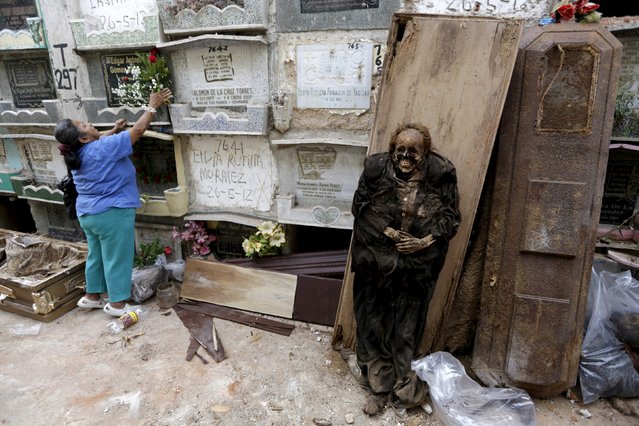
A woman (L) places flowers at a grave next to a mummified body during exhumation works at the General Cemetery in Guatemala City, April 15, 2015. (Photo by Jorge Dan Lopez/Reuters)

A woman (L) places flowers at a grave next to a mummified body during exhumation works at the General Cemetery in Guatemala City, April 15, 2015. If a lease on a grave has expired or not been paid, grave cleaners will break open the crypts to remove and rebury the bodies. Any remains that have not been claimed are packed into plastic bags, labeled and stored in mass graves. Bodies that have been stored in the upper crypt are exposed to dry and sunny conditions which means they do not decompose and instead become mummified. (Photo by Jorge Dan Lopez/Reuters)
Details
16 Apr 2015 13:01:00
Models  backstage ahead of the St George New Generation show at Mercedes-Benz Fashion Week Australia 2015 at Carriageworks on April 16, 2015 in Sydney, Australia. (Photo by Brendon Thorne/Getty Images)

Models backstage ahead of the St George New Generation show at Mercedes-Benz Fashion Week Australia 2015 at Carriageworks on April 16, 2015 in Sydney, Australia. (Photo by Brendon Thorne/Getty Images)
Details
19 Apr 2015 09:20:00
A model presents makeup creations during dress reharsal by Maybelline New York at the Berlin Fashion Week Autumn/Winter 2015 in Berlin January 19, 2015. (Photo by Fabrizio Bensch/Reuters)

A model presents makeup creations during dress reharsal by Maybelline New York at the Berlin Fashion Week Autumn/Winter 2015 in Berlin January 19, 2015. (Photo by Fabrizio Bensch/Reuters)
Details
20 Jan 2015 13:10:00
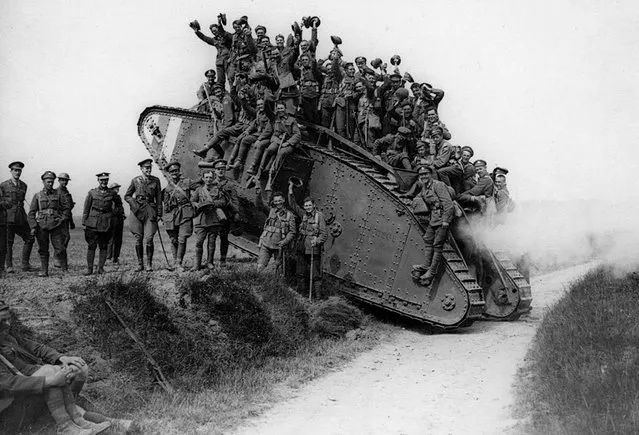
These black-and-white photos are taken from the new book “Armoured Warfare in the First World War 1916 – 1918” by Anthony Tucker-Jones and published by Pen & Sword Military. “Interestingly the British, French and Germans took completely different approaches with varying results”. The British military produced “Little Willie” in Autumn 1915 weighing 18 tonnes, which had a crew of two plus four gunners. “Inspired by a tracked artillery tractor “Little Willie” was referred to as a water tank – hence the name tank – to ensure secrecy”, said Anthony. “This led to the strange looking Mark I with its peculiar rhomboid shape, designed to cross trenches with guns in sponsons on either side. The Germans saw the tank as unchivalrous and were slow to grasp its utility. They favoured the Stormtrooper (specialist soldiers used to infiltrate enemy trenches) and artillery, not the tank”, said Anthony. “However, they didn’t hesitate to make use of captured British tanks. Although the tank helped secure victory and German soldiers dubbed it “Germany’s Downfall” the country was ultimately brought to its knees by the Allies blockade”. Here: British troops hitch a ride on a Mark IV after the massed tank fleet spearheading attack at Cambrai on November 20, 1917. (Photo by Anthony Tucker-Jones/Mediadrumworld.com)

These black-and-white photos are taken from the new book “Armoured Warfare in the First World War 1916 – 1918” by Anthony Tucker-Jones and published by Pen & Sword Military. Here: British troops hitch a ride on a Mark IV after the massed tank fleet spearheading attack at Cambrai on November 20, 1917. (Photo by Anthony Tucker-Jones/Mediadrumworld.com)
Details
23 Feb 2017 00:02:00
A model is photographed backstage before he BCBG MAX AZRIA Fall 2015 collection is modeled during Fashion Week, in New York, Thursday, February 12, 2015. (Photo by Richard Drew/AP Photo)

A model is photographed backstage before he BCBG MAX AZRIA Fall 2015 collection is modeled during Fashion Week, in New York, Thursday, February 12, 2015. (Photo by Richard Drew/AP Photo)
Details
15 Feb 2015 14:32:00
Singer Katy Perry arrives at the Metropolitan Museum of Art Costume Institute Gala 2015 celebrating the opening of “China: Through the Looking Glass” in Manhattan, New York May 4, 2015. (Photo by Lucas Jackson/Reuters)

Singer Katy Perry arrives at the Metropolitan Museum of Art Costume Institute Gala 2015 celebrating the opening of “China: Through the Looking Glass” in Manhattan, New York May 4, 2015. (Photo by Lucas Jackson/Reuters)
Details
09 May 2015 10:46:00
Men give bananas to monkeys gathered on the side of the road as India remains under an unprecedented lockdown over the highly contagious coronavirus (COVID-19) on April 08, 2020 in New Delhi, India. Wild animals, including monkeys, are roaming human settlements in India as people are staying indoors due to the 21-day lockdown. With India's 1.3 billion population and tens of millions of cars off the roads, wildlife is moving towards areas inhabited by humans. Wild animals in many countries have been seen roaming streets. A study says some 60 percent of the new diseases found around the globe every year are zoonotic, meaning they originate in animals and are passed on to humans. COVID-19 is a zoonotic disease that is suspected to have come from the wet markets of Wuhan, China. (Photo by Yawar Nazir/Getty Images)

Men give bananas to monkeys gathered on the side of the road as India remains under an unprecedented lockdown over the highly contagious coronavirus (COVID-19) on April 08, 2020 in New Delhi, India. Wild animals, including monkeys, are roaming human settlements in India as people are staying indoors due to the 21-day lockdown. (Photo by Yawar Nazir/Getty Images)
Details
12 Apr 2020 00:05:00
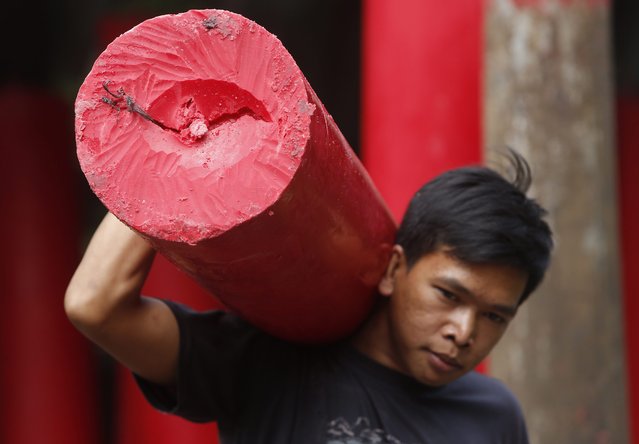
An Indonesian worker carries a giant candle at a traditional Chinese candle maker for the upcoming Lunar New Year in Bogor, Indonesia, 27 January  2015. The Chinese Lunar New Year, known here as Imlek, is only three weeks away. The whole city is getting decked out to celebrate the event on 19 February 2015. (Photo by Adi Weda/EPA)

An Indonesian worker carries a giant candle at a traditional Chinese candle maker for the upcoming Lunar New Year in Bogor, Indonesia, 27 January 2015. The Chinese Lunar New Year, known here as Imlek, is only three weeks away. The whole city is getting decked out to celebrate the event on 19 February 2015. (Photo by Adi Weda/EPA)
Details
29 Jan 2015 10:58:00