Loading...
Done
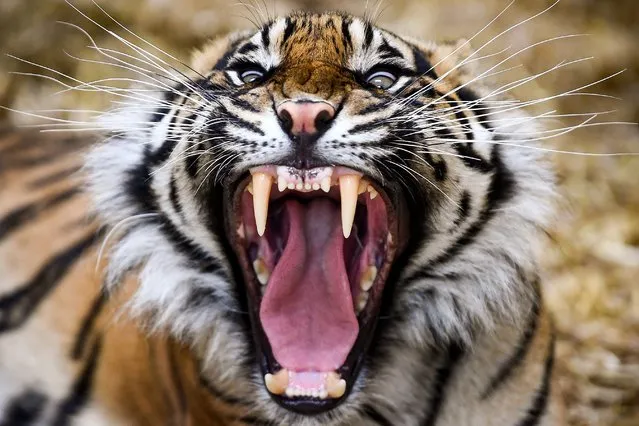
Dharma the Sumatran tiger yawns as members of the public return to Edinburgh Zoo as it opens for the first time following the easing of Scottish Governments lockdown restrictions on June 29, 2020 in Edinburgh, Scotland. Outdoor visitor attractions in Scotland have reopened along with many non-essential retailers after more than three months in lockdown, as Scotland moves into phase 2 of its “route map” for easing coronavirus restrictions. (Photo by Jeff J. Mitchell/Getty Images)

Dharma the Sumatran tiger yawns as members of the public return to Edinburgh Zoo as it opens for the first time following the easing of Scottish Governments lockdown restrictions on June 29, 2020 in Edinburgh, Scotland. Outdoor visitor attractions in Scotland have reopened along with many non-essential retailers after more than three months in lockdown, as Scotland moves into phase 2 of its “route map” for easing coronavirus restrictions. (Photo by Jeff J. Mitchell/Getty Images)
Details
05 Jul 2020 00:01:00
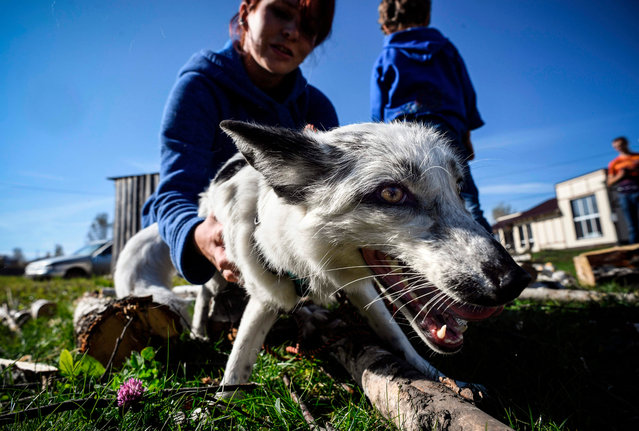
Tatyana Abramova, 33, plays with her home fox Plombir at her countryside house outside Siberian city of Novosibirsk on September 12, 2020. The official start of the Soviet experiment to better understand the domestication of animals by humans began in 1959, and was initiated by geneticists Dmitri Beliaiev and Lioudmila Trout on a farm in Akademgorodok, the scientific center of excellence in Siberia. Their primary objective was to domesticate foxes, to understand how the ancestor of wolves, another canine, evolved into a loyal and loving dog. And understand what this domestication tells us about the genetic evolution of species. (Photo by Alexander Nemenov/AFP Photo)

Tatyana Abramova, 33, plays with her home fox Plombir at her countryside house outside Siberian city of Novosibirsk on September 12, 2020. The official start of the Soviet experiment to better understand the domestication of animals by humans began in 1959, and was initiated by geneticists Dmitri Beliaiev and Lioudmila Trout on a farm in Akademgorodok, the scientific center of excellence in Siberia. Their primary objective was to domesticate foxes, to understand how the ancestor of wolves, another canine, evolved into a loyal and loving dog. And understand what this domestication tells us about the genetic evolution of species. (Photo by Alexander Nemenov/AFP Photo)
Details
25 Oct 2020 00:05:00
People socialising in Soho, central London on July 11, 2020, after the lifting of further coronavirus lockdown restrictions in England. Revellers are urged to remember the importance of social distancing as pubs gear up for the second weekend of trade since the lifting of lockdown measures. (Photo by Stefan Rousseau/PA Images via Getty Images)

People socialising in Soho, central London on July 11, 2020, after the lifting of further coronavirus lockdown restrictions in England. Revellers are urged to remember the importance of social distancing as pubs gear up for the second weekend of trade since the lifting of lockdown measures. (Photo by Stefan Rousseau/PA Images via Getty Images)
Details
27 Oct 2020 00:03:00
Supporters of US President Donald Trump rally in front of a poll station at Coral Gable Branch Public Library in Miami, Florida on November 3, 2020. (Photo by Eva Marie Uzcategui/AFP Photo)

Supporters of US President Donald Trump rally in front of a poll station at Coral Gable Branch Public Library in Miami, Florida on November 3, 2020. (Photo by Eva Marie Uzcategui/AFP Photo)
Details
26 Nov 2020 00:01:00
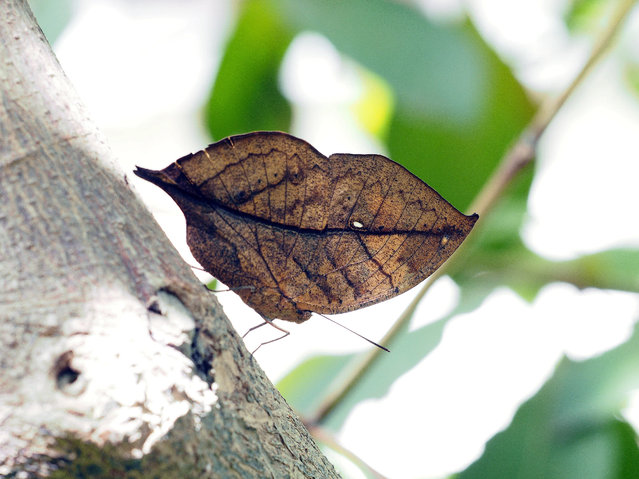
A Dead Leaf butterfly (Kallima inachu formosana, also called Orange Oakleaf Butterfly) rests on a tree trunk at the Taipei Zoo in Taipei, Tawian, 03 August 2019. Dead Leaf butterfly can be found in Tropical Asia from India to Japan. When its wings close, it resembles a dead leaf, providing camouflage against predators including birds, ants, spiders and wasps. (Photo by David Chang/EPA/EFE)

A Dead Leaf butterfly (Kallima inachu formosana, also called Orange Oakleaf Butterfly) rests on a tree trunk at the Taipei Zoo in Taipei, Tawian, 03 August 2019. Dead Leaf butterfly can be found in Tropical Asia from India to Japan. When its wings close, it resembles a dead leaf, providing camouflage against predators including birds, ants, spiders and wasps. (Photo by David Chang/EPA/EFE)
Details
18 Aug 2019 00:01:00
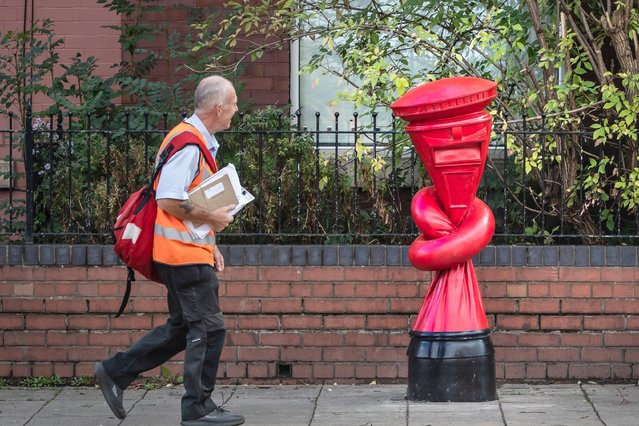
A postman walks past an art work titled “Alphabetti Spaghett” by artist Alex Chinneck on Norborough Road in Sheffield, Yorkshire, England on September 26, 2019. (Photo by Danny Lawson/PA Images via Getty Images)

A postman walks past an art work titled “Alphabetti Spaghett” by artist Alex Chinneck on Norborough Road in Sheffield, Yorkshire, England on September 26, 2019. (Photo by Danny Lawson/PA Images via Getty Images)
Details
28 Sep 2019 00:07:00
An AI Gamer “Q56” robot plays a video game during a demonstration at the Bandai Namco Holdings Inc. booth at the Combined Exhibition of Advanced Technologies in Chiba, Japan on October 16, 2019. (Photo by Kiyoshi Ota/Bloomberg)

An AI Gamer “Q56” robot plays a video game during a demonstration at the Bandai Namco Holdings Inc. booth at the Combined Exhibition of Advanced Technologies in Chiba, Japan on October 16, 2019. (Photo by Kiyoshi Ota/Bloomberg)
Details
04 Nov 2019 00:03:00
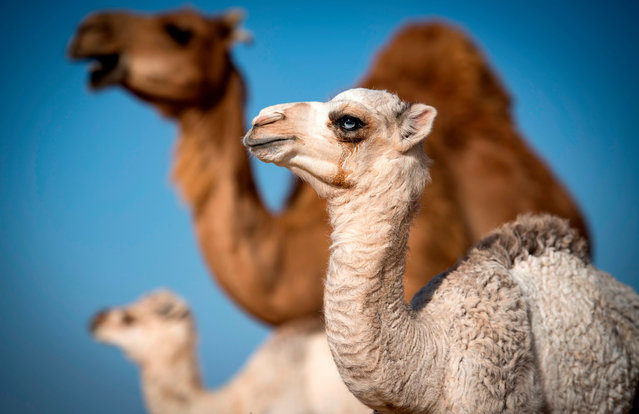
A camel calf is seen among a herd in the desert near Dakhla in Morocco-administered Western Sahara, on October 13, 2019. In the Oued Eddahab desert in Western Sahara, Habiboullah Dlimi raises dairy and racing camels just like his ancestors used to, but with a little help from modern technology. While his animals roam free and are milked traditionally, by hand, at dawn and dusk, they are watched over by hired herders and Dlimi follows GPS coordinates across the desert in a 4X4 vehicle to reach them. (Photo by Fadel Senna/AFP Photo)

A camel calf is seen among a herd in the desert near Dakhla in Morocco-administered Western Sahara, on October 13, 2019. In the Oued Eddahab desert in Western Sahara, Habiboullah Dlimi raises dairy and racing camels just like his ancestors used to, but with a little help from modern technology. While his animals roam free and are milked traditionally, by hand, at dawn and dusk, they are watched over by hired herders and Dlimi follows GPS coordinates across the desert in a 4X4 vehicle to reach them. (Photo by Fadel Senna/AFP Photo)
Details
24 Nov 2019 00:03:00