Loading...
Done
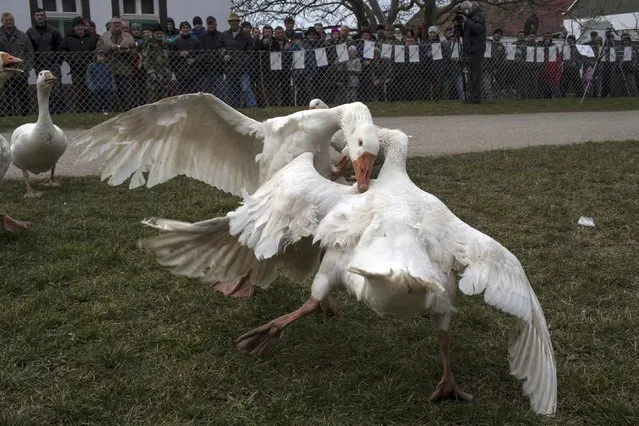
Geese fight during the annual Geese Fight Day in the northern Serbian village of Mokrin, some 160km (100 miles) from Belgrade February 22, 2015. (Photo by Marko Djurica/Reuters)

Geese fight during the annual Geese Fight Day in the northern Serbian village of Mokrin, some 160km (100 miles) from Belgrade February 22, 2015. Every year in the last week of February, goose fights are held in the northern Serbian village of Mokrin. Left alone, male geese, or ganders, are unlikely to fight each other, hence why females are brought along for whose affections the ganders then fight until one or the other gives up. (Photo by Marko Djurica/Reuters)
Details
23 Feb 2015 13:01:00
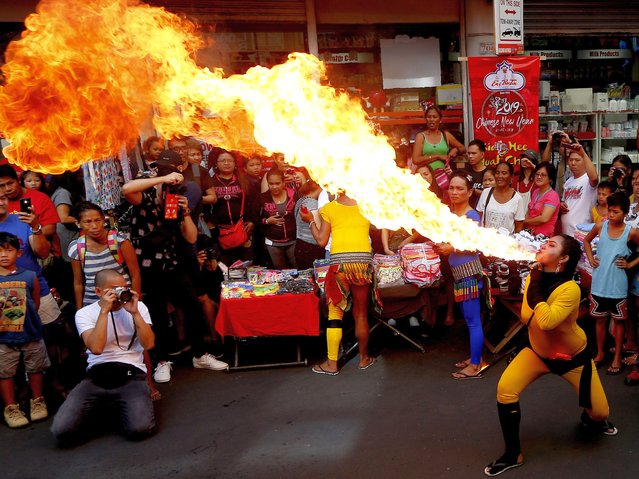
In this Tuesday, February 5, 2019, photo, fire-eater performs during celebrations of the Lunar New Year in the Chinatown district of Manila, Philippines. This year is the Year of the Earth Pig in the Chinese Lunar calendar and is supposed to represent abundance, diligence and generosity. (Photo by Bullit Marquez/AP Photo)

In this Tuesday, February 5, 2019, photo, fire-eater performs during celebrations of the Lunar New Year in the Chinatown district of Manila, Philippines. This year is the Year of the Earth Pig in the Chinese Lunar calendar and is supposed to represent abundance, diligence and generosity. (Photo by Bullit Marquez/AP Photo)
Details
07 Feb 2019 08:22:00
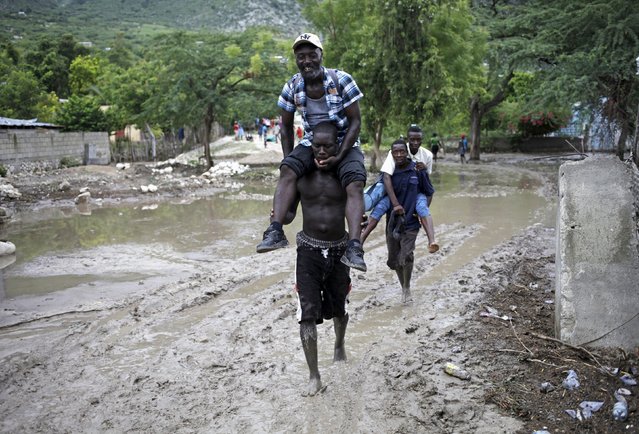
Men carry others, so they do not soil their shoes and clothes, through a mudslide caused by Tropical Storm Erika in Carries, Haiti, August 29, 2015. (Photo by Andres Martinez Casares/Reuters)

Men carry others, so they do not soil their shoes and clothes, through a mudslide caused by Tropical Storm Erika in Carries, Haiti, August 29, 2015. Erika, a tropical storm that killed 20 people on the Caribbean island of Dominica and at least one person in Haiti, fell apart on Saturday over eastern Cuba, the U.S. National Hurricane Center said. (Photo by Andres Martinez Casares/Reuters)
Details
30 Aug 2015 11:47:00
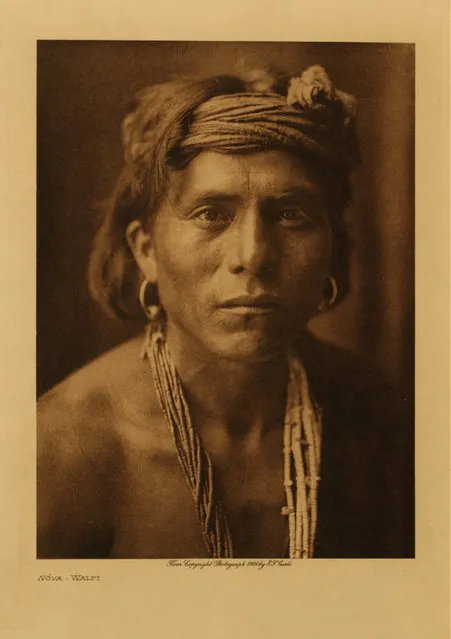
Nova, a Walpi, in 1906. (Photo by Edward S. Curtis)

At the beginning of the 20th century, Edward S. Curtis set out to document what he saw as a disappearing race: the Native American. From 1907 to 1930, Curtis took more than 2,000 photos of 80 tribes stretching from the Great Plains to the Pacific Northwest and Alaska. He then published and sold these photos, along with narrative text, in 20 volumes of work known as “The North American Indian”. It is one of the most significant collections of its kind, “probably the most important photographic document of its age and its topic,” said Jeffrey Garrett, associate university librarian for Special Libraries at Northwestern University. (Photo by Edward S. Curtis)
Details
07 Sep 2014 12:57:00
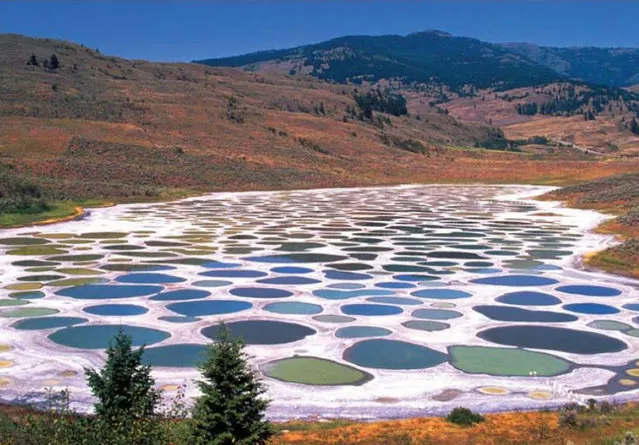
Kliluk, the Spotted Lake, Canada

Originally known to the First Nations of the Okanagan Valley as Khiluk, which was- and remains today revered as a sacred site producing therapeutic waters. During World War I the minerals of Spotted Lake were used in manufacturing ammunition. Later the area came under the control of the Ernest Smith Family, for a term of about 40 years. In 1979 Smith attempted to create interest in a spa at the lake. The First Nations responded with an effort to buy the lake; in October 2001 they finally struck a deal. First Nations arranged the purchase of 22 hectares of land for a total of $720,000, and contributed about 20% of the cost. The Indian Affairs Department paid the remainder.
Details
06 Mar 2015 12:59:00
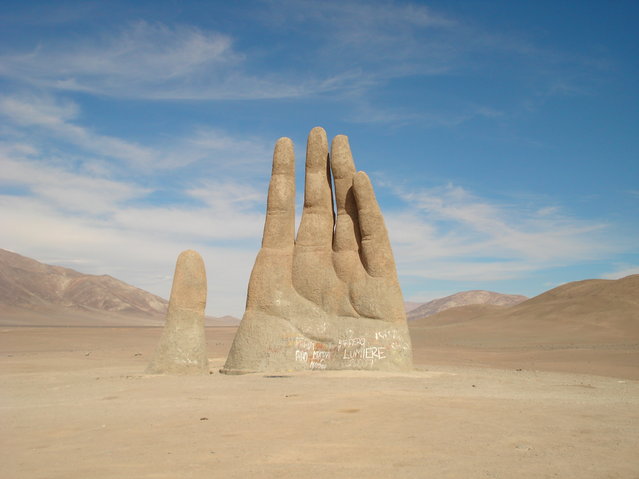
The Giant Hand of Atacama

The Mano de Desierto is a large-scale sculpture of a hand located in the Atacama Desert in Chile, 75 km to the south of the city of Antofagasta, on the Panamerican Highway. The nearest point of reference is the “Ciudad Empresarial La Negra” (La Negra Business City). The sculpture was constructed by the Chilean sculptor Mario Irarrázabal at an altitude of 1,100 meters above sea level. Irarrázabal used the human figure to express emotions like injustice, loneliness, sorrow and torture. Its exaggerated size is said to emphasize human vulnerability and helplessness. The work has a base of iron and cement, and stands 11 metres (36 ft) tall. Funded by Corporación Pro Antofagasta, a local booster organization, the sculpture was inaugurated on March 28, 1992.
Details
21 Dec 2013 10:18:00


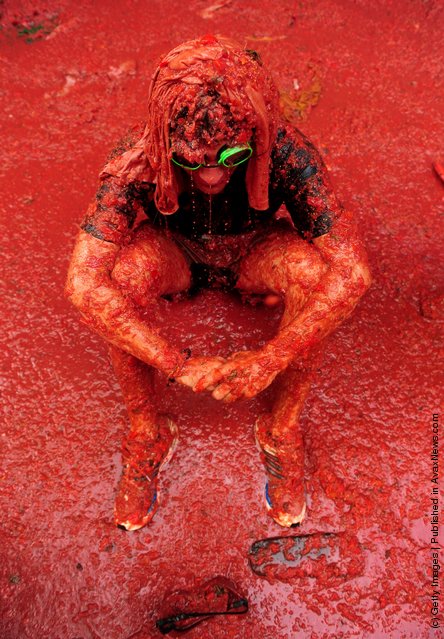
“La Tomatina is a festival that is held in the Valencian town of Buñol, in which participants throw tomatoes at each other”. – Wikipedia

Photo: A man sits in tomato pulp at the end of the world's biggest tomato fight at La Tomatina festival on August 26, 2009 in Bunol, Spain. More than 45000 people from all over the world descended on the small Valencian town to participate La Tomatina festival, with the local town hall estimating that over 100 tons of rotten and over-ripe tomatoes were thrown. (Photo by Jasper Juinen/Getty Images)
Details
24 May 2011 09:27:00
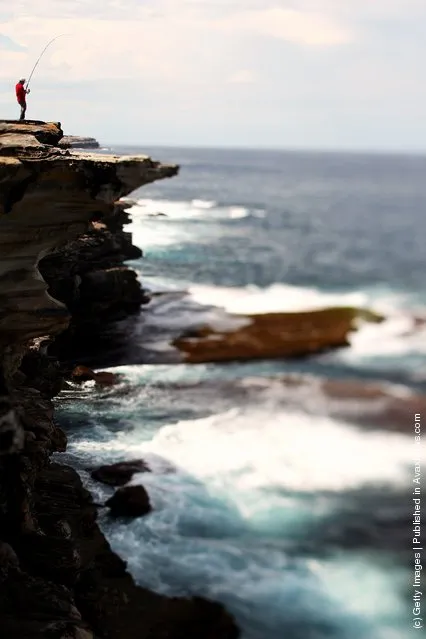
Rock Fishing In Sydney

A fisherman is seen standing on a cliff edge at Cape Bank in La Perouse on February 20, 2011 in Sydney, Australia. The practice of fishing from rock platforms, cliffs and rocky outcrops is notoriously dangerous with many anglers per year being washed into the ocean by dangerous surf or unexpected large waves. Angling is often reported as the sport having the highest mortality rate on average due to fishermen drowning with rocking fishing contributing to a high number of these deaths. (Photo by Mark Kolbe/Getty Images)
Details
16 Aug 2011 11:34:00