Loading...
Done
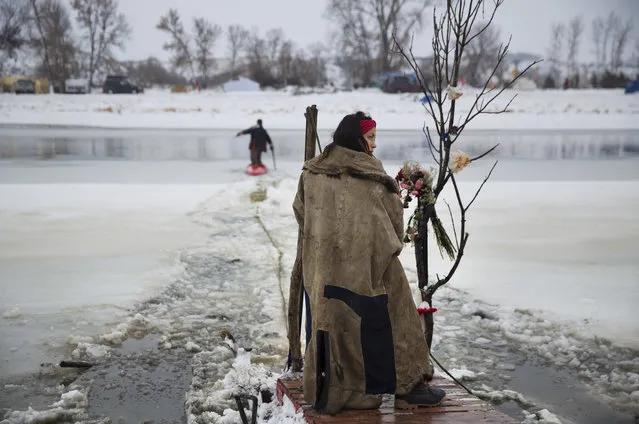
In this Thursday, December 1, 2016 photo, Cat Bigney, part of the Oglala Native American tribe, waits on the shore of the Cannonball river for travelers to arrive by canoe at the Oceti Sakowin camp where people have gathered to protest the Dakota Access oil pipeline in Cannon Ball, N.D. So far, those at the camp have shrugged off the heavy snow, icy winds and frigid temperatures. But if they defy next week's government deadline to abandon the camp, demonstrators know the real deep freeze lies ahead. Life-threatening wind chills and towering snow drifts could mean the greatest challenge is simple survival. (Photo by David Goldman/AP Photo)

In this Thursday, December 1, 2016 photo, Cat Bigney, part of the Oglala Native American tribe, waits on the shore of the Cannonball river for travelers to arrive by canoe at the Oceti Sakowin camp where people have gathered to protest the Dakota Access oil pipeline in Cannon Ball, N.D. So far, those at the camp have shrugged off the heavy snow, icy winds and frigid temperatures. But if they defy next week's government deadline to abandon the camp, demonstrators know the real deep freeze lies ahead. Life-threatening wind chills and towering snow drifts could mean the greatest challenge is simple survival. (Photo by David Goldman/AP Photo)
Details
06 Dec 2016 10:22:00
A Rajasthani folk dance artist performs while standing on two glasses during the “Dhora Ri Mahak” festival in Bhopal, India, 07 January 2015. The event is being organised by the 'Indira Gandhi Rashtriya Manav Sangrahalaya' anthropology museum. (Photo by Sanjeev Gupta/EPA)

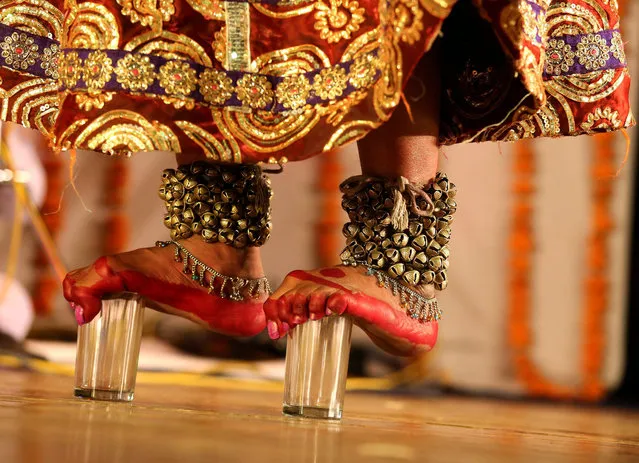
A Rajasthani folk dance artist performs while standing on two glasses during the “Dhora Ri Mahak” festival in Bhopal, India, 07 January 2015. The event is being organised by the “Indira Gandhi Rashtriya Manav Sangrahalaya” anthropology museum. (Photo by Sanjeev Gupta/EPA)
Details
10 Jan 2015 13:51:00
This picture taken on January 25, 2015 shows a participant taking part in an ice water challenge in Zhangjiajie, central China's Hunan province. Participants were required to stay in an ice pond, holding an ice block while eating ice-cream with an electric fan blowing at them. (Photo by AFP Photo/Stringer)

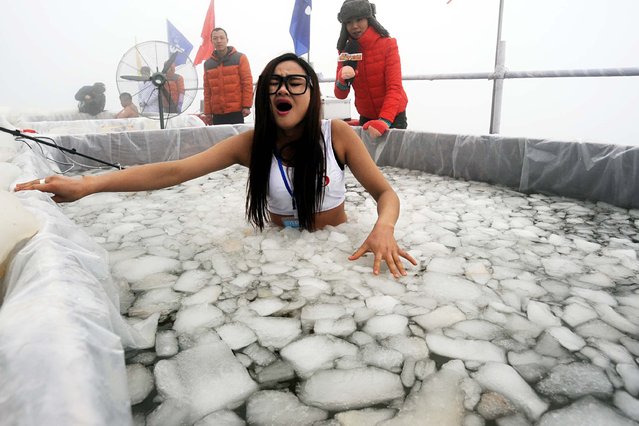
This picture taken on January 25, 2015 shows a participant taking part in an ice water challenge in Zhangjiajie, central China's Hunan province. Participants were required to stay in an ice pond, holding an ice block while eating ice-cream with an electric fan blowing at them. (Photo by AFP Photo/Stringer)
Details
31 Jan 2015 12:58:00
A devotee takes a holy bath at the Balaju Baise Dhara (22 water spouts) during the Baishak Asnan festival in Kathmandu April 4, 2015. Devotees believe that the water from these stone spouts, which is collected from the catchment area of the Nagarjun forest behind the spouts, will cure pains and skin diseases. (Photo by Navesh Chitrakar/Reuters)

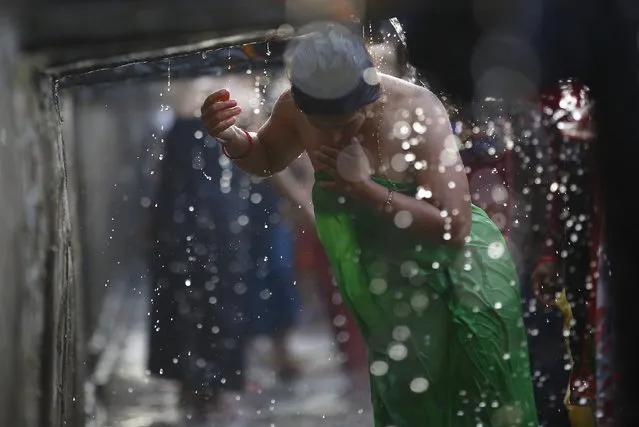
A devotee takes a holy bath at the Balaju Baise Dhara (22 water spouts) during the Baishak Asnan festival in Kathmandu April 4, 2015. Devotees believe that the water from these stone spouts, which is collected from the catchment area of the Nagarjun forest behind the spouts, will cure pains and skin diseases. (Photo by Navesh Chitrakar/Reuters)
Details
04 Apr 2015 10:53:00
Wrestler Kairi Hojo jumps at her opponent  Mieko satomura during their Stardom female professional wrestling show at Korakuen Hall in Tokyo, Japan, July 26, 2015. (Photo by Thomas Peter/Reuters)

Wrestler Kairi Hojo jumps at her opponent Mieko satomura during their Stardom female professional wrestling show at Korakuen Hall in Tokyo, Japan, July 26, 2015. Professional women's wrestling in Japan means body slams, sweat, and garish costumes. But Japanese rules on hierarchy also come into play, with a culture of deference to veteran fighters. The brutal reality of the ring is masked by a strong fantasy element that feeds its popularity with fans, most of them men. (Photo by Thomas Peter/Reuters)
Details
08 Apr 2016 15:18:00
Iraqi Kurdish female fighter Haseba Nauzad looks through a pair of binoculars during a deployment near the frontline of the fight against Islamic State militants in Nawaran near Mosul, Iraq, April 20, 2016. (Photo by Ahmed Jadallah/Reuters)

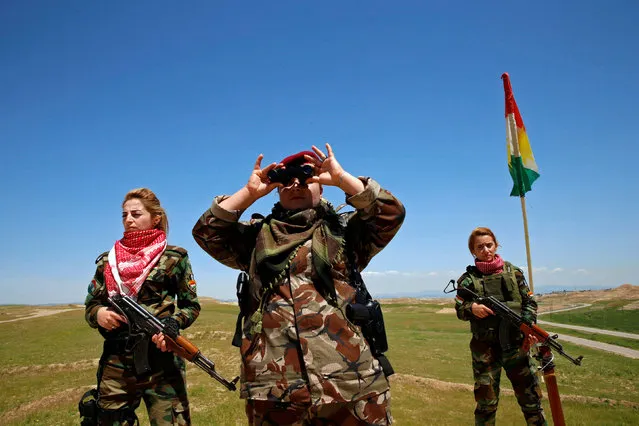
Iraqi Kurdish female fighter Haseba Nauzad looks through a pair of binoculars during a deployment near the frontline of the fight against Islamic State militants in Nawaran near Mosul, Iraq, April 20, 2016. (Photo by Ahmed Jadallah/Reuters)
Details
05 May 2016 14:00:00
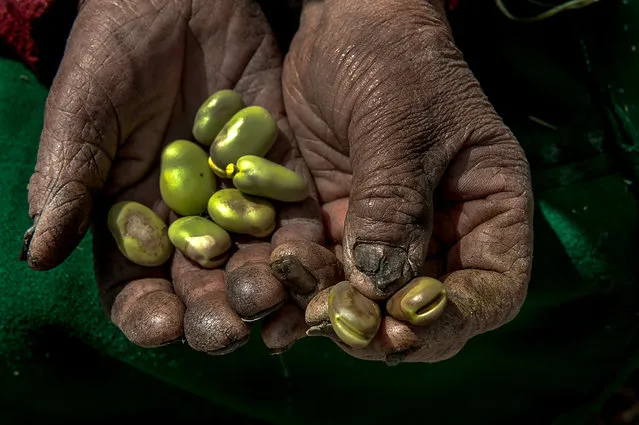
The hard-worked hands of Jacaba Coaquira, 80, holding the green beans she grew on her land. This year the production of her land was affected by lack of rain and early cold weather that froze the crops before they finished growing. Santiago de Okola, Bolivia. (Photo by Renée C. Byer/Living on a Dollar a Day)

The hard-worked hands of Jacaba Coaquira, 80, holding the green beans she grew on her land. This year the production of her land was affected by lack of rain and early cold weather that froze the crops before they finished growing. Santiago de Okola, Bolivia. (Photo by Renée C. Byer/Living on a Dollar a Day)
Details
16 Oct 2014 13:11:00
A stuffed rabbit doll sits among children's beds standing in the abandoned kindergarten of Kopachi village located inside the Chernobyl Exclusion Zone on September 29, 2015 near Chornobyl, Ukraine. Kopachi, a village that before 1986 had a population of 1,114, lies only a few kilometers south of the former Chernobyl nuclear power plant, where in 1986 workers inadvertantly caused reactor number four to explode, creating the worst nuclear accident in history. Radiation fallout was so high that authorities bulldozed and buried all of Kopachi's structures except for the kindergarten. (Photo by Sean Gallup/Getty Images)

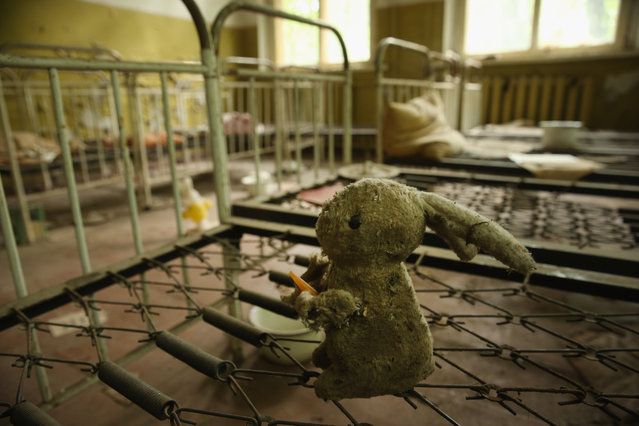
A stuffed rabbit doll sits among children's beds standing in the abandoned kindergarten of Kopachi village located inside the Chernobyl Exclusion Zone on September 29, 2015 near Chornobyl, Ukraine. Kopachi, a village that before 1986 had a population of 1,114, lies only a few kilometers south of the former Chernobyl nuclear power plant, where in 1986 workers inadvertantly caused reactor number four to explode, creating the worst nuclear accident in history. (Photo by Sean Gallup/Getty Images)
Details
27 Apr 2016 09:28:00