Loading...
Done
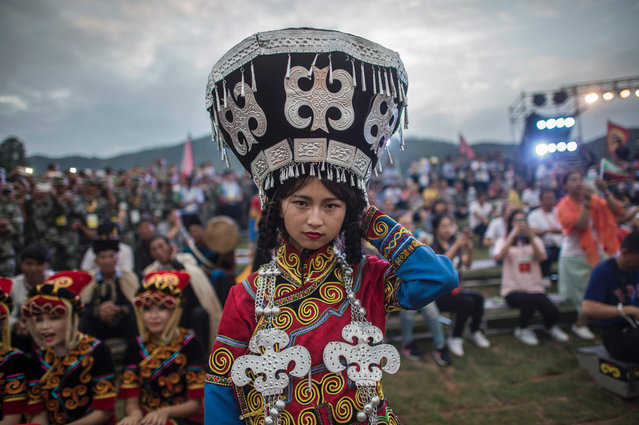
A Dancer, dressed with the traditional Yi costume, waits to perform at the Torch Festival, in Xichang, China's Sichuan province on July 27, 2016. (Photo by Fred Dufour/AFP Photo)

A Dancer, dressed with the traditional Yi costume, waits to perform at the Torch Festival, in Xichang, China's Sichuan province on July 27, 2016. As a result of fast urbanisation in the rural area of China Like Lienchang prefecture, the traditional costume is fading away for the Yi people in daily life. (Photo by Fred Dufour/AFP Photo)
Details
01 Aug 2016 10:04:00
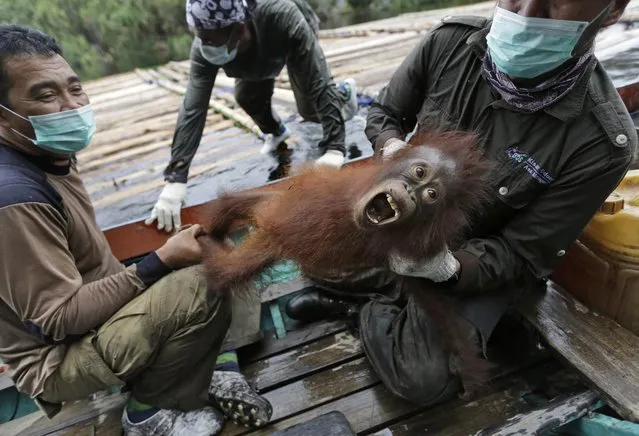
In this January 7, 2016, photo, conservationists of Borneo Orangutan Survival Foundation hold a baby orangutan rescued along with its mother during a rescue and release operation for orangutans trapped in a swath of jungle in Sungai Mangkutub, Central Kalimantan, Indonesia. Last year's forest fires drove orangutans closer to the river bank, where they had to live in an over-populated swath of forest as thin as 30 meters wide along the river. (Photo by Dita Alangkara/AP Photo)

In this January 7, 2016, photo, conservationists of Borneo Orangutan Survival Foundation hold a baby orangutan rescued along with its mother during a rescue and release operation for orangutans trapped in a swath of jungle in Sungai Mangkutub, Central Kalimantan, Indonesia. Last year's forest fires drove orangutans closer to the river bank, where they had to live in an over-populated swath of forest as thin as 30 meters wide along the river. (Photo by Dita Alangkara/AP Photo)
Details
25 Jan 2016 11:36:00
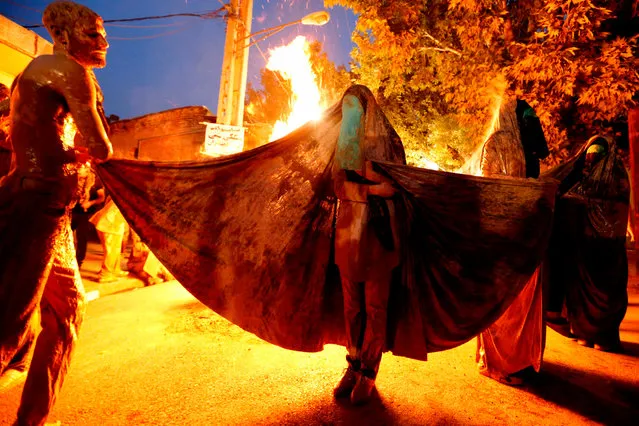
Iranian Shiite Muslim women gather around a bonfire after rubbing mud on their body during the “Kharrah Mali” (Mud Rubbing) ritual to mark the Ashura religious ceremony in the city of Khorramabad, some 470 kms southwest of Tehran, early in the morning on October 1, 2017. “Khrreh Mali” or “Mud Rubbing” is a ritual that is held in the city of Khorramabad every year to commemorate the seventh century slaying of Prophet Mohammed' s grandson Imam Hussein, in which Iranian men roll over in mud and dry themselves by gathering around the bonfires before flagellating themselves. (Photo by Atta Kenare/AFP Photo)

Iranian Shiite Muslim women gather around a bonfire after rubbing mud on their body during the “Kharrah Mali” (Mud Rubbing) ritual to mark the Ashura religious ceremony in the city of Khorramabad, some 470 kms southwest of Tehran, early in the morning on October 1, 2017. “Khrreh Mali” or “Mud Rubbing” is a ritual that is held in the city of Khorramabad every year to commemorate the seventh century slaying of Prophet Mohammed' s grandson Imam Hussein, in which Iranian men roll over in mud and dry themselves by gathering around the bonfires before flagellating themselves. (Photo by Atta Kenare/AFP Photo)
Details
02 Oct 2017 08:38:00
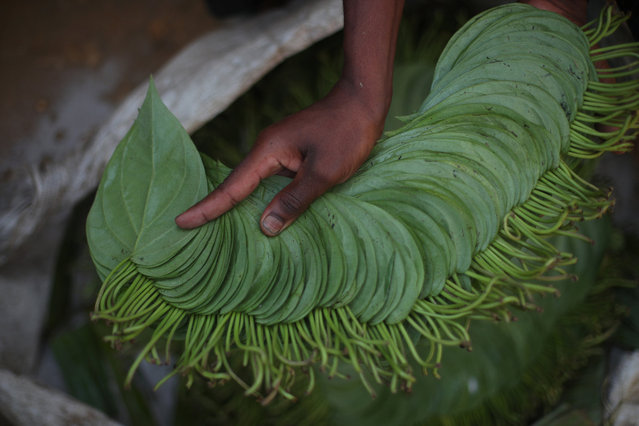
Faruk, 17, a Rohingya refugee trader holds betel leaves which are on sale at a stall in Palong Khali refugee camp near Cox's Bazar, Bangladesh, November 3, 2017. He left his village in Myanmar when the military opened fire towards the Rohingya. “I buy this betel leaf from Palong Khali market, in one bundle there are 160 pieces, I buy it for 80 taka and I sell it for 100 taka. Bangladeshi's and I sell for the same rate in the camp. Outside in the local market it is 80 taka per bundle. My problem is that I don't have money so I can't buy anything to eat, I can't buy fish to eat”, he said. (Photo by Hannah McKay/Reuters)

Faruk, 17, a Rohingya refugee trader holds betel leaves which are on sale at a stall in Palong Khali refugee camp near Cox's Bazar, Bangladesh, November 3, 2017. He left his village in Myanmar when the military opened fire towards the Rohingya. “I buy this betel leaf from Palong Khali market, in one bundle there are 160 pieces, I buy it for 80 taka and I sell it for 100 taka (1 Bangladeshi Taka = 0.012 US Dollar). Bangladeshi's and I sell for the same rate in the camp. Outside in the local market it is 80 taka per bundle. My problem is that I don't have money so I can't buy anything to eat, I can't buy fish to eat”, he said. (Photo by Hannah McKay/Reuters)
Details
27 Nov 2017 08:54:00
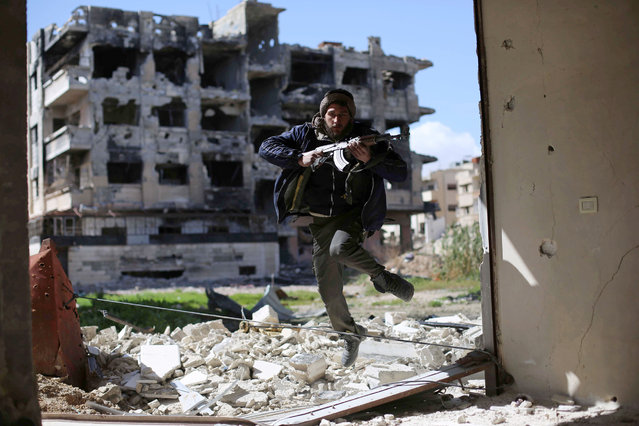
A fighter belonging to Jaish al-Islam (Islam Army) runs to take cover near the frontline on March 14, 2016 in the neighbourhood of Jobar, on the eastern outskirts of the capital Damascus. (Photo by Amer Almohibany/AFP Photo)

A fighter belonging to Jaish al-Islam (Islam Army) runs to take cover near the frontline on March 14, 2016 in the neighbourhood of Jobar, on the eastern outskirts of the capital Damascus. (Photo by Amer Almohibany/AFP Photo)
Details
25 Mar 2016 13:28:00
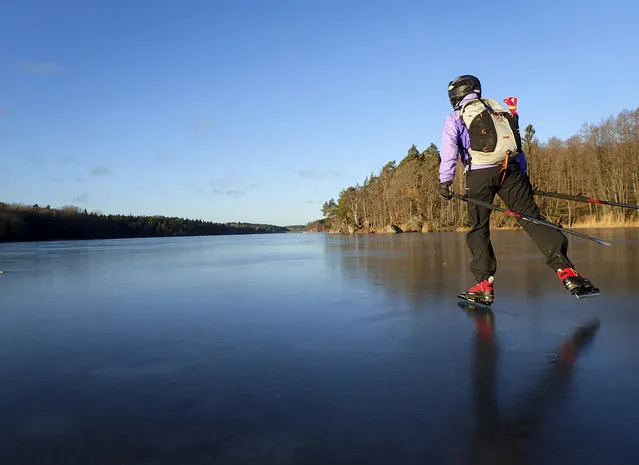
A woman tour skates on the frozen lake of Orlangen, south of Stockholm, Sweden, on December 23, 2016. Tour skating is recreational long distance ice skating on natural ice particularly popular in the Nordic countries. (Photo by Tobias Roestlund/AFP Photo/TT News Agency)

A woman tour skates on the frozen lake of Orlangen, south of Stockholm, Sweden, on December 23, 2016. Tour skating is recreational long distance ice skating on natural ice particularly popular in the Nordic countries. (Photo by Tobias Roestlund/AFP Photo/TT News Agency)
Details
24 Dec 2016 11:40:00
Hostesses pose in front of a Suzuki Ignis car at the European Motor Show in Brussels, Belgium, January 13, 2017. (Photo by Francois Lenoir/Reuters)

Hostesses pose in front of a Suzuki Ignis car at the European Motor Show in Brussels, Belgium, January 13, 2017. (Photo by Francois Lenoir/Reuters)
Details
14 Jan 2017 13:02:00
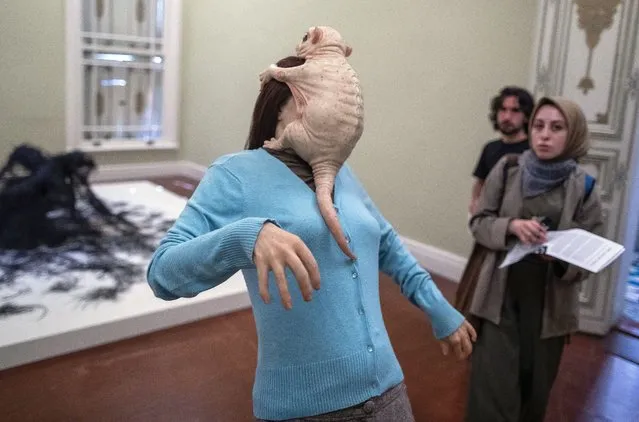
vVisitors view Patricia Piccinini's “The Embrace” artwork during the “You Know Who” exhibition at the Abdulmecit Efendi mansion in Istanbul, Turkey, 27 September 2022. The exhibition, which by the organizers is described as questioning “the representation of the unknown in contemporary art, based on the symbolic world of the supernatural and unknown in the Byzantine period”, is shown from 20 September until 11 December 2022. (Photo by Erdem Sahin/EPA/EFE/Rex Features/Shutterstock)

Visitors view Patricia Piccinini's “The Embrace” artwork during the “You Know Who” exhibition at the Abdulmecit Efendi mansion in Istanbul, Turkey, 27 September 2022. The exhibition, which by the organizers is described as questioning “the representation of the unknown in contemporary art, based on the symbolic world of the supernatural and unknown in the Byzantine period”, is shown from 20 September until 11 December 2022. (Photo by Erdem Sahin/EPA/EFE/Rex Features/Shutterstock)
Details
28 Sep 2022 05:03:00