Loading...
Done
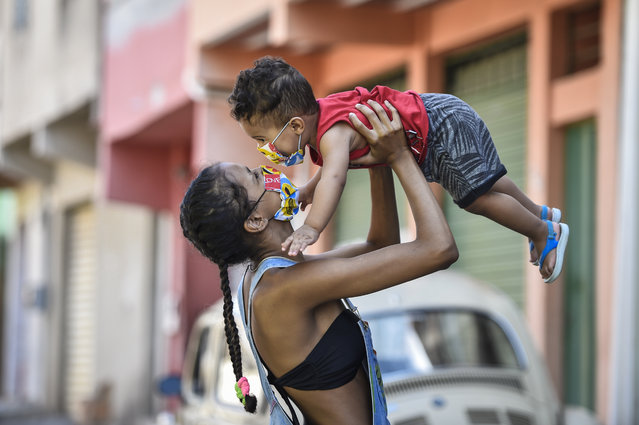
Carolaine Reis and her son Miguel Alves, residents of the Aglomerado da Serra favela, wear a protective mask against the spread of the new Coronavirus (COVID-19) made by the seamstresses of the Remexe Favelinha studio, in the Aglomerado da Serra favela, on April 13, 2020 in Belo Horizonte, Brazil. Facial masks follow the protocol and guidelines defined by the Ministry of Health. Around 6,000 masks have already been produced. The masks are being distributed to a part of the population and sold throughout the country, in the amount of 5 reais per unit. (Photo by Pedro Vilela/Getty Images)

Carolaine Reis and her son Miguel Alves, residents of the Aglomerado da Serra favela, wear a protective mask against the spread of the new Coronavirus (COVID-19) made by the seamstresses of the Remexe Favelinha studio, in the Aglomerado da Serra favela, on April 13, 2020 in Belo Horizonte, Brazil. Facial masks follow the protocol and guidelines defined by the Ministry of Health. Around 6,000 masks have already been produced. The masks are being distributed to a part of the population and sold throughout the country, in the amount of 5 reais per unit. (Photo by Pedro Vilela/Getty Images)
Details
16 Apr 2020 00:03:00
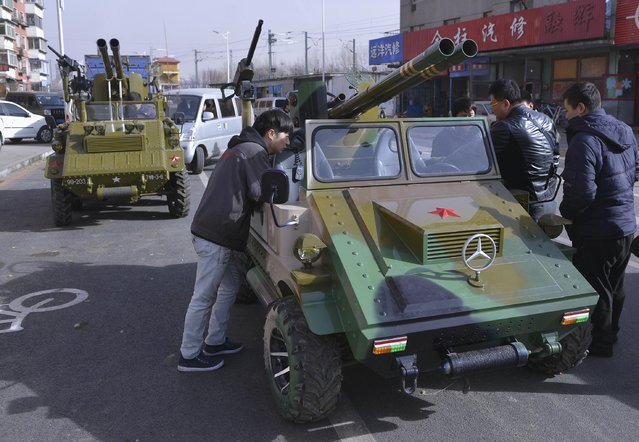
People look at home-made armoured vehicle look-alikes on a street in Shenyang, Liaoning province, November 12, 2014. A man surnamed Zhang and his friends converted two cars into these two vehicles, for his son, and will be displaying them on show at a local park. The cannons on the vehicles can fire paintballs and smoke shells, local media cited Zhang as saying. (Photo by Reuters/Stringer)

People look at home-made armoured vehicle look-alikes on a street in Shenyang, Liaoning province, November 12, 2014. A man surnamed Zhang and his friends converted two cars into these two vehicles, for his son, and will be displaying them on show at a local park. The cannons on the vehicles can fire paintballs and smoke shells, local media cited Zhang as saying. (Photo by Reuters/Stringer)
Details
15 Nov 2014 12:39:00
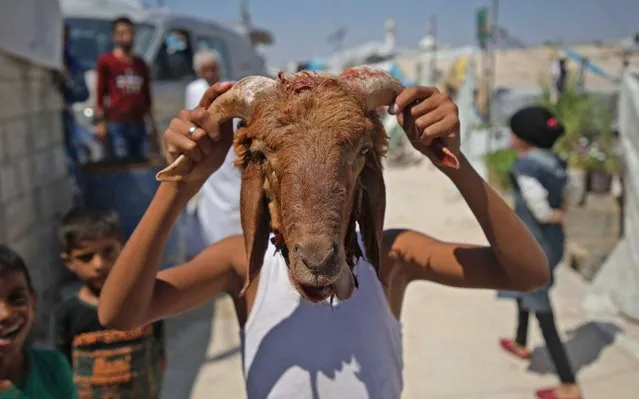
A Syrian boy plays with the head of a sacrificed sheep at a DIP camp for Interally Displaced Persons near the town of Aqrabat in Syria's northern Idlib province on August 12, 2019. Known as the “big” festival, Eid Al-Adha is celebrated each year by Muslims sacrificing various animals according to religious traditions, including cows, camels, goats and sheep. The festival marks the end of the Hajj pilgrimage to Mecca and commemorates Prophet Abraham's readiness to sacrifice his son to show obedience to God. (Photo by Aaref Watad/AFP Photo)

A Syrian boy plays with the head of a sacrificed sheep at a DIP camp for Interally Displaced Persons near the town of Aqrabat in Syria's northern Idlib province on August 12, 2019. Known as the “big” festival, Eid Al-Adha is celebrated each year by Muslims sacrificing various animals according to religious traditions, including cows, camels, goats and sheep. The festival marks the end of the Hajj pilgrimage to Mecca and commemorates Prophet Abraham's readiness to sacrifice his son to show obedience to God. (Photo by Aaref Watad/AFP Photo)
Details
15 Aug 2019 00:05:00
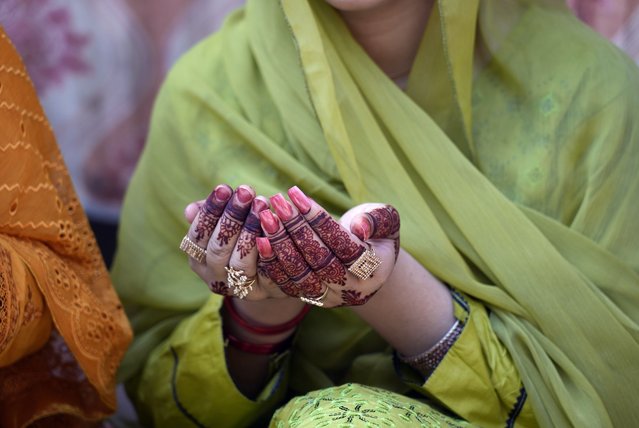
A woman has her hands painted with traditional henna as she attends Eid al-Adha prayers at historical Badshahi mosque in Lahore, Pakistan, Monday, June 17, 2024. Eid al-Adha or Feast of Sacrifice, the most important Islamic holiday, marks the willingness of the Prophet Ibrahim, Abraham to Christians and Jews, to sacrifice his son. During the holiday, which in most places lasts three days, Muslims slaughter goat, sheep or cattle, distribute part of the meat to the poor. (Photo by K.M. Chaudary/AP Photo)

A woman has her hands painted with traditional henna as she attends Eid al-Adha prayers at historical Badshahi mosque in Lahore, Pakistan, Monday, June 17, 2024. Eid al-Adha or Feast of Sacrifice, the most important Islamic holiday, marks the willingness of the Prophet Ibrahim, Abraham to Christians and Jews, to sacrifice his son. During the holiday, which in most places lasts three days, Muslims slaughter goat, sheep or cattle, distribute part of the meat to the poor. (Photo by K.M. Chaudary/AP Photo)
Details
06 Sep 2024 04:02:00
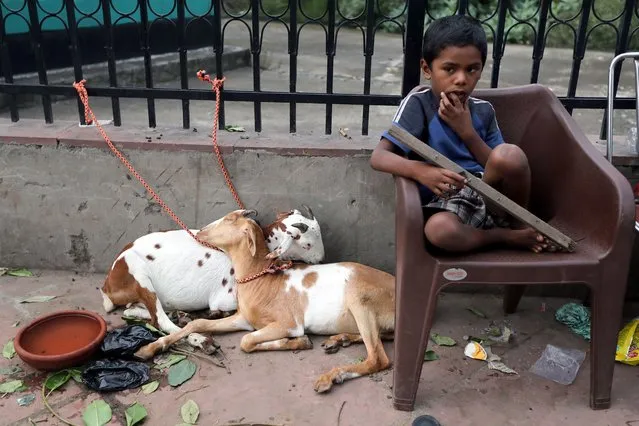
A boy sits next to sacrificial goats resting during Eid al-Adha in New Delhi, India, 29 June 2023. Muslims around the world celebrate Eid al-Adha or feast of sacrifice, by slaughtering sheep, goats and cows to commemorate Prophet Abraham's willingness to sacrifice his son Ismail at God's command. (Photo by Harish Tyagi/EPA)

A boy sits next to sacrificial goats resting during Eid al-Adha in New Delhi, India, 29 June 2023. Muslims around the world celebrate Eid al-Adha or feast of sacrifice, by slaughtering sheep, goats and cows to commemorate Prophet Abraham's willingness to sacrifice his son Ismail at God's command. (Photo by Harish Tyagi/EPA)
Details
07 Jul 2023 02:48:00
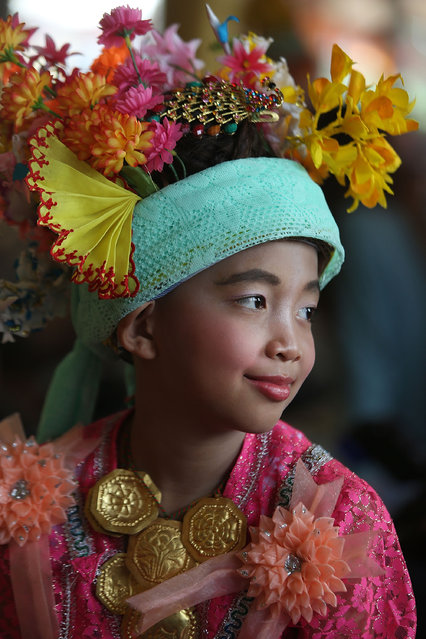
A Tai Yai boy waits for a ceremony to begin at Wat Don Chedi on April 7, 2014 in Mae Hong Son, Thailand. Poy Sang Long is a Buddhist novice ordination ceremony of the Shan people or Tai Yai, an ethnic group of Shan State in Myanmar and northern Thailand. Young boys aged between 7 and 14 are ordained as novices to learn the Buddhist doctrines. It's believed that they will gain merit for their parents by ordaining. (Photo by Taylor Weidman/Getty Images)

A Tai Yai boy waits for a ceremony to begin at Wat Don Chedi on April 7, 2014 in Mae Hong Son, Thailand. Poy Sang Long is a Buddhist novice ordination ceremony of the Shan people or Tai Yai, an ethnic group of Shan State in Myanmar and northern Thailand. Young boys aged between 7 and 14 are ordained as novices to learn the Buddhist doctrines. It's believed that they will gain merit for their parents by ordaining. (Photo by Taylor Weidman/Getty Images)
Details
09 Apr 2014 08:06:00
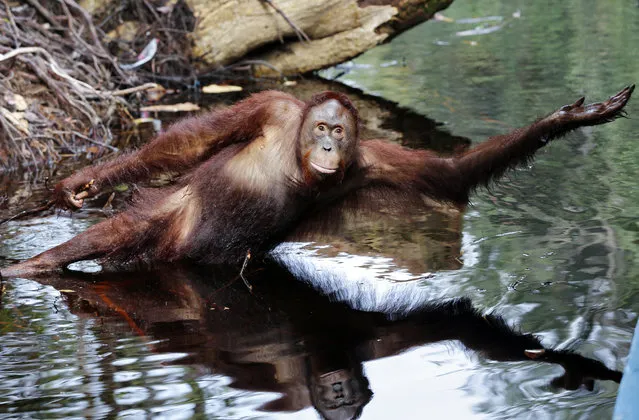
Male orangutan Percy is reflected in the Sekonyer River as he reaches over to try and touch a wooden klotok boat carrying crew and tourists, in Tanjung Puting National Park, in Kalimantan (Indonesian Borneo), Indonesia, September 4, 2013. Percy is a son, born and living in the wild, of a female orangutan named Princess, a freed former captive orangutan that anthropologist Dr Birute Galdikas rescued, rehabilitated and returned to the wild. (Photo by Barbara Walton/EPA)

Male orangutan Percy is reflected in the Sekonyer River as he reaches over to try and touch a wooden klotok boat carrying crew and tourists, in Tanjung Puting National Park, in Kalimantan (Indonesian Borneo), Indonesia, September 4, 2013. Percy is a son, born and living in the wild, of a female orangutan named Princess, a freed former captive orangutan that anthropologist Dr Birute Galdikas rescued, rehabilitated and returned to the wild. (Photo by Barbara Walton/EPA)
Details
03 Jul 2014 12:26:00
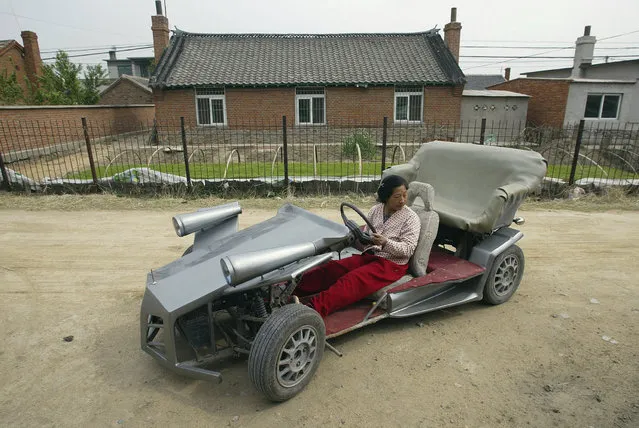
Zhang Jinduo's wife tries on a self-made racing car on the outskirts of Shenyang, Liaoning province May 10, 2008. Zhang, the 53-year-old local farmer made the racing car with the help of his son who is a car mechanic. The car is equipped with a rear-mounted motorcycle engine and can achieve 60-80 km per hour, according to local media. (Photo by Reuters/Stringer)

Zhang Jinduo's wife tries on a self-made racing car on the outskirts of Shenyang, Liaoning province May 10, 2008. Zhang, the 53-year-old local farmer made the racing car with the help of his son who is a car mechanic. The car is equipped with a rear-mounted motorcycle engine and can achieve 60-80 km per hour, according to local media. (Photo by Reuters/Stringer)
Details
17 Sep 2013 08:46:00