Loading...
Done
Wang Zi Won’s Mechanical Buddhas

South Korean artist Wang Zi Won creates enlightened robots, including the Buddha and an idealized mechanical doll based upon himself, as a guidepost for a future in which technology lead to self-actualization.
Humans will evolve and adapt themselves to enhanced science and technology just as men and animals in the past evolved to adapt themselves to their natural circumstances. The artist sees this as our destiny, not as a negative, gloomy dystopia.
Details
22 Mar 2013 12:02:00
Archaeologists repair a pottery statue found in Aohan Banner, North China's Inner Mongolia autonomous region, July 3, 2012. (Photo by Xinhua)

On July 7, Chinese archaeologists from the Academy of Social Sciences announced that they have reconstituted a 5,300-year-old Mongolion pottery statue found at a relic site in North China, according to Xinhua news agency.
Details
08 Mar 2015 12:13:00


A visitor views a human body specimen during the “Human Body's Wonder Scientific Travelling Exhibition” at the Haikou Gymnasium April 30, 2006 in Haikou of Hainan Province, China. The exhibition displays 13 complete real human body specimens and about 300 pieces of small samples, such as organs, skin, etc with the purpose to promote science and help people know more about their bodies. (Photo by China Photos/Getty Images)
Details
18 Jun 2011 10:51:00


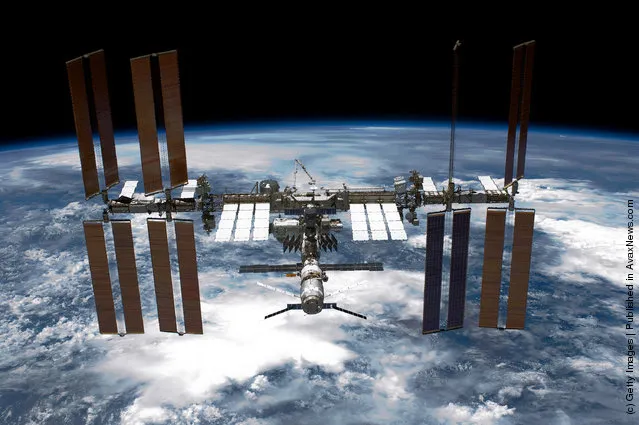
Back dropped by planet Earth the International Space Station (ISS) is seen from NASA space shuttle Endeavour after the station and shuttle began their post-undocking relative separation May 29, 2011 in space. After 20 years, 25 missions and more than 115 million miles in space, NASA space shuttle Endeavour is on the last leg of its final flight to the International Space Station before being retired and donated to the California Science Center in Los Angeles. Capt. Mark E. Kelly, U.S. Rep. Gabrielle Giffords' (D-AZ) husband, has lead mission STS-134 as it delivered the Express Logistics Carrier-3 (ELC-3) and the Alpha Magnetic Spectrometer (AMS-2) to the International Space Station. (Photo by NASA via Getty Images)
Details
01 Jun 2011 06:47:00
U.S. Rep Steve Southerland grins after winning an auctioned possum during the Wausau Possum Festival on Saturday, August 2, 2014, in Wausau, Fla. What is usually a must-attend event for statewide candidates was notably lacking of them this year, perhaps because candidates who now raise tens of millions of dollars focus more on television ads than making personal contact. (Photo by Heather Leiphart/AP Photo/The News Herald)

U.S. Rep Steve Southerland grins after winning an auctioned possum during the Wausau Possum Festival on Saturday, August 2, 2014, in Wausau, Fla. What is usually a must-attend event for statewide candidates was notably lacking of them this year, perhaps because candidates who now raise tens of millions of dollars focus more on television ads than making personal contact. But not attending is a missed opportunity, said Susan MacManus, a University of South Florida political science professor who drove more than 350 miles for the festival. (Photo by Heather Leiphart/AP Photo/The News Herald)
Details
17 Dec 2014 12:12:00
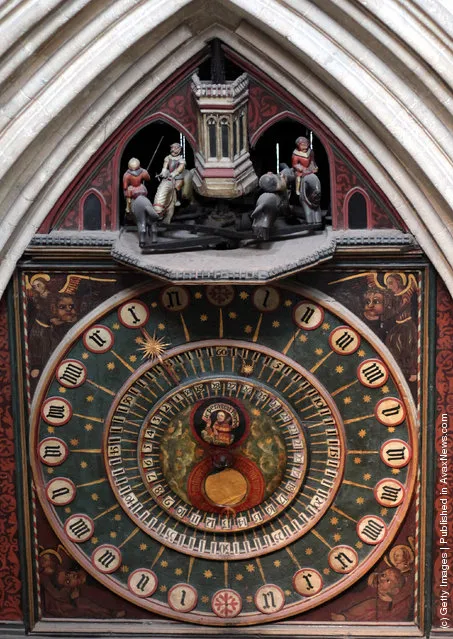
Wells Clock – World's Oldest Mechanical Clock

“Wells Cathedral is a Church of England cathedral in Wells, Somerset, England. Built between 1175 and 1490, Wells Cathedral has been described as “the most poetic of the English Cathedrals”. The Wells clock, an astronomical clock, is located in the north transept. The surviving mechanism, dated to between 1386 and 1392, was replaced in the 19th century, and was eventually moved to the Science Museum in London, where it continues to operate. It is the second-oldest surviving clock in England”. – Wikipedia

Photo: The clock face of world's oldest continually-working mechanical clock is seen as it is hand wound for the very last time on August 21, 2010 in Wells, England. (Photo by Matt Cardy/Getty Images)
Details
10 Aug 2011 11:23:00
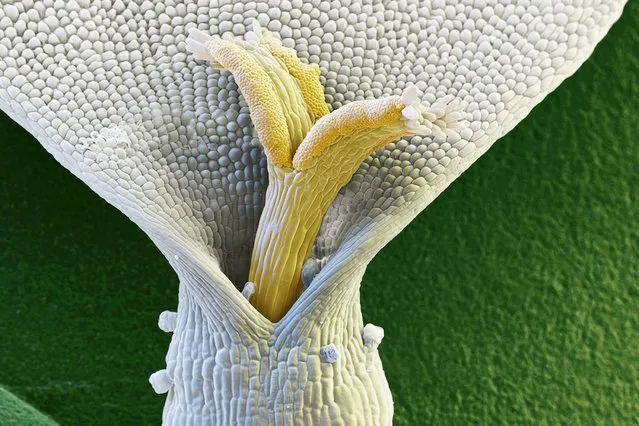
The floret of a Chamomile flower up close and personal. (Photo by Oliver Meckes/Barcroft Media)

These images have been created using a colour scanning electron microscope (SEM) by the award-winning Eye of Science, comprised of snapper Oliver Meckes and biologist Nicole Ottawa. For a decade the pair, based in Reutlingen in the south of Germany, worked with an old SEM they saved from the scrapheap, but for the last five years they have used a £250,000 FEI Quanta Series Field Emission SEM. Oliver said: “Flowers are beautiful in 'normal' view, but when you look closer, some parts get very bizarre and unexpected structures appear – flowers within flowers, worlds within worlds”. Photo: The floret of a Chamomile flower up close and personal. (Photo by Oliver Meckes/Barcroft Media)
Details
26 May 2014 13:51:00
Sea lions wait on the deck of the boat before being released in front of Palomino island, in Callao, Peru September 12, 2015. (Photo by Mariana Bazo/Reuters)

Sea lions wait on the deck of the boat before being released in front of Palomino island, in Callao, Peru September 12, 2015. Four young sea lions returned to the wild after being rescued by marine biologists and treated for various illnesses. The sea lions are survivors of various illnesses which they contracted off the coast of Peru caused by the elevated temperatures in the water because of the El Nino phenomenon, according to Carlos Yaipen, Director of Animal Science and Well-being Organization (ORCA). (Photo by Mariana Bazo/Reuters)
Details
14 Sep 2015 13:37:00