Loading...
Done
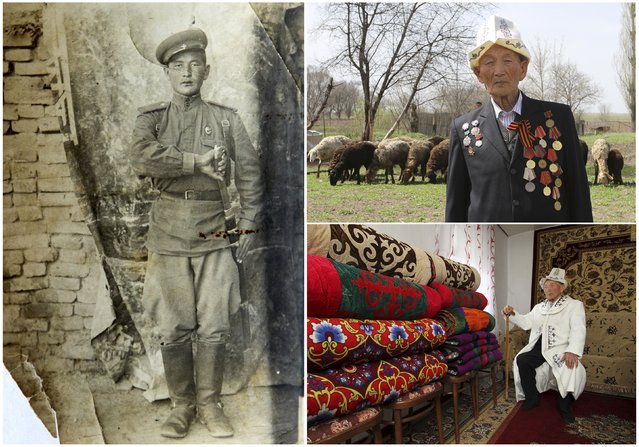
World War Two veteran Abla Begaliyev, 91, is seen in an undated handout picture (L), poses for a picture in Arashan (Top R) and at home in Kyrgyzstan April 14, 2015. Begaliyev served in the border guard cavalry from February 1942 until April 1947. Originally from Kyrgyzstan, he fought on the Ukrainian front and relocated to the border with Afghanistan at the end of World War Two. (Photo by Vladimir Pirogov/Reuters/Family handout (L))

World War Two veteran Abla Begaliyev, 91, is seen in an undated handout picture (L), poses for a picture in Arashan (Top R) and at home in Kyrgyzstan April 14, 2015. Begaliyev served in the border guard cavalry from February 1942 until April 1947. Originally from Kyrgyzstan, he fought on the Ukrainian front and relocated to the border with Afghanistan at the end of World War Two. As the world marks the 70th anniversary of the end of World War Two, Reuters photographers the length and breadth of the former Soviet republics (CCCP) captured portraits of Red Army veterans, mostly now in their 80s and 90s, today and through archive pictures at the time. More than 20 million Soviet citizens were killed in the war. (Photo by Vladimir Pirogov/Reuters/Family handout (L))
Details
08 May 2015 14:22:00
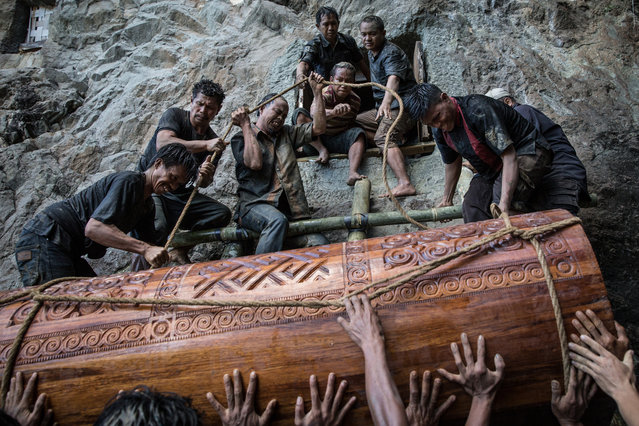
It is said that Torajans are people who “live to die”. For this Indonesian ethnic group, funerals are such extravagant events that they sometimes attract tourists. Families can postpone burials years (and the deceased are considered sick and hosted at home until the funeral) until the family can raise enough money and gather as many relatives as possible. And then it’s a jubilant multiday social event with a parade, dances and animal sacrifices. Agung Parameswara photographed these funerary practices when he traveled to South Sulawesi province, where the Torajans live. But often, their funeral isn’t the last time the dead are seen. In August, crypts are opened, coffins are slid back out and bodies delicately unsheathed. This tender ritual is known as Ma’Nene, which is customarily performed every few years. (Photo by Agung Parameswara/The Washington Post)

It is said that Torajans are people who “live to die”. For this Indonesian ethnic group, funerals are such extravagant events that they sometimes attract tourists. Families can postpone burials years (and the deceased are considered sick and hosted at home until the funeral) until the family can raise enough money and gather as many relatives as possible. And then it’s a jubilant multiday social event with a parade, dances and animal sacrifices. Agung Parameswara photographed these funerary practices when he traveled to South Sulawesi province, where the Torajans live. (Photo by Agung Parameswara/The Washington Post)
Details
06 Oct 2016 09:15:00
Microsoft Announces Surface Tablet

Microsoft has unveiled Surface, a tablet computer to compete with Apple’s iPad.
Details
19 Jun 2012 13:31:00
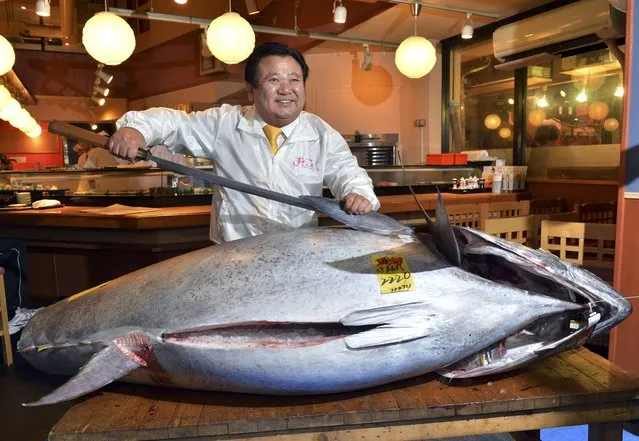
President of sushi restaurant chain Sushi-Zanmai, Kiyoshi Kimura, displays a 222kg bluefin tuna at his main restaurant near Tokyo's Tsukiji fish market on January 5, 2013. The bluefin tuna was traded at 155.4 million yen (1.77 million USD) at the wholesale market, smashing a previous record. (Photo by Yoshikazu Tsuno/AFP Photo)

Japanese businessman Kiyoshi Kimura has paid 1.38 million euros ($1.76 million, or 155.4 million yen) for a blue fin tuna – more than three times the previous high – which he also set one year ago. The 222-kilogram fish will be served to Kimura’s customers. Blue fin tuna is annually sold in a traditional New Year’s auction. Japan consumes 80 percent blue fin tuna caught worldwide.

Photo: President of sushi restaurant chain Sushi-Zanmai, Kiyoshi Kimura, displays a 222kg bluefin tuna at his main restaurant near Tokyo's Tsukiji fish market on January 5, 2013. The bluefin tuna was traded at 155.4 million yen (1.77 million USD) at the wholesale market, smashing a previous record. (Photo by Yoshikazu Tsuno/AFP Photo)
Details
06 Jan 2013 13:26:00
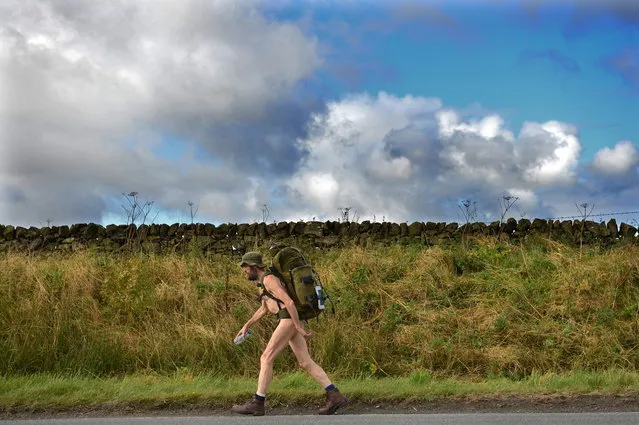
Stephen Gough the naked rambler makes his way south through Peebles in the Scottish Borders, following his release from Saughton Prison yesterday after serving his latest sentence on October 6, 2012 in Peebles, Scotland. The rambler has 18 convictions and has been in prison on and off since 2006 with offences ranging from not wearing clothes in front of the sheriff, breach of the peace and contempt of court. (Photo by Jeff J. Mitchell)

“Stephen Gough (born c. 1959), also known as Steve Gough and the Naked Rambler, is an activist, and a British former Royal Marine. In 2003-2004, he walked the length of Great Britain naked. He did it again in 2005-2006, but was arrested in England and in Scotland. He subsequently spent six years in prison, having been repeatedly rearrested for public nudity within a short period, each time he was released. He has spent most of his sentences in Saughton and Perth prisons, in Scotland”. – Wikipedia

Photo: Stephen Gough the naked rambler makes his way south through Peebles in the Scottish Borders, following his release from Saughton Prison yesterday after serving his latest sentence on October 6, 2012 in Peebles, Scotland. (Photo by Jeff J. Mitchell)
Details
07 Oct 2012 08:18:00
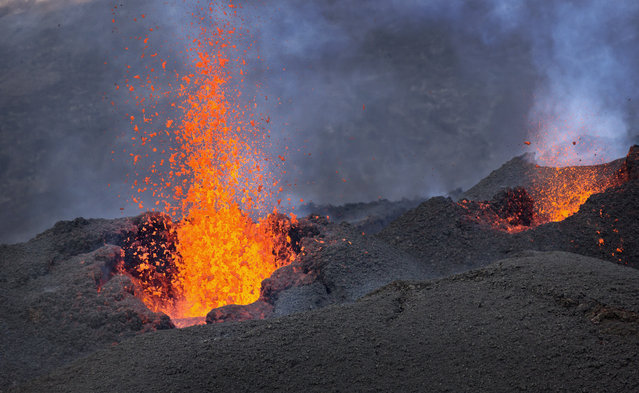
Lava erupts from the Piton de la Fournaise “Peak of the Furnace” volcano, on the southeastern corner of the Indian Ocean island of Reunion Saturday, August 1, 2015. Spewing red-hot lava, one of the most active volcanoes in the world is currently erupting on this Indian Ocean island, where the world's attention has been focused since a wing fragment believed to be from the missing Malaysian jet was discovered washed up on a beach. (Photo by Ben Curtis/AP Photo)

Lava erupts from the Piton de la Fournaise “Peak of the Furnace” volcano, on the southeastern corner of the Indian Ocean island of Reunion Saturday, August 1, 2015. Spewing red-hot lava, one of the most active volcanoes in the world is currently erupting on this Indian Ocean island, where the world's attention has been focused since a wing fragment believed to be from the missing Malaysian jet was discovered washed up on a beach. The lava fountains are shooting as high as 40 meters (44 yards) and are creating cones that are about 20 meters high after only one day of eruption, said Peltier. The volcano is in the Reunion National Park – a world heritage site. The volcano is not seen as dangerous because the lava flows down the east side of the mountain through an uninhabited area called the Grand Brule, or the Big Burned, toward the sea. The last times the volcano threatened the population was in 1977 and 1986. (Photo by Ben Curtis/AP Photo)
Details
03 Aug 2015 12:23:00
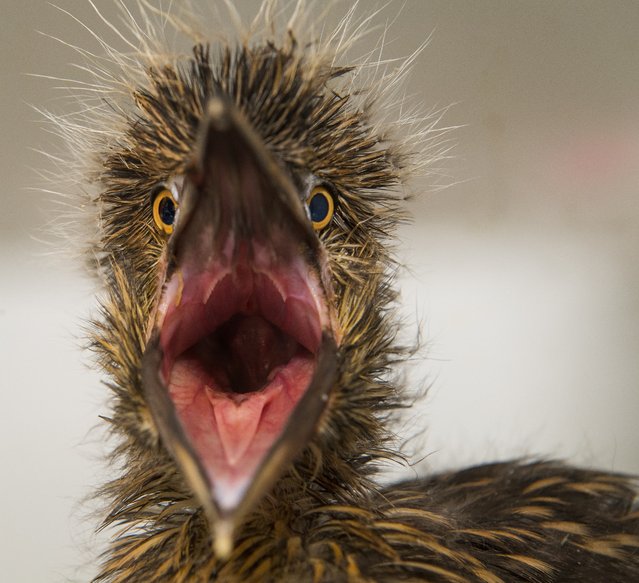
A baby Black-crowned Night Heron squawks in its incubator while being cared for at City Wildlife rescue and rehabilitation center in Washington, DC on May 31, 2017. The heron is one of several that have been brought to CW by the staff at The National Zoo over the past few years. The heron is a native bird and has made an established rookery inside the zoo grounds over a hundred years ago.  Every year at this time, some of the chicks get pushed or fall out of the nest and require human care.  Because the birds are native and not part of the Smithsonian collection, they partnered with CW to rehabilitate the herons for re-release back to the flock inside Zoo. They're reintroduced back to their flock so that they can migrate together in the Fall. The Black-crowned heron usually migrates from the DC area down to southeast North Carolina, some going as far as Jacksonville, FL in winter. The Black-crowned heron is the species of greatest conservation need in the District of Columbia because their numbers are in such rapid decline due to habitat loss. (Photo Linda Davidson/The Washington Post)

A baby Black-crowned Night Heron squawks in its incubator while being cared for at City Wildlife rescue and rehabilitation center in Washington, DC on May 31, 2017. The heron is one of several that have been brought to CW by the staff at The National Zoo over the past few years. (Photo Linda Davidson/The Washington Post)
Details
04 Jun 2017 08:04:00
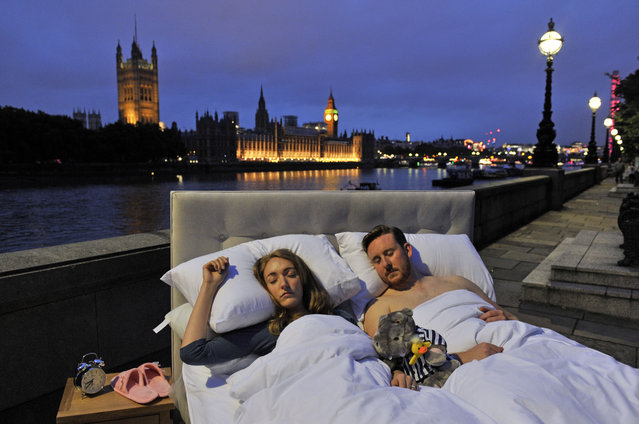
Londoners enjoy a “Silent Night” as Big Ben falls silent, London, UK on August 21, 2017. Londoners snuggle up to enjoy the city's first silent night as Big Ben chimed its last for four years. As the sun set over London last night the city bid a temporary farewell to the chimes of its beloved Big Ben. Londoners were testing out the new quiet of the Southbank in an unusual fashion. A luxurious bed, courtesy of bed firm, Silentnight, complete with fluffy white duvet, plump pillows, a hot water bottle and a cuddly toy, emerged in the heart of the city, just in time for bed. It didn't take local residents and workers long to make the most of the peace and quiet with the city's tired workers climbing in for a nap. Rose Allerston from Clapham, London said “After a stressful day in the office, I couldn't think of anything better than going home and climbing into bed - but when I saw this bed opposite Big Ben I just couldn't resist getting in for a snuggle”. (Photo by Imagewise Ltd/Rex Features/Shutterstock)

Londoners enjoy a “Silent Night” as Big Ben falls silent, London, UK on August 21, 2017. ose Allerston from Clapham, London said “After a stressful day in the office, I couldn't think of anything better than going home and climbing into bed – but when I saw this bed opposite Big Ben I just couldn't resist getting in for a snuggle”. (Photo by Imagewise Ltd/Rex Features/Shutterstock)
Details
23 Aug 2017 08:44:00