Loading...
Done
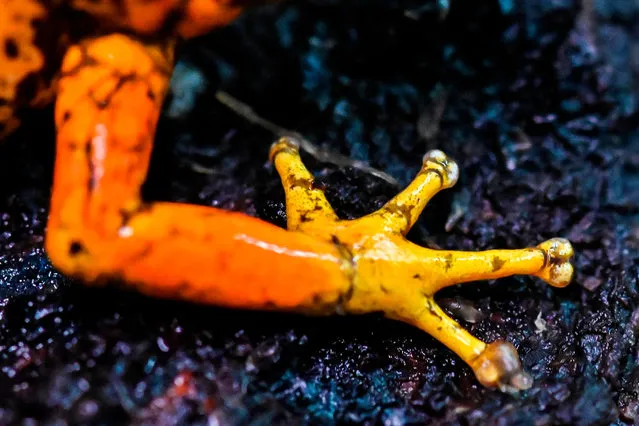
A leg of a “diablito” frog (Oophaga sylvatica) is photographed in a laboratory at a laboratory in the zoo of Cali, Colombia, on July 19, 2019. Colombia is the second country with the largest number of amphibians in the world after Brazil. More than 40% of amphibian species worldwide are in danger of extinction. (Photo by Luis Robayo/AFP Photo)

A leg of a “diablito” frog (Oophaga sylvatica) is photographed in a laboratory at a laboratory in the zoo of Cali, Colombia, on July 19, 2019. Colombia is the second country with the largest number of amphibians in the world after Brazil. More than 40% of amphibian species worldwide are in danger of extinction. (Photo by Luis Robayo/AFP Photo)
Details
28 Nov 2020 00:03:00
A man walks along a corridor at a hotel in Singapore on February 7, 2024. (Photo by Edgar Su/Reuters)

A man walks along a corridor at a hotel in Singapore on February 7, 2024. (Photo by Edgar Su/Reuters)
Details
06 Mar 2024 06:23:00
Beach volleyball athletes from Lithuania and Spain train in Paris on July 25, 2024. (Photo by Louisa Gouliamaki/Reuters)

Beach volleyball athletes from Lithuania and Spain train in Paris on July 25, 2024. (Photo by Louisa Gouliamaki/Reuters)
Details
03 Aug 2024 04:24:00
People watch police destroy confiscated illegal firecrackers in Shenyang, Liaoning province, China, January 29, 2016. (Photo by Reuters/Stringer)

People watch police destroy confiscated illegal firecrackers in Shenyang, Liaoning province, China, January 29, 2016. (Photo by Reuters/Stringer)
Details
31 Jan 2016 09:40:00
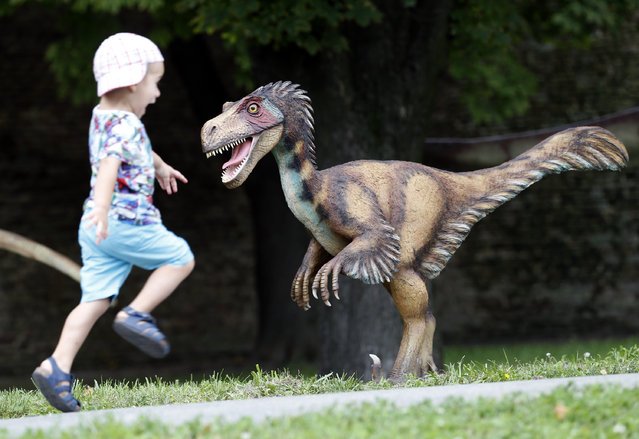
A boy runs past one of the exhibits during the Dinosaurs exhibition in Belgrade, Serbia, Thursday, August 21, 2014. “Dino Park” has opened at Belgrade's Kalemegdan Fortress. (Photo by Darko Vojinovic/AP Photo)

A boy runs past one of the exhibits during the Dinosaurs exhibition in Belgrade, Serbia, Thursday, August 21, 2014. “Dino Park” has opened at Belgrade's Kalemegdan Fortress. (Photo by Darko Vojinovic/AP Photo)
Details
23 Aug 2014 11:56:00
People in costume take photos during a Halloween event on October 31, 2015 in Lan Kwai Fong, Central District, Hong Kong. Halloween, a named taken from 'All Hallows' Even' falls on the day before All Saints' Day on November 1, a holiday when Christians remember their deceased loved ones. (Photo by Jerome Favre/Getty Images)

People in costume take photos during a Halloween event on October 31, 2015 in Lan Kwai Fong, Central District, Hong Kong. Halloween, a named taken from 'All Hallows' Even' falls on the day before All Saints' Day on November 1, a holiday when Christians remember their deceased loved ones. (Photo by Jerome Favre/Getty Images)
Details
17 Nov 2015 08:06:00
Angel Taylor Hill attends Angel Taylor Hill introduces the new Tease Dreamer Fragrance Collection at Victoria's Secret on March 12, 2019 in Los Angeles, California. (Photo by Neilson Barnard/Getty Images for Victoria's Secret)

Angel Taylor Hill attends Angel Taylor Hill introduces the new Tease Dreamer Fragrance Collection at Victoria's Secret on March 12, 2019 in Los Angeles, California. (Photo by Neilson Barnard/Getty Images for Victoria's Secret)
Details
17 Mar 2019 00:01:00
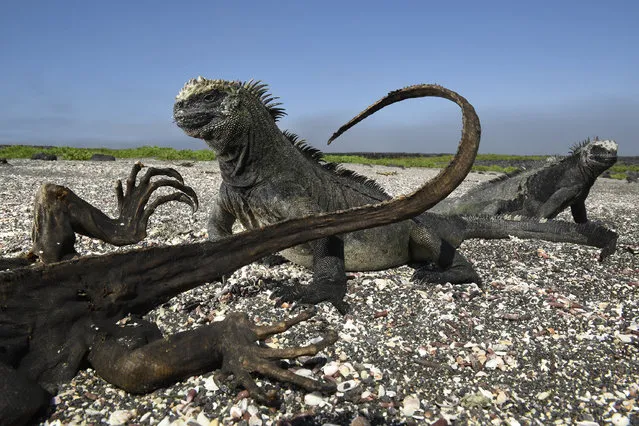
Galapagos – Rocking the Cradle: Four major ocean currents converge along the Galapagos archipelago, creating the conditions for an extraordinary diversity of animal life, April 25, 2016. The islands are home to at least 7,000 flora and fauna species, of which 97 percent of the reptiles, 80 percent of the land birds, 50 percent of the insects and 30 percent of the plants are endemic. The local ecosystem is highly sensitive to the changes in temperature, rainfall and ocean currents that characterize the climatic events known as El Niño and La Niña. These changes cause marked fluctuations in weather and food availability. Many scientists expect the frequency of El Niño and La Niña to increase as a result of climate change, making the Galapagos a possible early-warning location for its effects. (Photo by Thomas P. Peschak for National Geographic/World Press Photo)

Galapagos – Rocking the Cradle: Four major ocean currents converge along the Galapagos archipelago, creating the conditions for an extraordinary diversity of animal life, April 25, 2016. The islands are home to at least 7,000 flora and fauna species, of which 97 percent of the reptiles, 80 percent of the land birds, 50 percent of the insects and 30 percent of the plants are endemic. (Photo by Thomas P. Peschak for National Geographic/World Press Photo)
Details
16 Apr 2018 00:01:00