Loading...
Done
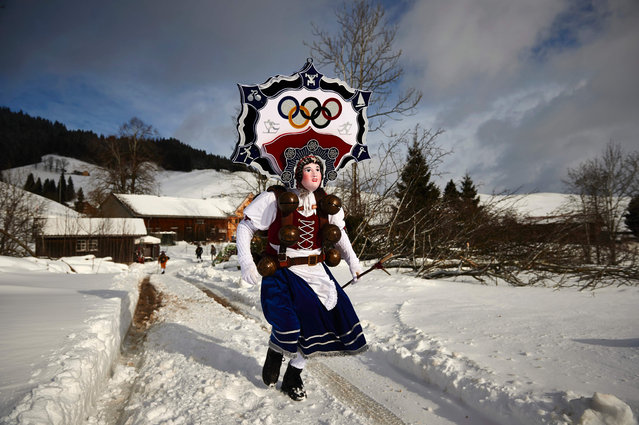
A leader “Rolli” of a yodel group “Schuppel” runs in the snow in front of a farmstead during the “Silvesterchlausen” in the early morning in Urnaesch in the Swiss canton Appenzell Ausserroden on January 13, 2017. The “Silvesterchlausen” is a tradition of the Swiss canton Appenzell, where colorfull characters organized in groups called “Schuppel”, chase out the old year and welcome the new one. They run all day long from farmstead to farmstead, gather together to sing a jodel and great the farmers. A “Schuppel” consists of some “Schelli” and two “Rolli”, sometimes with female dresses and nice scenes over the head, despite the dress all participants are males. The Silversterchlausen run twice a year, first for the new Silvester on December 31, and then again on January 13, for the old Silvester following the Julian calendar. (Photo by Michael Buholzer/AFP Photo)

A leader “Rolli” of a yodel group “Schuppel” runs in the snow in front of a farmstead during the “Silvesterchlausen” in the early morning in Urnaesch in the Swiss canton Appenzell Ausserroden on January 13, 2017. (Photo by Michael Buholzer/AFP Photo)
Details
14 Jan 2017 12:41:00
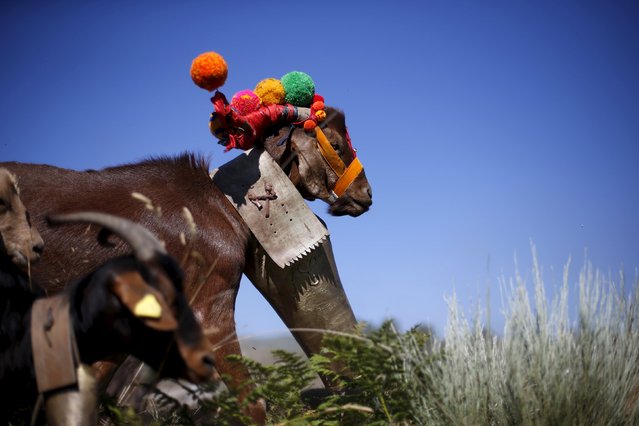
Sheep walk as they are herded to summer pastures in Serra da Estrela, near Seia, Portugal June 27, 2015. (Photo by Rafael Marchante/Reuters)

Sheep walk as they are herded to summer pastures in Serra da Estrela, near Seia, Portugal June 27, 2015. In late June, shepherds young and old in the Seia region of central Portugal start guiding sheep, goats and cattle to the Serra da Estrela, the country’s highest mountains, in search of better pastures. There they stay until the end of September. Modern-day shepherds may have mobile phones to keep in touch with family and friends, but their lifestyle has changed little for centuries. The sound of cowbells and the bark of longhaired mastiffs starts early in the morning as the animals – often decorated with traditional woollen balls on their horns – are herded up steep, narrow paths. (Photo by Rafael Marchante/Reuters)
Details
14 Jul 2015 13:48:00
A model of the New Horizons spacecraft is seen at a live television program on NASA television celebrating the spacecraft's closest proximity to Pluto, at Johns Hopkins University Applied Physics Laboratory, site of the mission operations center, in Laurel, Maryland, USA, 14 July 2015. (Photo by Michael Reynolds/EPA)

A model of the New Horizons spacecraft is seen at a live television program on NASA television celebrating the spacecraft's closest proximity to Pluto, at Johns Hopkins University Applied Physics Laboratory, site of the mission operations center, in Laurel, Maryland, USA, 14 July 2015. At approximately 7:49 am ET (11:49 am GMT), 14 July, New Horizons was scheduled to be as close to Pluto as the spacecraft will get; about 7,800 miles (12,500 kilometers) above the surface, following a journey of more than nine years and three billion miles. This is the first mission to the Pluto System and the Kuiper Belt. (Photo by Michael Reynolds/EPA)

Details
15 Jul 2015 10:08:00
Clowns and entertainers gather to attend an annual service of remembrance in honour of British clown Joseph Grimaldi at All Saints Church in Haggerston in London, Britain, February 5, 2017. (Photo by Toby Melville/Reuters)

Clowns and entertainers gather to attend an annual service of remembrance in honour of British clown Joseph Grimaldi at All Saints Church in Haggerston in London, Britain, February 5, 2017. (Photo by Toby Melville/Reuters)
Details
07 Feb 2017 00:03:00
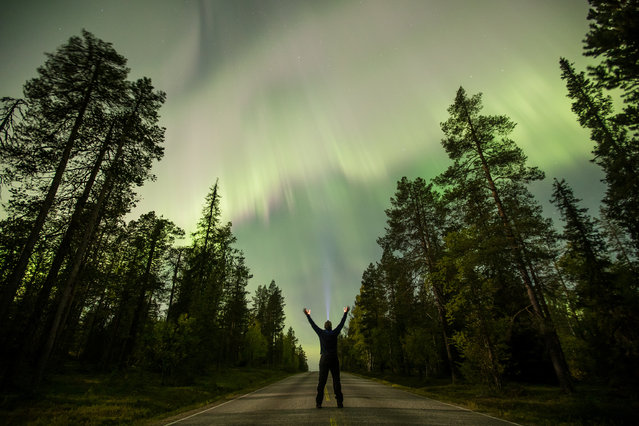
The Aurora Borealis (Northern Lights) lights up the sky near the village of Pallas (Muonio region) of Lapland, Finland September 8, 2017. (Photo by Alexander Kuznetsov/Reuters/All About Lapland)

The Aurora Borealis (Northern Lights) lights up the sky near the village of Pallas (Muonio region) of Lapland, Finland September 8, 2017. (Photo by Alexander Kuznetsov/Reuters/All About Lapland)
Details
04 Jan 2018 08:13:00
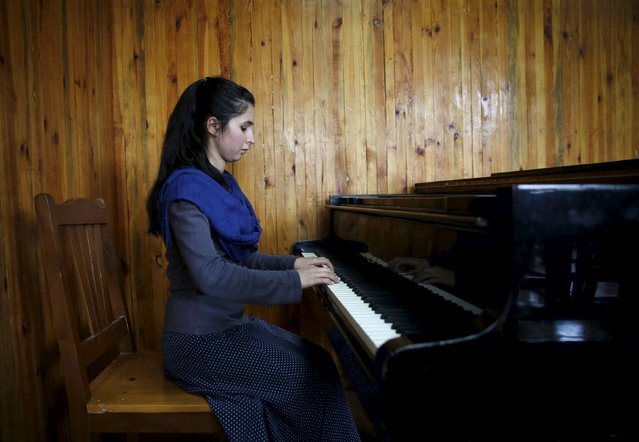
Negin Ekhpulwak, leader of the Zohra orchestra, an ensemble of 35 women, practises on a piano at Afghanistan's National Institute of Music, in Kabul, Afghanistan April 9, 2016. (Photo by Ahmad Masood/Reuters)

Negin Ekhpulwak, leader of the Zohra orchestra, an ensemble of 35 women, practises on a piano at Afghanistan's National Institute of Music, in Kabul, Afghanistan April 9, 2016. Playing instruments was banned under Taliban rule in Afghanistan, and even today, many conservative Muslims frown on most forms of music. Living in an orphanage in the capital, Kabul, 19-year-old Negin Ikhpolwak leads an ensemble of 35 women that plays both Western and Afghan musical instruments. In a country notorious internationally for harsh restrictions on women in most areas of life, Negin's story highlights a double challenge. (Photo by Ahmad Masood/Reuters)
Details
19 Apr 2016 13:47:00
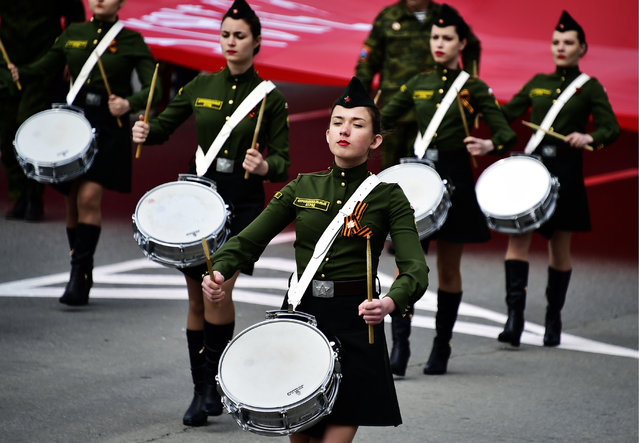
A military band playing during the Immortal Regiment march in Vladivostok, Russia on May 9, 2016. (Photo by Yuri Smityuk/TASS/Getty Images)

A military band playing during the Immortal Regiment march in Vladivostok, Russia on May 9, 2016. The celebrations marked the 71st anniversary of the defeat of Germany in WWII. (Photo by Yuri Smityuk/TASS/Getty Images)
Details
10 May 2016 12:32:00
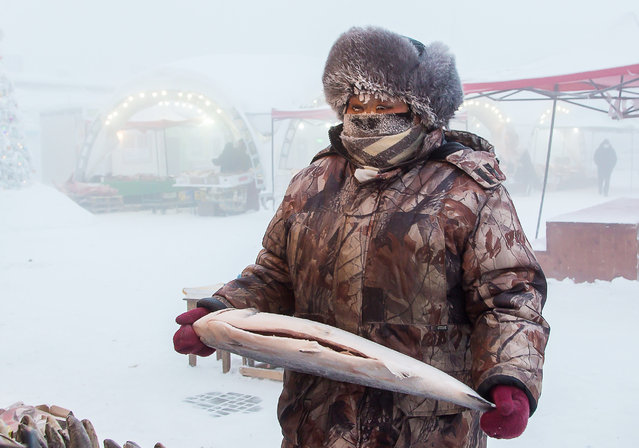
A vendor sells fish at Central Market in freezing conditions of minus 43 degrees Celsius in the city of Yakutsk, Sakha (Yakutia), Russia on December 13, 2020. The winters in Yakutsk are extremely cold and long and the summers short and warm, with temperatures sometimes rising above 30C. (Photo by Yevgeny Sofroneyev/TASS)

A vendor sells fish at Central Market in freezing conditions of minus 43 degrees Celsius in the city of Yakutsk, Sakha (Yakutia), Russia on December 13, 2020. The winters in Yakutsk are extremely cold and long and the summers short and warm, with temperatures sometimes rising above 30C. (Photo by Yevgeny Sofroneyev/TASS)
Details
30 Dec 2020 00:01:00