An Iraqi army cadet participates in “the leap of faith”, from a bridge as part of their training, in Baghdad, Iraq on December 15, 2023. (Photo by Ahmed Saad/Reuters)
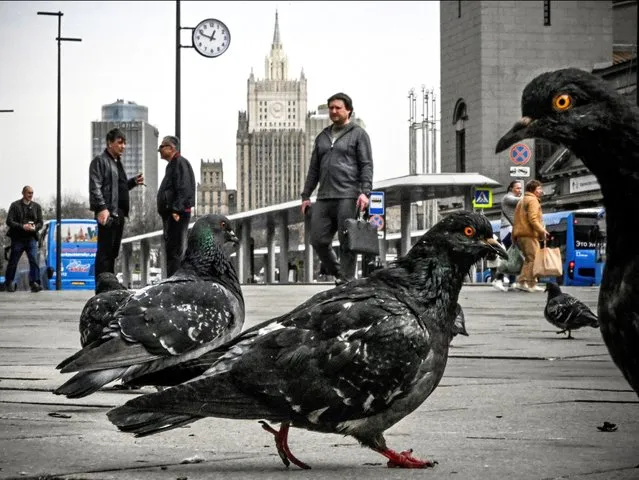
Pigeons walk in front of the Russian Foreign Ministry building (C) in Moscow on April 8, 2024. Russian Foreign Minister Sergei Lavrov will visit Moscow's key diplomatic and economic partner China on April 8-9, his Ministry said in a statement. (Photo by Alexander Nemenov/AFP Photo)
People in costume as a Minecraft bee (left) and Crying Child from Fright Night at Freddy's 4 (right) at the Sheffield Anime & Gaming Con at the Mercure Sheffield in London on Sunday, September 17, 2023. (Photo by Danny Lawson/PA Images via Getty Images)
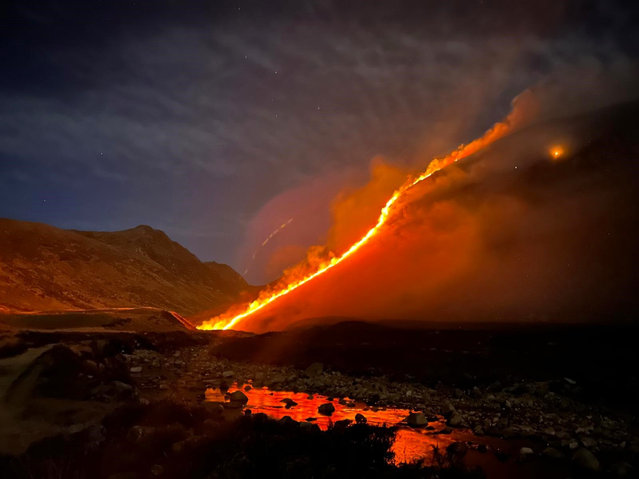
A wildfire on the Scottish island in the first decade of April 2025. Fire services are calling on people to act responsibly after an “extreme” wildfire warning was issued for the whole of Scotland. (Photo by Police Scotland/PA Wire)
An elephant tries to eat leaves during a religious procession called Jal Yatra, ahead of the annual Rath Yatra, or chariot procession of Hindu god Lord Jagannath, in Ahmedabad, India, Wednesday, June 11, 2025. (Photo by Ajit Solanki/AP Photo)
People dressed as zombies participate in a parade for World Zombie Day 2016 in London's West End, Britain on October 9, 2016. (Photo by Splash News and Pictures)
This Thursday, January 22, 2015 photo made with a long exposure shows the glow from a Noctiluca scintillans algal bloom along the seashore in Hong Kong. The luminescence, also called Sea Sparkle, is triggered by farm pollution that can be devastating to marine life and local fisheries, according to University of Georgia oceanographer Samantha Joye. Noctiluca itself does not produce neurotoxins like other similar organisms do. But its role as both prey and predator tends can eventually magnify the accumulation of toxins in the food chain, according to R. Eugene Turner at Louisiana State University. (Photo by Kin Cheung/AP Photo)