Loading...
Done
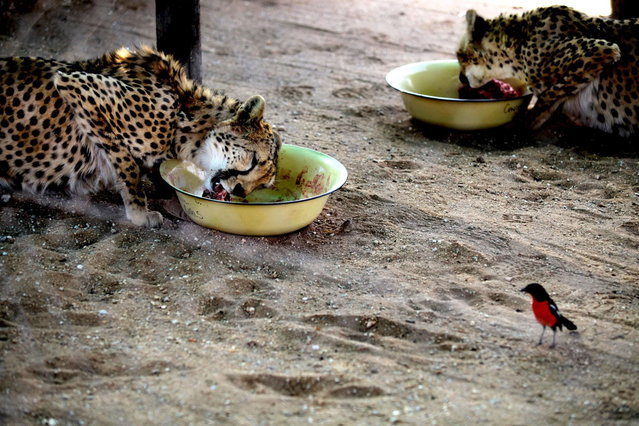
Young cheetahs eat meat at The Cheetah Conservation Fund (CCF) center in Otjiwarongo, Namibia, on August 13, 2013. The CCF started breeding Anatolian livestock dogs to promote cheetah-friendly farming after some 10,000 big cats – the current total worldwide population – were killed or moved off farms in the 1980s.  Up to 1,000 cheetahs were being killed a year, mostly by farmers who saw them as livestock killers. But the use of dogs has slashed losses for sheep and goat farmers and led to less retaliation against the vulnerable cheetah. (Photo by Jennifer Bruce/AFP Photo)

Young cheetahs eat meat at The Cheetah Conservation Fund (CCF) center in Otjiwarongo, Namibia, on August 13, 2013. The CCF started breeding Anatolian livestock dogs to promote cheetah-friendly farming after some 10,000 big cats – the current total worldwide population – were killed or moved off farms in the 1980s. Up to 1,000 cheetahs were being killed a year, mostly by farmers who saw them as livestock killers. But the use of dogs has slashed losses for sheep and goat farmers and led to less retaliation against the vulnerable cheetah. (Photo by Jennifer Bruce/AFP Photo)
Details
29 Aug 2013 10:56:00
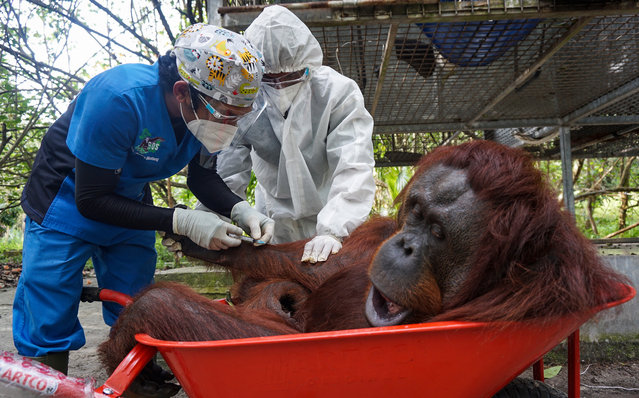
A handout photo made available by Borneo Orangutan Survival Foundation (BOSF) shows veterinarian wearing protective masks and suit, conducting anesthesia procedure on Nenuah, a nine year old Bornean Orangutan before being transported and released to the Bukit Batikap protection forest, at the Nyaru Menteng Orangutan Rehabilitation Center in Palangkaraya, Central Kalimantan, Indonesia, 15 February 2021. BOSF and the national nature conservation agency (BKSDA) released 10 orangutans back to the wild in Bukit Batikap Protection Forest in Central Kalimantan and the Kehje Sewen Forest in East Kalimantan amid the pandemic according to BOSF. (Photo by BOSF Handout/EPA/EFE)

A handout photo made available by Borneo Orangutan Survival Foundation (BOSF) shows veterinarian wearing protective masks and suit, conducting anesthesia procedure on Nenuah, a nine year old Bornean Orangutan before being transported and released to the Bukit Batikap protection forest, at the Nyaru Menteng Orangutan Rehabilitation Center in Palangkaraya, Central Kalimantan, Indonesia, 15 February 2021. BOSF and the national nature conservation agency (BKSDA) released 10 orangutans back to the wild in Bukit Batikap Protection Forest in Central Kalimantan and the Kehje Sewen Forest in East Kalimantan amid the pandemic according to BOSF. (Photo by BOSF Handout/EPA/EFE)
Details
07 Mar 2021 09:54:00
The main church in the town of San Damian Texoloc, Mexico stands in front of the Popocatepetl volcano as is spews ash and vapor early Tuesday, July 9, 2013. Last Saturday, Mexico's National Center for Disaster Prevention raised the volcano alert from Stage 2 Yellow to Stage 3 Yellow, the final step before a Red alert, when possible evacuations could be ordered after the Popocatepetl volcano spit out a cloud of ash and vapor 2 miles (3 kilometers) high over several days of eruptions. (Photo by J. Guadalupe Perez/AP Photo)

The main church in the town of San Damian Texoloc, Mexico stands in front of the Popocatepetl volcano as is spews ash and vapor early Tuesday, July 9, 2013. Last Saturday, Mexico's National Center for Disaster Prevention raised the volcano alert from Stage 2 Yellow to Stage 3 Yellow, the final step before a Red alert, when possible evacuations could be ordered after the Popocatepetl volcano spit out a cloud of ash and vapor 2 miles (3 kilometers) high over several days of eruptions. (Photo by J. Guadalupe Perez/AP Photo)
Details
10 Jul 2013 08:45:00
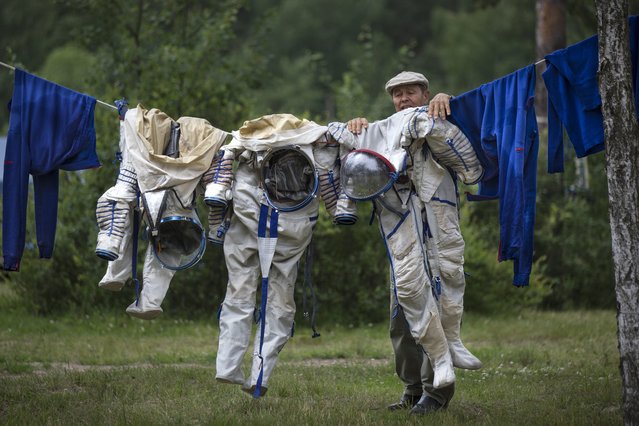
An employe of Russian Space Training Center hangs out to dry space suits of Russian cosmonaut Anatoly Ivanishin, NASA's U.S. flight engineer Kathleen Rubins, and Japanese space agency's flight engineer Takuya Onishi, right, after their undergoing  training near in Noginsk, 60 km (38 miles) east of Moscow, Russia, Wednesday, July 2, 2014. (Photo by Alexander Zemlianichenko/AP Photo)

An employe of Russian Space Training Center hangs out to dry space suits of Russian cosmonaut Anatoly Ivanishin, NASA's U.S. flight engineer Kathleen Rubins, and Japanese space agency's flight engineer Takuya Onishi, right, after their undergoing training near in Noginsk, 60 km (38 miles) east of Moscow, Russia, Wednesday, July 2, 2014. The training was intended to simulate the capsule landing on water. Russian cosmonaut Anatoly Ivanishin, Japanese space agency's flight engineer Takuya Onishi, and NASA's U.S. flight engineer Kathleen Rubins are being trained for a future mission to the International Space Station. (Photo by Alexander Zemlianichenko/AP Photo)
Details
05 Jul 2014 11:47:00
This photo provided April 14, 2023, by the North Korean government, shows North Korean leader Kim Jong Un, center, inspects what it says is the test-launch of Hwasong-18 intercontinental ballistic missile Thursday, April 13, 2023 at an undisclosed location, North Korea. Independent journalists were not given access to cover the event depicted in this image distributed by the North Korean government. The content of this image is as provided and cannot be independently verified. Korean language watermark on image as provided by source reads: “KCNA” which is the abbreviation for Korean Central News Agency. (Photo by Korean Central News Agency/Korea News Service via AP Photo)

This photo provided April 14, 2023, by the North Korean government, shows North Korean leader Kim Jong Un, center, inspects what it says is the test-launch of Hwasong-18 intercontinental ballistic missile Thursday, April 13, 2023 at an undisclosed location, North Korea. Independent journalists were not given access to cover the event depicted in this image distributed by the North Korean government. The content of this image is as provided and cannot be independently verified. Korean language watermark on image as provided by source reads: “KCNA” which is the abbreviation for Korean Central News Agency. (Photo by Korean Central News Agency/Korea News Service via AP Photo)
Details
31 Jul 2024 06:24:00
Law enforcement clashes with demonstrators outside the Metropolitan Detention Center, MDC, in downtown Los Angeles, California on June 8, 2025. US President Donald Trump deployed 2,000 troops on June 7 to handle escalating protests against immigration enforcement raids in the Los Angeles area, a move the state's governor termed “purposefully inflammatory”. Federal agents clashed with angry crowds in a Los Angeles suburb as protests stretched into a second night Saturday, shooting flash-bang grenades and shutting part of a freeway amid raids on undocumented migrants, reports said. (Photo by Frederic J. Brown/AFP Photo)

Law enforcement clashes with demonstrators outside the Metropolitan Detention Center, MDC, in downtown Los Angeles, California on June 8, 2025. US President Donald Trump deployed 2,000 troops on June 7 to handle escalating protests against immigration enforcement raids in the Los Angeles area, a move the state's governor termed “purposefully inflammatory”. Federal agents clashed with angry crowds in a Los Angeles suburb as protests stretched into a second night Saturday, shooting flash-bang grenades and shutting part of a freeway amid raids on undocumented migrants, reports said. (Photo by Frederic J. Brown/AFP Photo)
Details
16 Jun 2025 03:08:00
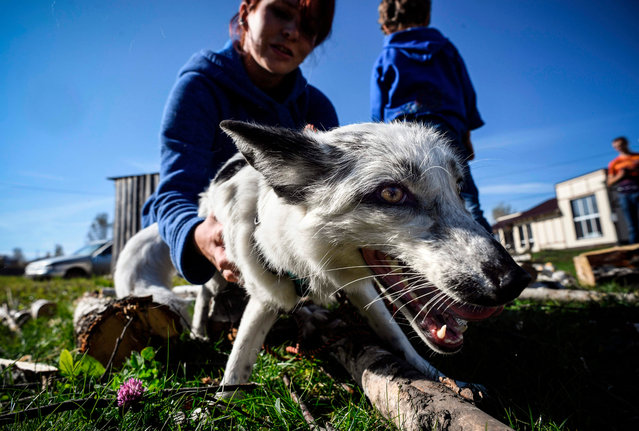
Tatyana Abramova, 33, plays with her home fox Plombir at her countryside house outside Siberian city of Novosibirsk on September 12, 2020. The official start of the Soviet experiment to better understand the domestication of animals by humans began in 1959, and was initiated by geneticists Dmitri Beliaiev and Lioudmila Trout on a farm in Akademgorodok, the scientific center of excellence in Siberia. Their primary objective was to domesticate foxes, to understand how the ancestor of wolves, another canine, evolved into a loyal and loving dog. And understand what this domestication tells us about the genetic evolution of species. (Photo by Alexander Nemenov/AFP Photo)

Tatyana Abramova, 33, plays with her home fox Plombir at her countryside house outside Siberian city of Novosibirsk on September 12, 2020. The official start of the Soviet experiment to better understand the domestication of animals by humans began in 1959, and was initiated by geneticists Dmitri Beliaiev and Lioudmila Trout on a farm in Akademgorodok, the scientific center of excellence in Siberia. Their primary objective was to domesticate foxes, to understand how the ancestor of wolves, another canine, evolved into a loyal and loving dog. And understand what this domestication tells us about the genetic evolution of species. (Photo by Alexander Nemenov/AFP Photo)
Details
25 Oct 2020 00:05:00
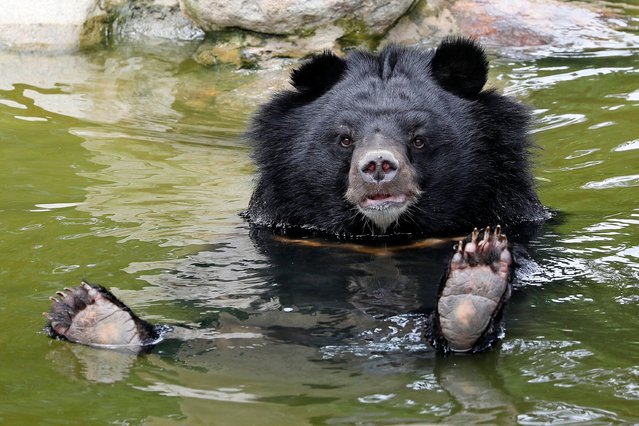
A moon bear rests in a pool inside an enclosure at the Vietnam bear rescue centre, in Tam Dao national park, Vinh Phuc, Vietnam, 09 July 2019. The center is operated by international organization Animals Asia. There are currently 184 bears living at the the Vietnam Bear Rescue Centre. It is estimated that there are less than a few hundred bears left in the wild in Vietnam. According to the latest data from the Ministry of Agriculture and Rural development, around 600 bears are still being kept on farms. In Vietnam, Animals Asia has rescued a total of 209 sun bears and moon bears. (Photo by Minh Hoang/EPA/EFE/Rex Features/Shutterstock)

A moon bear rests in a pool inside an enclosure at the Vietnam bear rescue centre, in Tam Dao national park, Vinh Phuc, Vietnam, 09 July 2019. The center is operated by international organization Animals Asia. There are currently 184 bears living at the the Vietnam Bear Rescue Centre. It is estimated that there are less than a few hundred bears left in the wild in Vietnam. According to the latest data from the Ministry of Agriculture and Rural development, around 600 bears are still being kept on farms. In Vietnam, Animals Asia has rescued a total of 209 sun bears and moon bears. (Photo by Minh Hoang/EPA/EFE/Rex Features/Shutterstock)
Details
14 Jul 2019 00:05:00