A wide-angle view shows the ascent of the shuttle Challenger on January 28, 1986. In the seconds after ignition, the rocket engines' hot blast began the process of destruction. (Photo by NASA)
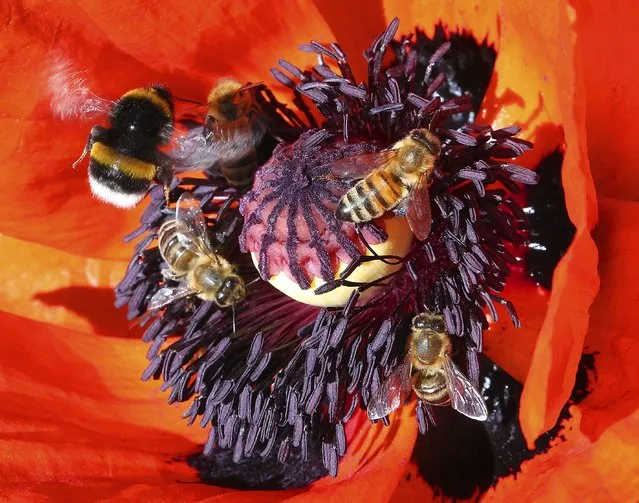
Honey bees and ground bumblebees fly with thick purple pollen pouches to the flower of a corn poppy, also called poppy or corn rose, to obtain nectar in Berlin, Germany, Tuesday, June 7, 2022. Bumblebees, which like bees belong to the stinging bee family, form so-called summer colonies that exist for only a few months. (Photo by Wolfgang Kumm/dpa via AP Photo)
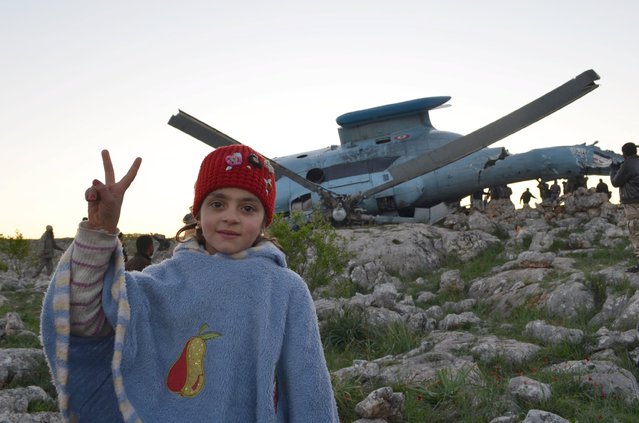
A girl flashes a victory sign as she poses near a helicopter that belongs to forces loyal to Syria's President Bashar Al-Assad after it crashed in Jabal al-Zawiya in the southern countryside of Idlib March 22, 2015. The Syrian military helicopter crashed in northwestern Syria on Sunday and at least four of its crew were captured by rebels, according to a monitoring group. (Photo by Abed Kontar/Reuters)
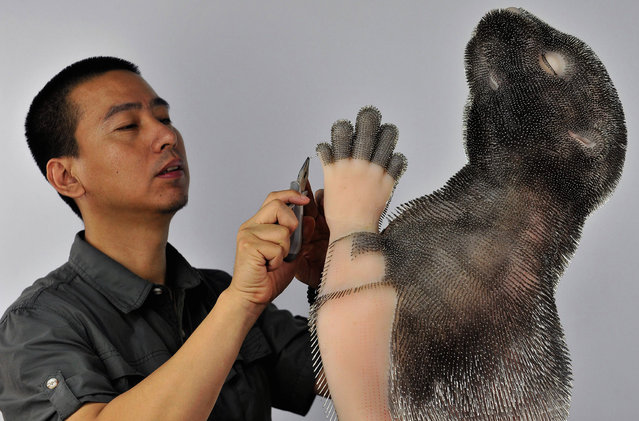
Professor Xie Yong works on an art installation of a beaver, which is made out of plastic and around 300,000 needles, in Shenyang, Liaoning province, July 23, 2013. The needles, according to Xie, represent the pain felt by animals when their fur is taken off to produce clothing. (Photo by Reuters/Stringer)
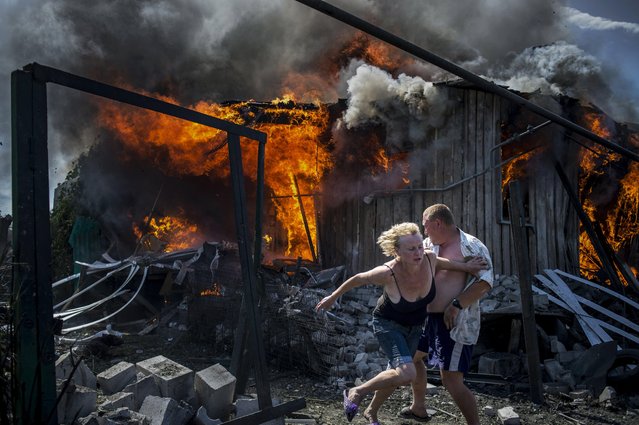
A handout photo made available by the World Press Photo (WPP) organization on 13 February 2017 shows a picture by Rossiya Segodnya photographer Valery Melnikov that won the Long-Term Projects – First Prize award of the 60th annual World Press Photo Contest, it was announced by the WPP Foundation in Amsterdam, The Netherlands on 13 February 2017. Caption: Civilians escape from a fire at a house destroyed by an air attack in the Luhanskaya village. (Photo by Valery Melnikov/EPA/Rossiya Segodnya/World Press Photo)
An employee of the National Park Service takes a selfie with President Barack Obama, left, in the background meeting with the crowd after a tour of Everglades National Park on Earth Day, Wednesday, April 22, 2015, in Florida. Obama used the visit to warn of the damage that climate change is already inflicting on the nation's environmental treasures. (Photo by Lynne Sladky/AP Photo)
Luling, Louisiana, US. New evidence contradicts previous claims of the relative safety of glyphosate, the world’s most widely used herbicide, which is manufactured here. It is often used in conjunction with seeds that have been genetically modified to tolerate its application, meaning that anyone consuming these crops is eating a genetically modified plant, and whatever residue of the pesticide that remains. (Photo by J. Henry Fair/Industrial Scars/Papadakis Publisher)