Loading...
Done
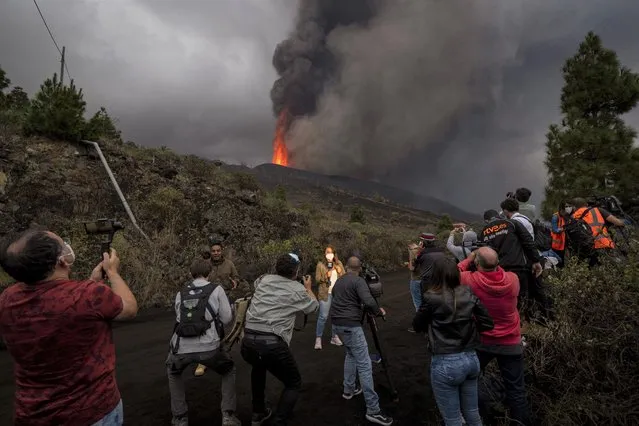
Journalists report during a media tour near the volcano on the island of La Palma in the Canaries, Spain, Wednesday, September 22, 2021. A volcano on a small Spanish island in the Atlantic Ocean erupted on Sunday, forcing the evacuation of thousands of people. Experts say the volcanic eruption and its aftermath on a Spanish island could last for up to 84 days. The Canary Island Volcanology Institute said Wednesday it based its calculation on the length of previous eruptions on the archipelago. (Photo by Emilio Morenatti/AP Photo)

Journalists report during a media tour near the volcano on the island of La Palma in the Canaries, Spain, Wednesday, September 22, 2021. A volcano on a small Spanish island in the Atlantic Ocean erupted on Sunday, forcing the evacuation of thousands of people. Experts say the volcanic eruption and its aftermath on a Spanish island could last for up to 84 days. The Canary Island Volcanology Institute said Wednesday it based its calculation on the length of previous eruptions on the archipelago. (Photo by Emilio Morenatti/AP Photo)
Details
05 Oct 2021 09:18:00
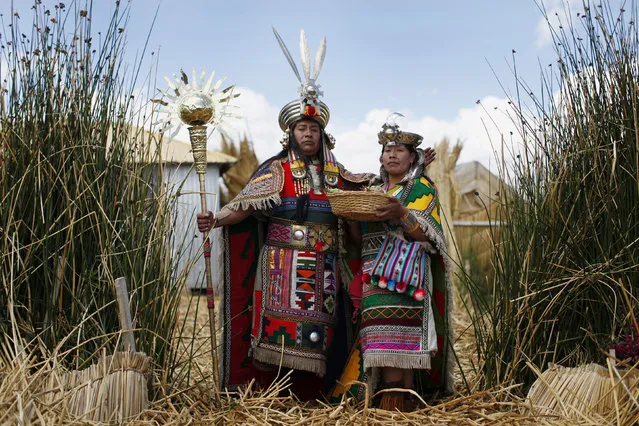
An Andean man and a woman, depicting Inca's legendary characters Manco Capac and Mama Ocllo, pose for a portrait in a Uros island at Lake Titicaca before a re-enactment in Puno November 5, 2014. The Uros islands are a group of 70 man-made totora reed islands floating on the lake, which according to Peru's tourism board iPeru is the world's highest navigable lake at over 4,000 meters above sea level. (Photo by Enrique Castro-Mendivil/Reuters)

An Andean man and a woman, depicting Inca's legendary characters Manco Capac and Mama Ocllo, pose for a portrait in a Uros island at Lake Titicaca before a re-enactment in Puno November 5, 2014. The Uros islands are a group of 70 man-made totora reed islands floating on the lake, which according to Peru's tourism board iPeru is the world's highest navigable lake at over 4,000 meters above sea level. The Uros people fish and hunt, but tourism is their main source of livelihood. (Photo by Enrique Castro-Mendivil/Reuters)
Details
07 Nov 2014 12:52:00
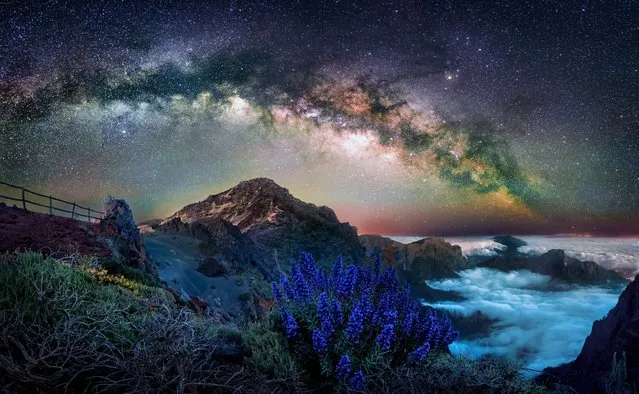
Tony North; First place, Breathing Spaces; Overall Winner; Blue Tajinaste, La Palma, Canary Islands, Spain. “Echium thyrsiflorum is endemic to the mountains of La Palma island – from high up, there was a magnificent view of both the caldera below, and the stars above. The Unesco La Palma biosphere reserve encompasses the entire island, with the Caldera de Taburiente containing mountains with a highest peak of 2,426 metres – the Roque de los Muchachos”. (Photo by Tony North/IGPOTY)

Tony North; First place, Breathing Spaces; Overall Winner; Blue Tajinaste, La Palma, Canary Islands, Spain. “Echium thyrsiflorum is endemic to the mountains of La Palma island – from high up, there was a magnificent view of both the caldera below, and the stars above. The Unesco La Palma biosphere reserve encompasses the entire island, with the Caldera de Taburiente containing mountains with a highest peak of 2,426 metres – the Roque de los Muchachos”. (Photo by Tony North/IGPOTY)
Details
10 Feb 2023 04:41:00
An American white pelican takes flight on the island of Petatan in the municipality of Cojumatlan de Regules, Michoacan state, Mexico on February 23, 2024. The island becomes home to the pelicans during the winter, when they travel from the north of the United States and the south of Canada to the warmer waters of Lake Chapala in Mexico. The birds are a tourist attraction and people gather on the island's boardwalk to feed them and watch them fly. (Photo by Enrique Castro/AFP Photo)

An American white pelican takes flight on the island of Petatan in the municipality of Cojumatlan de Regules, Michoacan state, Mexico on February 23, 2024. The island becomes home to the pelicans during the winter, when they travel from the north of the United States and the south of Canada to the warmer waters of Lake Chapala in Mexico. The birds are a tourist attraction and people gather on the island's boardwalk to feed them and watch them fly. (Photo by Enrique Castro/AFP Photo)
Details
24 May 2025 02:21:00
UK Love Island beauty Samira Mighty (L) seen arriving at Mahiki Kensington on November 16, 2018 in London, England. (Photo by CURLEY)

UK Love Island beauty Samira Mighty (L) seen arriving at Mahiki Kensington on November 16, 2018 in London, England. (Photo by CURLEY)
Details
25 Nov 2018 00:05:00
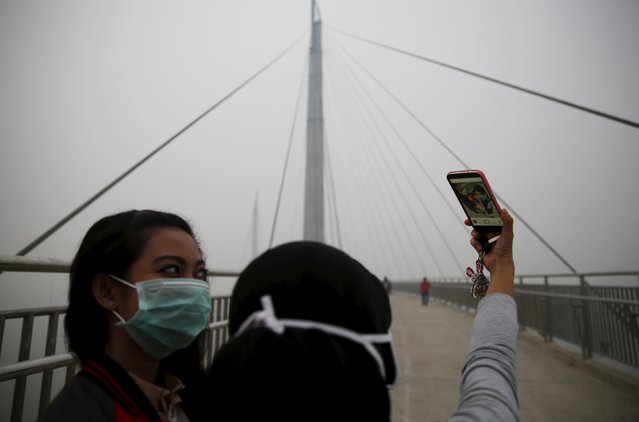
Girls take a selfie at the haze shrouded Batanghari River bridge in Jambi, Indonesia Sumatra island, September 14, 2015. Indonesian islands are blanketed in the so-called “haze”, caused by slash-and-burn clearances on the islands of Sumatra and Borneo, which makes thousands sick, delays flights and pushes air quality to unhealthy levels in neighboring Singapore and Malaysia. (Photo by Reuters/Beawiharta)

Girls take a selfie at the haze shrouded Batanghari River bridge in Jambi, Indonesia Sumatra island, September 14, 2015. Indonesian islands are blanketed in the so-called “haze”, caused by slash-and-burn clearances on the islands of Sumatra and Borneo, which makes thousands sick, delays flights and pushes air quality to unhealthy levels in neighboring Singapore and Malaysia. (Photo by Reuters/Beawiharta)
Details
15 Sep 2015 14:32:00
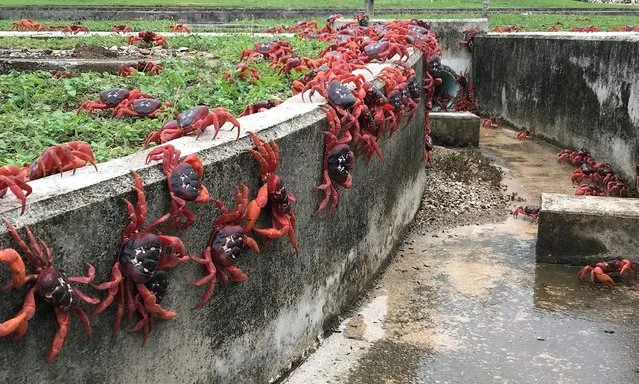
In this handout image provided by Parks Australia, thousands of red crabs are seen walking in a drain on November 23, 2021 in Christmas Island. The annual migration of red crabs begins with first rains of the wet season on Christmas Island, usually around October or November. Millions of the red crabs make their way across the island to the ocean to mate and spawn. (Photo by Parks Australia via Getty Images)

In this handout image provided by Parks Australia, thousands of red crabs are seen walking in a drain on November 23, 2021 in Christmas Island. The annual migration of red crabs begins with first rains of the wet season on Christmas Island, usually around October or November. Millions of the red crabs make their way across the island to the ocean to mate and spawn. (Photo by Parks Australia via Getty Images)
Details
13 Jul 2022 05:39:00
Titanoboa: Monster Snake

Titanoboa, meaning "titanic boa," is an extinct genus of snake that lived approximately 60–58 million years ago, during the Paleocene epoch, a 10-million-year period immediately following the dinosaur extinction event. The only known species is Titanoboa cerrejonensis, the largest, longest, and heaviest snake ever discovered, which supplanted the previous record holder, Gigantophis.

A full-scale model of the snake was unveiled at New York City's Grand Central station before the exhibit opens at the Smithsonian in Washington DC.
Details
06 Feb 2014 12:38:00