Loading...
Done
Vultures gather to eat waste in Bica beach, on the banks of the Guanabara Bay, with the Sugar Loaf mountain in background, 500 days ahead the Rio 2016 Olympic Games in Rio de Janeiro March 24, 2015. (Photo by Ricardo Moraes/Reuters)

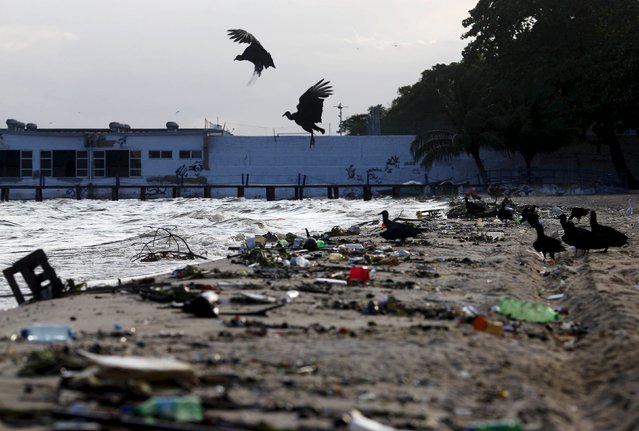
Vultures gather to eat waste in Bica beach, on the banks of the Guanabara Bay, with the Sugar Loaf mountain in background, 500 days ahead the Rio 2016 Olympic Games in Rio de Janeiro March 24, 2015. As part of its Olympic bid, Rio promised to clean up 80 percent of the bay for the games. But local government officials have already admitted that a cleanup by 2016 is not achievable. Despite millions of dollars of investment over the years, the bay still stinks of sewage. Sailors who visited the city for test events complained of a floating sofa and a dead dog in the water. (Photo by Ricardo Moraes/Reuters)
Details
26 Mar 2015 12:16:00
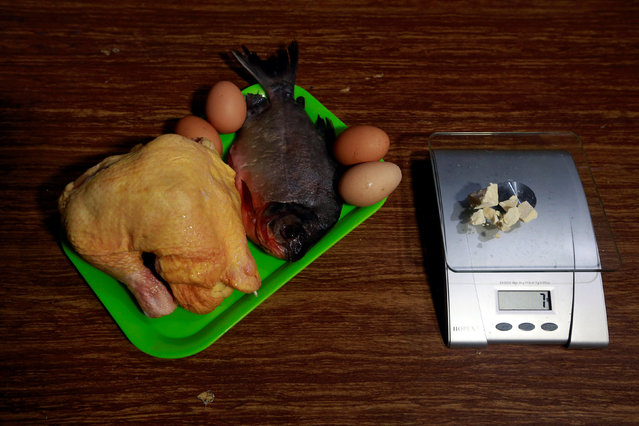
Chicken, fish and eggs lie next to coca paste worth $14,000 Colombian pesos at a local store in Guyabero Region, Guaviare, Colombia, May 24, 2016. (Photo by John Vizcaino/Reuters)

Chicken, fish and eggs lie next to coca paste worth $14,000 Colombian pesos at a local store in Guyabero Region, Guaviare, Colombia, May 24, 2016. As the government nears a historic peace deal with the rebels of the Revolutionary Armed Forces of Colombia (FARC), the nation's authorities are struggling to tame an increase in farming of coca, the raw material used to make cocaine. In the Guyabero Region, where many people work on coca plantations, locals barter coca paste to buy groceries at the local shop. (Photo by John Vizcaino/Reuters)
Details
03 Jun 2016 12:46:00
A member of the samba school of the Grupo Especial Academicos do Grande Rio parade during the Carnival celebration at the Marques de Sapucai sambadrome in Rio de Janeiro, Brazil, early 04 March 2019. The samba schools of the Rio de Janeiro Special Groups began their parades on 03 March at the sambadrome, considered the main attraction of the carnival in Brazil. (Photo by Marcelo Chello/EPA/EFE)

A member of the samba school of the Grupo Especial Academicos do Grande Rio parade during the Carnival celebration at the Marques de Sapucai sambadrome in Rio de Janeiro, Brazil, early 04 March 2019. The samba schools of the Rio de Janeiro Special Groups began their parades on 03 March at the sambadrome, considered the main attraction of the carnival in Brazil. (Photo by Marcelo Chello/EPA/EFE)
Details
09 Mar 2019 00:05:00
Members of the Women's Organization to War on Styles (WOW) picket a dress shop in Berkeley, Calif., August 23, 1947, in protest to longer skirts and padded hips. They are the wives of GI students at the University of California. Left to right: Jackie Houser; Wanda Ames; Dorothy Inman; Terry Ligon; Ruth Van Arkel; Carrol Reynolds, and Barbara Carmichael. (Photo by AP Photo)

Members of the Women's Organization to War on Styles (WOW) picket a dress shop in Berkeley, Calif., August 23, 1947, in protest to longer skirts and padded hips. They are the wives of GI students at the University of California. Left to right: Jackie Houser; Wanda Ames; Dorothy Inman; Terry Ligon; Ruth Van Arkel; Carrol Reynolds, and Barbara Carmichael. (Photo by AP Photo)
Details
18 Sep 2017 07:34:00
A vendor (C) serves customers at a vegetable market as a commuter train passes in Jakarta October 2, 2015. Indonesia's high annual inflation rate cooled in September and should drop more by year-end, but it likely will be 2016 before the central bank can cut interest rates to help an economy growing at its slowest pace in six years. (Photo by Reuters/Beawiharta)

A vendor (C) serves customers at a vegetable market as a commuter train passes in Jakarta October 2, 2015. Indonesia's high annual inflation rate cooled in September and should drop more by year-end, but it likely will be 2016 before the central bank can cut interest rates to help an economy growing at its slowest pace in six years. (Photo by Reuters/Beawiharta)
Details
05 Oct 2015 08:02:00
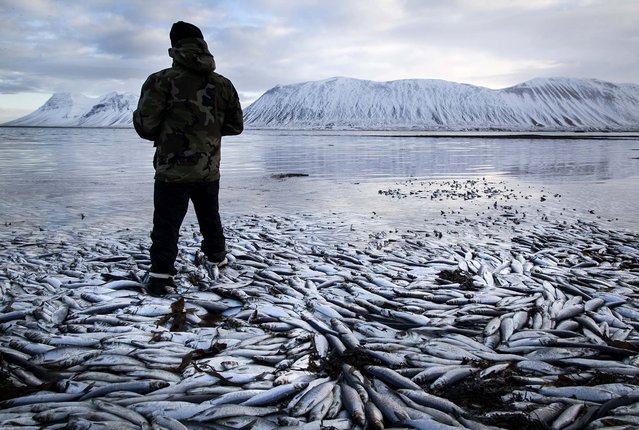
Herring worth millions in exports float dead in Kolgrafafjordur, a small fjord on the northern part of Snaefellsnes peninsula, west Iceland, for the second time in two months. Between 25,000 and 30,000 tons of fish died in December and more now, due to lack of oxygen in the fjord thought to have been caused by a landfill and bridge constructed across the fjord in December 2004. The current export value of  the estimated 10,000 tons of herring amounts to $ 9.8 million, according to the newspaper “Morgunbladid”.  (Photo by Brynjar Gauti/Associated Press)

Herring worth millions in exports float dead in Kolgrafafjordur, a small fjord on the northern part of Snaefellsnes peninsula, west Iceland, for the second time in two months. Between 25,000 and 30,000 tons of fish died in December and more now, due to lack of oxygen in the fjord thought to have been caused by a landfill and bridge constructed across the fjord in December 2004. The current export value of the estimated 10,000 tons of herring amounts to $ 9.8 million, according to the newspaper “Morgunbladid”. (Photo by Brynjar Gauti/Associated Press)
Details
06 Feb 2013 09:46:00
Giant's Causeway

Legend has it that the Irish warrior Fionn mac Cumhaill (Finn McCool) built the causeway to walk to Scotland to fight his Scottish counterpart Benandonner. One version of the legend tells that Fionn fell asleep before he got to Scotland. When he did not arrive, the much larger Benandonner crossed the bridge looking for him. To protect Fionn, his wife Oonagh laid a blanket over him so he could pretend that he was actually their baby son. In a variation, Fionn fled after seeing Benandonner's great bulk, and asked his wife to disguise him as the baby. In both versions, when Benandonner saw the size of the 'infant', he assumed the alleged father, Fionn, must be gigantic indeed. Therefore, Benandonner fled home in terror, ripping up the Causeway in case he was followed by Fionn.
Details
11 May 2015 10:45:00
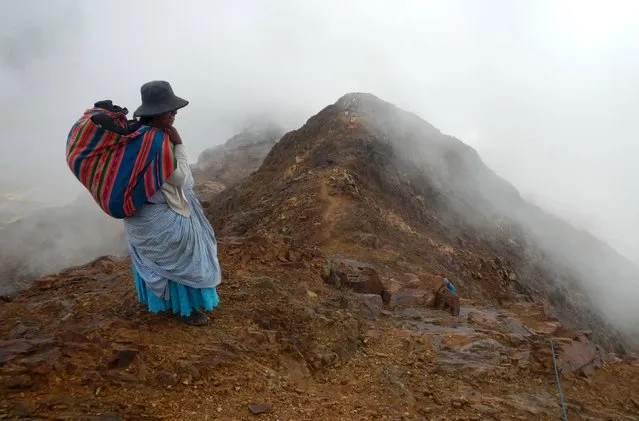
A porter stands at the bottom of the Illimani mountain, on the outskirts of La Paz, Bolivia, April 16, 2016. (Photo by David Mercado/Reuters)

A porter stands at the bottom of the Illimani mountain, on the outskirts of La Paz, Bolivia, April 16, 2016. For years, Lydia Huayllas, 48, has worked as a cook at base camps and mountain-climbing refuges on the steep, glacial slopes of Huayna Potosi, a 19,974-foot (6,088-meter) Andean peak outside of La Paz, Bolivia. But two years ago, she and 10 other Aymara indigenous women, ages 42 to 50, who also worked as porters and cooks for mountaineers, put on crampons – spikes fixed to a boot for climbing – under their wide traditional skirts and started to do their own climbing. (Photo by David Mercado/Reuters)
Details
22 Apr 2016 12:33:00