Loading...
Done
A young girl takes selfie with Easter rabbit sculpture during the Easter eggs (Pysanka) and rabbit exhibition in front of St. Sophia Cathedral in Kiev, Ukraine, 05 April 2018. Ukrainians will mark Orthodox Easter on 08 April 2018, according to Julian calendar. (Photo by Sergey Dolzhenko/EPA/EFE/Rex Features/Shutterstock)

A young girl takes selfie with Easter rabbit sculpture during the Easter eggs (Pysanka) and rabbit exhibition in front of St. Sophia Cathedral in Kiev, Ukraine, 05 April 2018. Ukrainians will mark Orthodox Easter on 08 April 2018, according to Julian calendar. (Photo by Sergey Dolzhenko/EPA/EFE/Rex Features/Shutterstock)
Details
10 Apr 2018 09:03:00
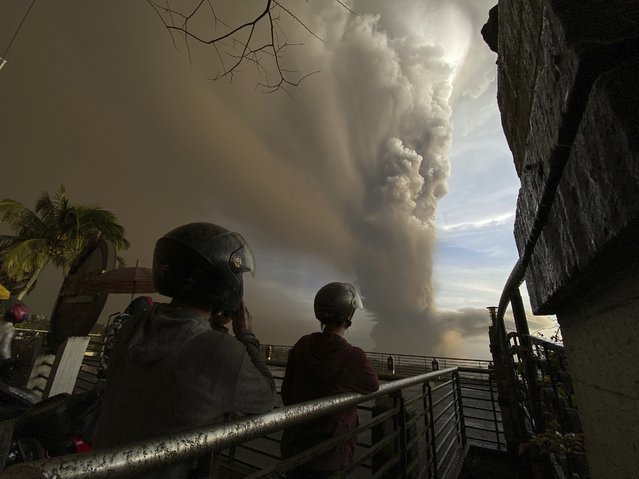
People watch plumes of smoke and ash rise from as Taal Volcano erupts Sunday January 12, 2020, in Tagaytay, Cavite province, outside Manila, Philippines. (Photo by Aaron Favila/AP Photo)

People watch plumes of smoke and ash rise from as Taal Volcano erupts Sunday January 12, 2020, in Tagaytay, Cavite province, outside Manila, Philippines. (Photo by Aaron Favila/AP Photo)
Details
15 Jan 2020 00:05:00
People take photos of hotel room lights shaping the word “Zero”, referring to Covid-19 cases, in Taipei, Taiwan, 17 April 2020. According to news reports Taiwan records no new COVID-19 cases for third time this week. Medical experts are rushing to develop a vaccine for the COVID-19 disease caused by the SARS-CoV-2 coronavirus and advising people to practice social distancing and proper hygiene. (Photo by David Chang/EPA/EFE/Rex Features/Shutterstock)

People take photos of hotel room lights shaping the word “Zero”, referring to Covid-19 cases, in Taipei, Taiwan, 17 April 2020. According to news reports Taiwan records no new COVID-19 cases for third time this week. Medical experts are rushing to develop a vaccine for the COVID-19 disease caused by the SARS-CoV-2 coronavirus and advising people to practice social distancing and proper hygiene. (Photo by David Chang/EPA/EFE/Rex Features/Shutterstock)
Details
19 Apr 2020 00:07:00
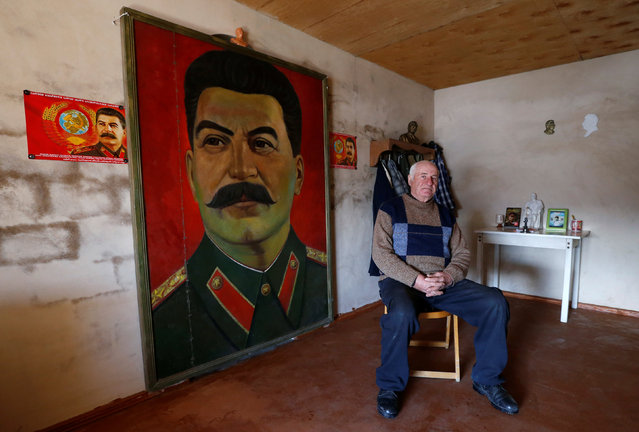
Retired builder Vasili Sidamonidze, 70, poses for a portrait at his home in Gori, Georgia, December 6, 2016. “Unfortunately, Stalin is not popular nowadays. Our people don't respect him. Only we, members of the (Communist) Party, respect him”, Sidamonidze said. “I always try to attend Stalin's birthday anniversaries in Gori. Unfortunately many people don't want to join us even if they live nearby. They look at us from their windows”. Stalin, who was born in Gori in 1878 and died in 1953, is largely reviled today in Georgia, which regained its independence during the 1991 collapse of the Soviet Union. Over the years, his memorials have been dismantled, most recently in 2010 when authorities removed a statue of the dictator from Gori's central square. But Stalin is still revered by a small group of mainly elderly supporters who stress his role in the industrialisation of the Soviet Union and in defeating Nazi Germany in World War Two. Each Dec. 21, a few dozen people mark his birthday by gathering outside a Gori museum dedicated to Stalin, where they make speeches and walk to the square where a 6-meter-high bronze statue of him once stood, calling for it to be reinstated. Opponents say it was a symbol of Moscow's still lingering shadow. In 2008, Russia fought a brief war with Georgia and recognised its breakaway regions of Abkhazia and South Ossetia as independent states. (Photo by David Mdzinarishvili/Reuters)

Retired builder Vasili Sidamonidze, 70, poses for a portrait at his home in Gori, Georgia, December 6, 2016. “Unfortunately, Stalin is not popular nowadays. Our people don't respect him. Only we, members of the (Communist) Party, respect him”, Sidamonidze said. “I always try to attend Stalin's birthday anniversaries in Gori. Unfortunately many people don't want to join us even if they live nearby. They look at us from their windows”. (Photo by David Mdzinarishvili/Reuters)
Details
17 Dec 2016 07:59:00
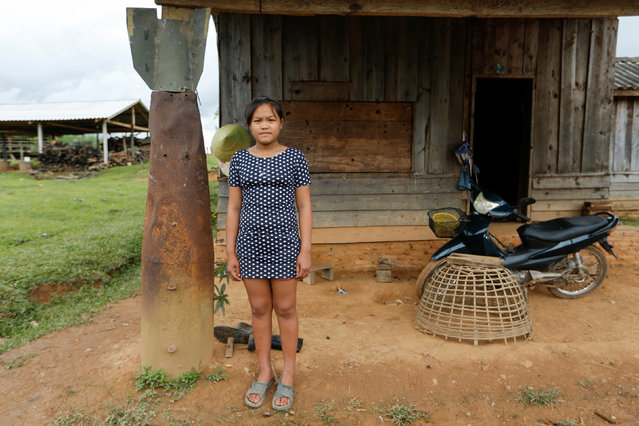
A girl poses at an entrance of her house next to a bomb dropped by the U.S. Air Force planes during the Vietnam War, in the village of Ban Napia in Xieng Khouang province, Laos September 3, 2016. (Photo by Jorge Silva/Reuters)

A girl poses at an entrance of her house next to a bomb dropped by the U.S. Air Force planes during the Vietnam War, in the village of Ban Napia in Xieng Khouang province, Laos September 3, 2016. From 1964 to 1973, U.S. warplanes dropped more than 270 million cluster munitions on Laos, one-third of which did not explode, according to the Lao National Regulatory Authority. (Photo by Jorge Silva/Reuters)
Details
06 Sep 2016 10:30:00
Yan Zhengming (R), 94, and his wife Zhou Suqing (C), 90, attend their wedding ceremony at their home, on the 70th anniversary of their marriage, in Quxian county of Dazhou, Sichuan province, China, May 15, 2015. (Photo by Reuters/Stringer)

Yan Zhengming (R), 94, and his wife Zhou Suqing (C), 90, attend their wedding ceremony at their home, on the 70th anniversary of their marriage, in Quxian county of Dazhou, Sichuan province, China, May 15, 2015. The wedding, organized by local charity groups, was a long-time wish of veteran of the World War Two Yan, who married Zhou 70 years ago, but could not afford to have a wedding ceremony, local media reported. (Photo by Reuters/Stringer)
Details
17 May 2015 11:56:00
Pupils of the Dao ethnic tribe return home from school along a hillside path at Suoi Thau village in Hoang Su Phi district of Vietnam's northern province of Ha Giang, located at the border with China, September 18, 2015. (Photo by Reuters/Kham)

Pupils of the Dao ethnic tribe return home from school along a hillside path at Suoi Thau village in Hoang Su Phi district of Vietnam's northern province of Ha Giang, located at the border with China, September 18, 2015. (Photo by Reuters/Kham)
Details
13 Oct 2015 08:04:00
A small section of the expanding remains of the Veil Nebula, a massive star that exploded about 8,000 years ago. The entire nebula is 110 light-years across, covering six full moons on the sky as seen from Earth, and resides about 2,100 light-years away in the constellation Cygnus, the Swan. Image taken by NASA's Hubble Space Telescope. Released September 24, 2015. (Photo by Reuters/NASA/ESA/Hubble Heritage Team)

A small section of the expanding remains of the Veil Nebula, a massive star that exploded about 8,000 years ago. The entire nebula is 110 light-years across, covering six full moons on the sky as seen from Earth, and resides about 2,100 light-years away in the constellation Cygnus, the Swan. Image taken by NASA's Hubble Space Telescope. Released September 24, 2015. (Photo by Reuters/NASA/ESA/Hubble Heritage Team)
Details
10 Dec 2015 08:01:00