Loading...
Done
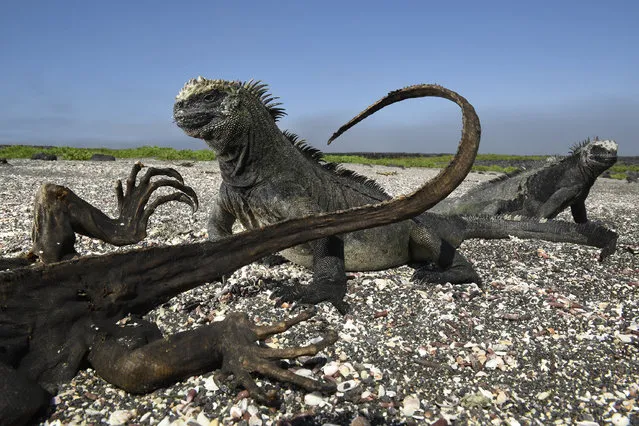
Galapagos – Rocking the Cradle: Four major ocean currents converge along the Galapagos archipelago, creating the conditions for an extraordinary diversity of animal life, April 25, 2016. The islands are home to at least 7,000 flora and fauna species, of which 97 percent of the reptiles, 80 percent of the land birds, 50 percent of the insects and 30 percent of the plants are endemic. The local ecosystem is highly sensitive to the changes in temperature, rainfall and ocean currents that characterize the climatic events known as El Niño and La Niña. These changes cause marked fluctuations in weather and food availability. Many scientists expect the frequency of El Niño and La Niña to increase as a result of climate change, making the Galapagos a possible early-warning location for its effects. (Photo by Thomas P. Peschak for National Geographic/World Press Photo)

Galapagos – Rocking the Cradle: Four major ocean currents converge along the Galapagos archipelago, creating the conditions for an extraordinary diversity of animal life, April 25, 2016. The islands are home to at least 7,000 flora and fauna species, of which 97 percent of the reptiles, 80 percent of the land birds, 50 percent of the insects and 30 percent of the plants are endemic. (Photo by Thomas P. Peschak for National Geographic/World Press Photo)
Details
16 Apr 2018 00:01:00
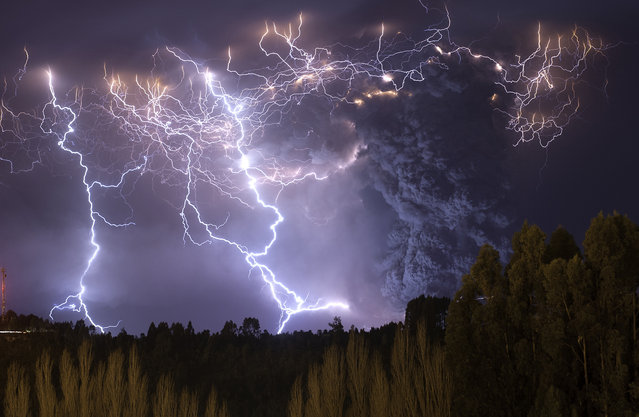
The eruption of Cordon Caulle began on June 4, 2011, located in the Region of Los Rios in Chile. For about 12 months, people and animals became accustomed to living with the daily fall of ash, which also caused problems in the air traffic in South America. The explosions and lightning during first days of the eruption could be seen from hundreds of miles around. This photograph was taken on the second night of eruption from the town of Lago Ranco. (Photo and caption by Francisco Negroni/National Geographic Traveler Photo Contest)

The eruption of Cordon Caulle began on June 4, 2011, located in the Region of Los Rios in Chile. For about 12 months, people and animals became accustomed to living with the daily fall of ash, which also caused problems in the air traffic in South America. The explosions and lightning during first days of the eruption could be seen from hundreds of miles around. This photograph was taken on the second night of eruption from the town of Lago Ranco. (Photo and caption by Francisco Negroni/National Geographic Traveler Photo Contest)

ATTENTION! All pictures are presented in high resolution. To see Hi-Res images – just TWICE click on any picture. In other words, click small picture – opens the BIG picture. Click BIG picture – opens VERY BIG picture.
Details
23 Jun 2013 11:24:00
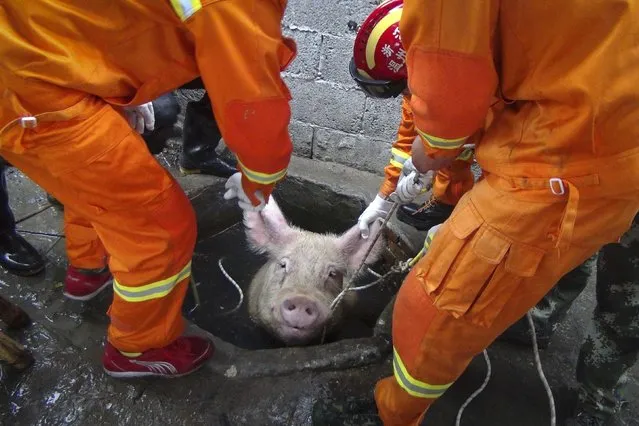
Firefighters pull a pig as they try to rescue it from a well at a pig farm in Huanghua township of Leqing, Zhejiang province, April 25, 2014. Seven local firefighters successfully rescued a 300 kg (661 lbs) pig which fell down a well on Friday morning, local media reported. (Photo by Reuters/China Daily)

Firefighters pull a pig as they try to rescue it from a well at a pig farm in Huanghua township of Leqing, Zhejiang province, April 25, 2014. Seven local firefighters successfully rescued a 300 kg (661 lbs) pig which fell down a well on Friday morning, local media reported. (Photo by Reuters/China Daily)
Details
26 Apr 2014 12:44:00
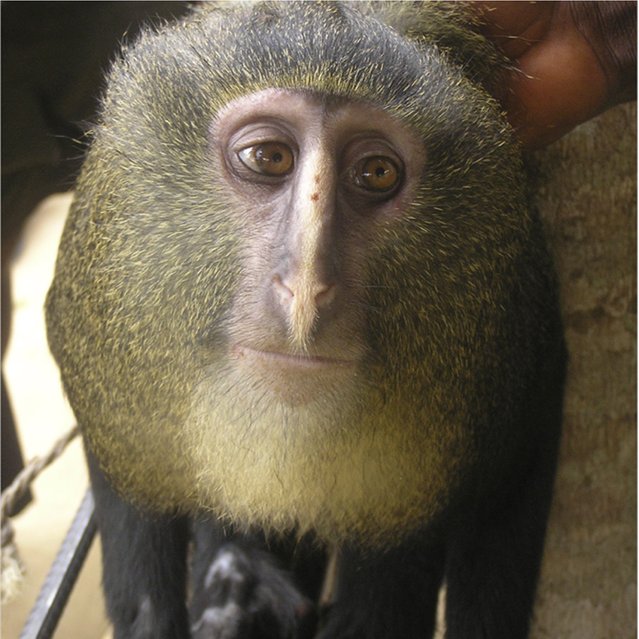
A new species of monkey found in the Democratic Republic of the Congo and identified as Lesula (Cercopithecus lomamiensis) is seen in this undated photograph from an article published September 12, 2012 in the science journal PLOS One. (Photo by Hart J. A., Detwiler K. M., Gilbert C. C./Reuters)

A new species of monkey found in the Democratic Republic of the Congo and identified as Lesula (Cercopithecus lomamiensis) is seen in this undated photograph from an article published September 12, 2012 in the science journal PLOS One. The monkey was first seen in 2007 by researchers John and Terese Hart of the Peabody Museum of Natural History at Yale Research Project. The finding of C. lomamiensis represents only the second new species of African monkey to be discovered in the past 28 years, according to the research article. (Photo by Hart J. A., Detwiler K. M., Gilbert C. C./Reuters)
Details
27 Sep 2012 08:17:00
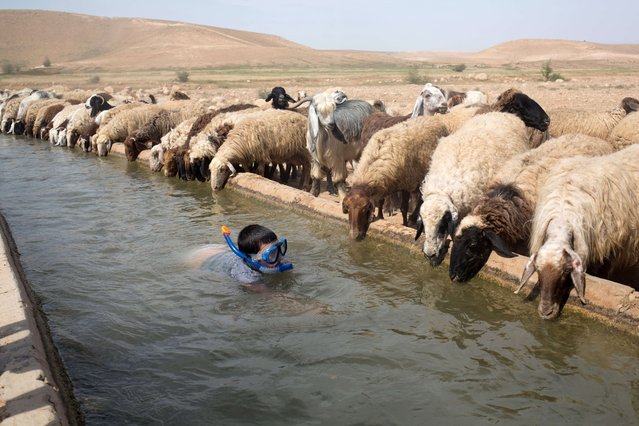
An Israeli boy swims next to sheep belonging to a Palestinian farmer in the West Bank village of Al-Auja in the Jordan Valley on April 8, 2015 during the Jewish Passover holiday. Thousands of Israelis spent the day outdoors, picnicking and touring the country during the eight-day Passover holiday, which commemorates the Israelites' exodus from Egypt some 3,500 years ago. (Photo by Menahem Kahana/AFP Photo)

An Israeli boy swims next to sheep belonging to a Palestinian farmer in the West Bank village of Al-Auja in the Jordan Valley on April 8, 2015 during the Jewish Passover holiday. Thousands of Israelis spent the day outdoors, picnicking and touring the country during the eight-day Passover holiday, which commemorates the Israelites' exodus from Egypt some 3,500 years ago. (Photo by Menahem Kahana/AFP Photo)
Details
11 Apr 2015 10:59:00
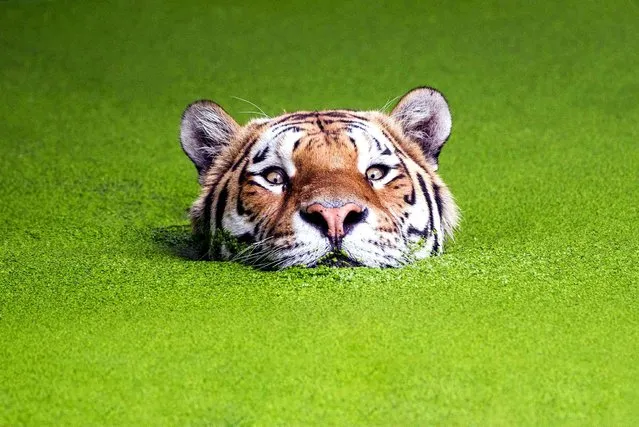
These stunning pictures show a normally vicious tiger calmly swimming in a pool of algae, on Jule 9, 2014. The powerful cat takes a refreshing break by taking a dip in the bright green algae. But it looks like this big cat is scared of getting his head wet as he strains to keep it above the water. After splashing around for a bit the tiger gets out and tries to air-dry with specks of the vegetation dripping off his fur. The striking pictures were taken at Copenhagen zoo by snapper Soren Lundgren Neilson. (Photo by Soren Nielsen/Caters News)

These stunning pictures show a normally vicious tiger calmly swimming in a pool of algae, on Jule 9, 2014. The powerful cat takes a refreshing break by taking a dip in the bright green algae. But it looks like this big cat is scared of getting his head wet as he strains to keep it above the water. After splashing around for a bit the tiger gets out and tries to air-dry with specks of the vegetation dripping off his fur. The striking pictures were taken at Copenhagen zoo by snapper Soren Lundgren Neilson. (Photo by Soren Nielsen/Caters News)
Details
12 Jul 2014 16:58:00
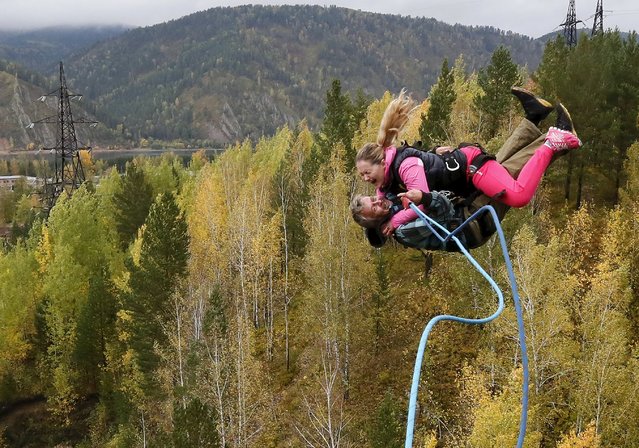
Members of the “Exit Point” amateur rope-jumping group jump from a 44-metre high (144-ft) waterpipe bridge in the Siberian Taiga area outside Krasnoyarsk, September 13, 2015. Rope-jumping, an extreme sport, involves jumping from a high point using an advanced leverage system combining mountaineering and rope safety equipment. (Photo by Ilya Naymushin/Reuters)

Members of the “Exit Point” amateur rope-jumping group jump from a 44-metre high (144-ft) waterpipe bridge in the Siberian Taiga area outside Krasnoyarsk, September 13, 2015. Rope-jumping, an extreme sport, involves jumping from a high point using an advanced leverage system combining mountaineering and rope safety equipment. (Photo by Ilya Naymushin/Reuters)
Details
14 Sep 2015 14:16:00
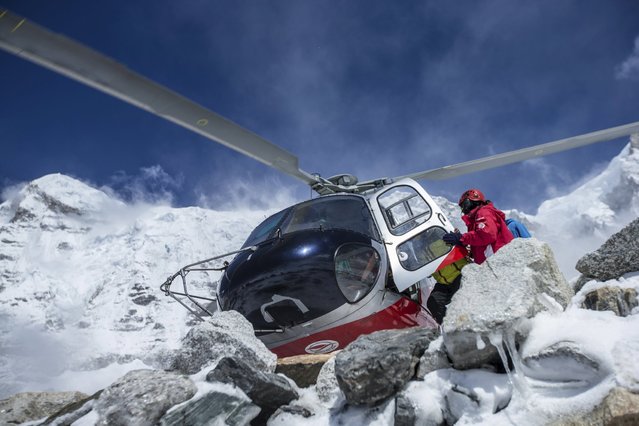
A rescue helicopter is shown at the Mount Everest south base camp in Nepal a day after a huge earthquake-caused avalanche killed at least 17 people, in this photo courtesy of 6summitschallenge.com taken on April 26, 2015 and released on April 27, 2015. (Photo by Reuters/6summitschallenge.com)

A rescue helicopter is shown at the Mount Everest south base camp in Nepal a day after a huge earthquake-caused avalanche killed at least 17 people, in this photo courtesy of 6summitschallenge.com taken on April 26, 2015 and released on April 27, 2015. Rescue teams, helped by clear weather, used helicopters to airlift scores of people stranded at higher altitudes, two at a time. (Photo by Reuters/6summitschallenge.com)
Details
28 Apr 2015 14:10:00