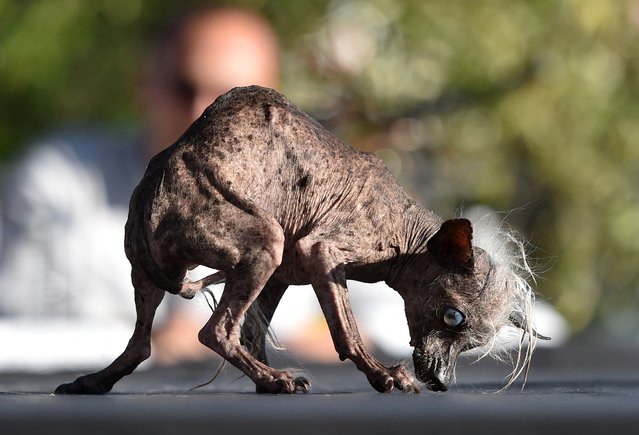
Sweepee Rambo, a Chinese Crested, is presented to judges during the World's Ugliest Dog Competition in Petaluma, California on June 26, 2015. (Photo by Josh Edelson/AFP Photo)
A lenticular cloud is seen during sunrise from Gokmen Aerospace Training Center (GUHEM) in Bursa, Turkiye on January 19, 2023. (Photo by Halit Mirahmetoglu/Anadolu Agency via Getty Images)
Focus on two glasses of champagne on floor. Ardent loving couple is sitting on bed and hugging with passion on background. Romantic date concept. (Photo by Olena Yakobchuk/Rex Features/Shutterstock)
Rows of blossoming peach trees line the fields of Aitona, in the province of Lleida, north eastern Spain, on March 22, 2025. Every year in March the thousands of hectares of blossoming peach trees create a sort of nature tourism with hundreds of people visiting the area to take in the colorful blossoms. (Photo by Josep Lago/AFP Photo)
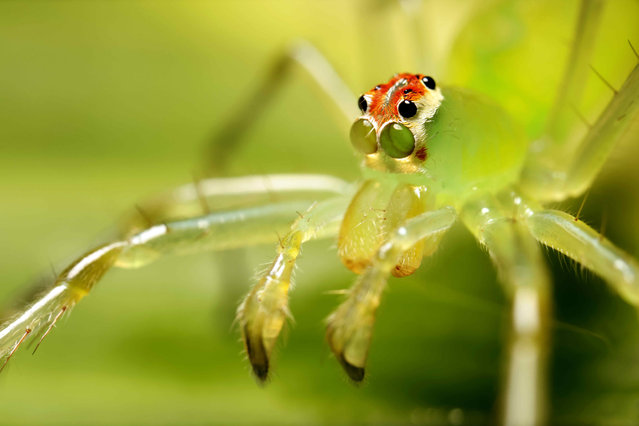
A green jumping spider (Lyssomanes viridis), in a forested area of Cerro de la Muerte, in San Jose, Costa Rica, 20 May 2025. International Day for Biological Diversity is celebrated every 22 May around the world. (Photo by Jeffrey Arguedas/EPA/EFE)
Apollo 9 Command/Service Modules (CSM) nicknamed “Gumdrop” and Lunar Module (LM), nicknamed “Spider” are shown docked together as Command Module pilot David R. Scott stands in the open hatch. Astronaut Russell L. Schweickart, Lunar Module pilot, took this photograph of Scott during his EVA as he stood on the porch outside the Lunar Module. Apollo 9 was an Earth orbital mission designed to test docking procedures between the CSM and LM as well as test fly the Lunar Module in the relative safe confines of Earth orbit. (Photo by NASA)
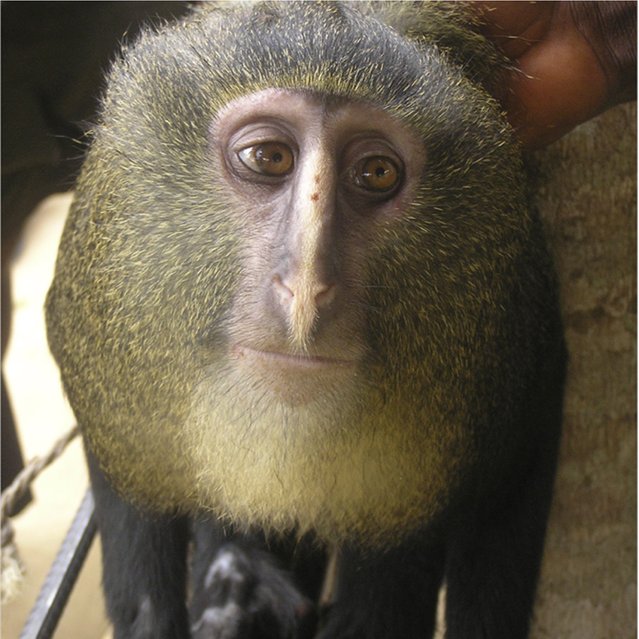
A new species of monkey found in the Democratic Republic of the Congo and identified as Lesula (Cercopithecus lomamiensis) is seen in this undated photograph from an article published September 12, 2012 in the science journal PLOS One. The monkey was first seen in 2007 by researchers John and Terese Hart of the Peabody Museum of Natural History at Yale Research Project. The finding of C. lomamiensis represents only the second new species of African monkey to be discovered in the past 28 years, according to the research article. (Photo by Hart J. A., Detwiler K. M., Gilbert C. C./Reuters)