Loading...
Done
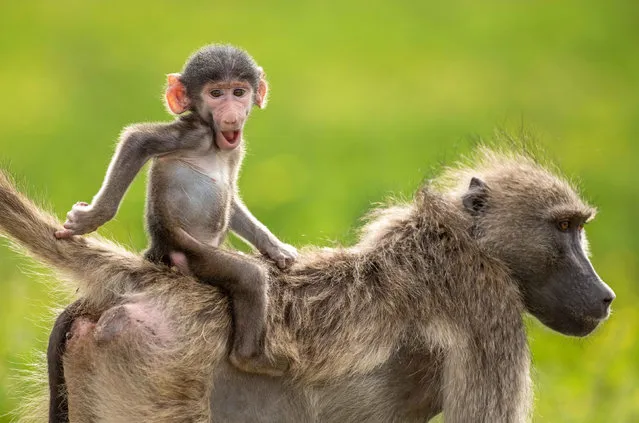
A baby baboon appears to ride its mother like a horse at the Chobe River, in The Chobe National Park, Botswana, Southern Africa in January 2023. Young monkeys often ride on their parent's backs, like this Chacma baboon, for protection. (Photo by William Steel/Solent News & Photo Agency)

A baby baboon appears to ride its mother like a horse at the Chobe River, in The Chobe National Park, Botswana, Southern Africa in January 2023. Young monkeys often ride on their parent's backs, like this Chacma baboon, for protection. (Photo by William Steel/Solent News & Photo Agency)
Details
22 Jan 2023 05:38:00
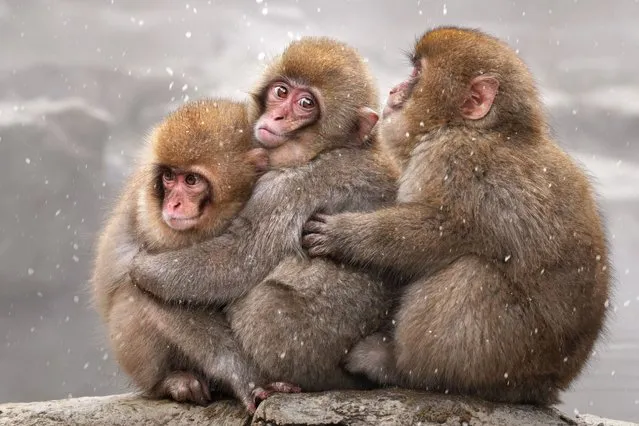
Macaques huddle together for warmth at a hot spring in Nagano, Japan in the last decade of December 2023. Known as snow monkeys, the animals soak in the 40°C water every day during cold weather, spending their bathtime grooming, snoozing and playing on visitors’ camera tripods. (Photo by David Lazar/Animal News Agency)

Macaques huddle together for warmth at a hot spring in Nagano, Japan in the last decade of December 2023. Known as snow monkeys, the animals soak in the 40°C water every day during cold weather, spending their bathtime grooming, snoozing and playing on visitors’ camera tripods. (Photo by David Lazar/Animal News Agency)
Details
02 Jan 2024 19:42:00
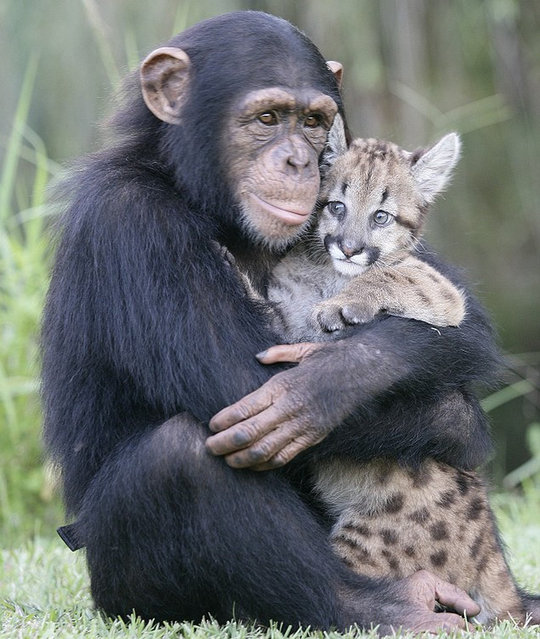
Chimp Mothers Tiger Cubs

Orphaned chimp Anjana lives with the resident feline curator at T.I.G.E.R.S, who taught the monkey how to care for all sorts of ferocious furry foster felines, including the Institute’s latest arrival Sierra.
Details
21 Sep 2012 10:28:00
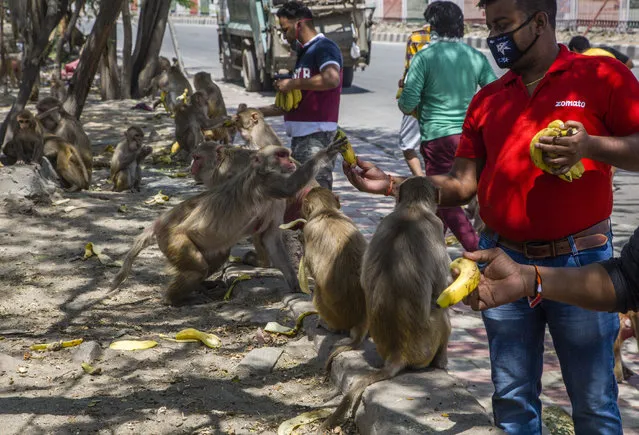
Men give bananas to monkeys gathered on the side of the road as India remains under an unprecedented lockdown over the highly contagious coronavirus (COVID-19) on April 08, 2020 in New Delhi, India. Wild animals, including monkeys, are roaming human settlements in India as people are staying indoors due to the 21-day lockdown. With India's 1.3 billion population and tens of millions of cars off the roads, wildlife is moving towards areas inhabited by humans. Wild animals in many countries have been seen roaming streets. A study says some 60 percent of the new diseases found around the globe every year are zoonotic, meaning they originate in animals and are passed on to humans. COVID-19 is a zoonotic disease that is suspected to have come from the wet markets of Wuhan, China. (Photo by Yawar Nazir/Getty Images)

Men give bananas to monkeys gathered on the side of the road as India remains under an unprecedented lockdown over the highly contagious coronavirus (COVID-19) on April 08, 2020 in New Delhi, India. Wild animals, including monkeys, are roaming human settlements in India as people are staying indoors due to the 21-day lockdown. (Photo by Yawar Nazir/Getty Images)
Details
12 Apr 2020 00:05:00
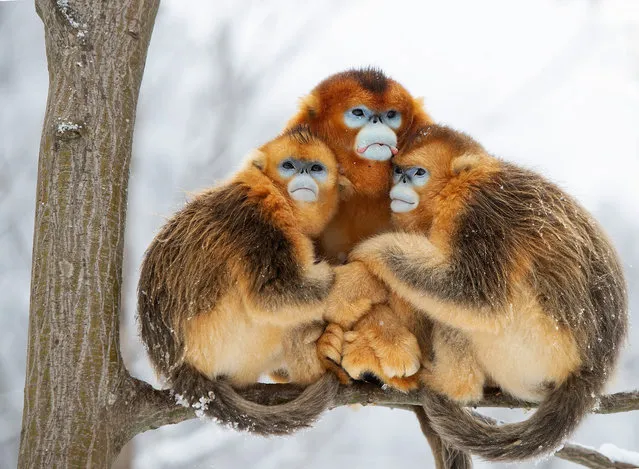
A golden huddle by Minqiang Lu, China. Two females and a male golden snub-nosed monkey huddle together to keep warm in the extreme cold. Threatened by forest loss and fragmentation, this endangered species is confined to central China. Restricted to living high up in the temperate forests, these monkeys – here in the Qinling mountains in Shaanxi province – feed mostly in the trees, on leaves, bark, buds and lichen. In heavy wind and snow, Minqiang walked up the mountain carrying his equipment. He stayed for half an hour in temperatures of –10C opposite the tree where the group was huddled before achieving this eye-level composition. (Photo by Minqiang Lu/Wildlife Photographer of the Year)

A golden huddle by Minqiang Lu, China. Two females and a male golden snub-nosed monkey huddle together to keep warm in the extreme cold. Threatened by forest loss and fragmentation, this endangered species is confined to central China. Restricted to living high up in the temperate forests, these monkeys – here in the Qinling mountains in Shaanxi province – feed mostly in the trees, on leaves, bark, buds and lichen. In heavy wind and snow, Minqiang walked up the mountain carrying his equipment. He stayed for half an hour in temperatures of –10C opposite the tree where the group was huddled before achieving this eye-level composition. (Photo by Minqiang Lu/Wildlife Photographer of the Year)
Details
12 Jan 2023 01:19:00
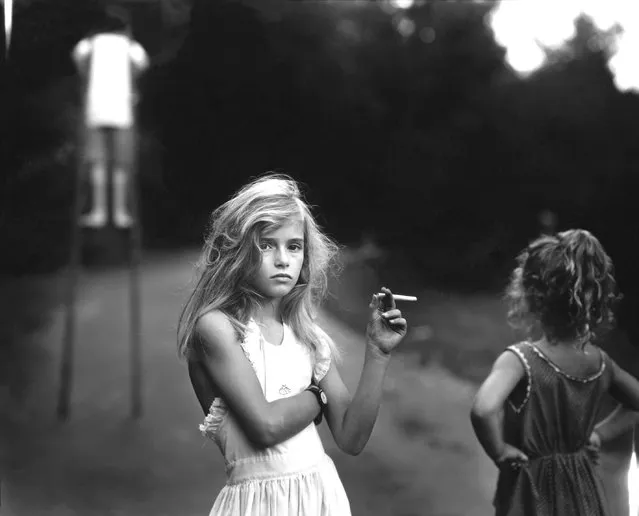
Candy Cigarette, 1989. (Photo by Sally Mann)

“Sally Mann (born in Lexington, Virginia, 1951) is one of America’s most renowned photographers. She has received numerous awards, including NEA, NEH, and Guggenheim Foundation grants, and her work is held by major institutions internationally. Her many books include Second Sight (1983), At Twelve (1988), Immediate Family (1992), Still Time (1994), What Remains (2003), Deep South (2005), Proud Flesh (2009), and The Flesh and the Spirit (2010). A feature film about her work, What Remains, debuted to critical acclaim in 2006. Mann is represented by Gagosian Gallery, New York. She lives in Virginia”.

Photo: Candy Cigarette, 1989. (Photo by Sally Mann)
Details
28 Apr 2012 11:32:00
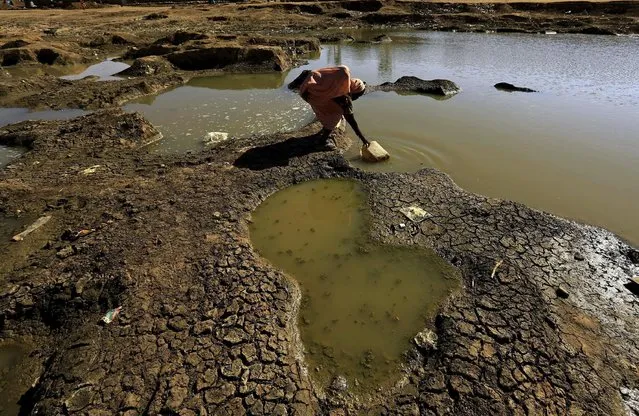
An internally displaced woman collects water from a pond to construct a mud-house at the Aboushok camp in El Fasher, North Darfur, Sudan, November 17, 2015. (Photo by Mohamed Nureldin Abdallah/Reuters)

An internally displaced woman collects water from a pond to construct a mud-house at the Aboushok camp in El Fasher, North Darfur, Sudan, November 17, 2015. The conflict in Sudan's Darfur region that erupted 12 years ago shows no sign of ending. But it hasn't stopped displaced youngsters, some of whom have spent their entire lives in refugee camps, from dreaming big. Twelve children aged 12 explain their hopes and dreams for the future; ambitions include becoming a doctor, an engineer and a teacher. (Photo by Mohamed Nureldin Abdallah/Reuters)
Details
13 Dec 2015 08:00:00
Dive The Deadly Jacob’s Well In Texas

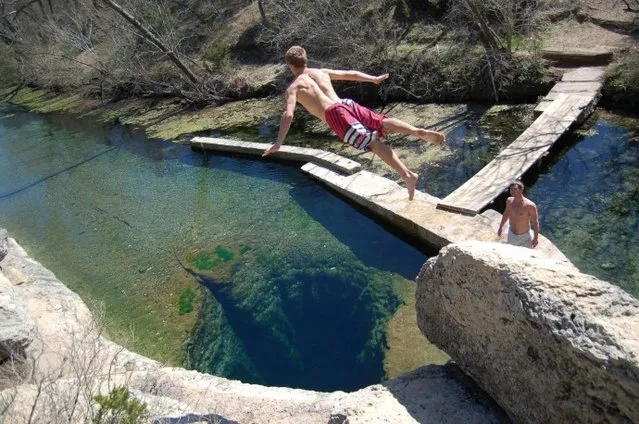
Jacob's Well is a perennial karstic spring in the Texas Hill Country flowing from the bed of Cypress Creek, located northwest of Wimberley, Texas. The twelve foot (four meter) diameter mouth of the spring serves as a popular swimming spot for the local land owners whose properties adjoin Cypress Creek. From the opening in the creek bed, Jacob's Well cave descends vertically for about thirty feet (ten meters), then continues downward at an angle through a series of silted chambers separated by narrow restrictions, finally reaching a depth of one hundred and twenty feet (forty meters). Until the modern era, the Trinity Aquifer-fed natural artesian spring gushed water from the mouth of the cave, with a measured flow in 1924 of one hundred and seventy gallons per second (six hundred and forty liters per second) discharging six feet (two meters) into the air. The spring is the greatest source of water recharging the Edwards Aquifer.
Details
03 Jan 2014 08:20:00