Loading...
Done
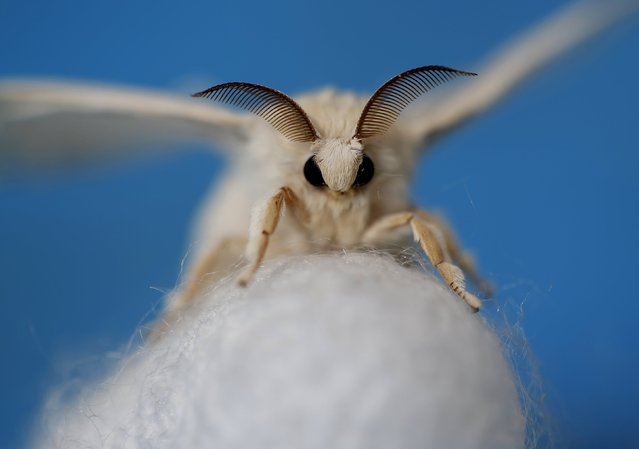
A silkmoth that has hatched out of its cocoon is seen at the Campoverde cooperative, Castelfranco Veneto, Italy June 4, 2015. Despite having wings, the adult moth cannot fly. Clusters of silkworms munch on piles of locally-grown mulberry leaves in a white marquee in Italy's northern Veneto region. They are nourishing hopes of a revival of Italy's 1,000 year-old silk industry. (Photo by Alessandro Bianchi/Reuters)

A silkmoth that has hatched out of its cocoon is seen at the Campoverde cooperative, Castelfranco Veneto, Italy June 4, 2015. Despite having wings, the adult moth cannot fly. Clusters of silkworms munch on piles of locally-grown mulberry leaves in a white marquee in Italy's northern Veneto region. They are nourishing hopes of a revival of Italy's 1,000 year-old silk industry. (Photo by Alessandro Bianchi/Reuters)
Details
18 Jul 2015 13:06:00
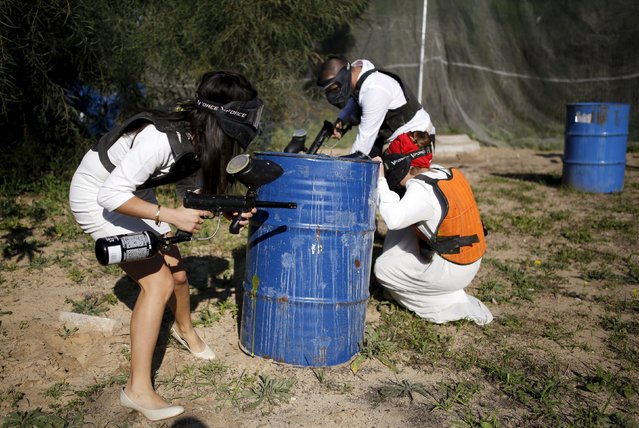
Israeli couples attend a “trash the dress” event at a paint-ball venue in the southern Israeli city of Ashdod, December 25, 2015. Twelve Israeli couples wore their wedding outfits once again on Friday as they took part in a video clip where they deliberately ruined their wedding outfits, in keeping with the trendy wedding style photography dubbed “trash the dress”. (Photo by Amir Cohen/Reuters)

Israeli couples attend a “trash the dress” event at a paint-ball venue in the southern Israeli city of Ashdod, December 25, 2015. Twelve Israeli couples wore their wedding outfits once again on Friday as they took part in a video clip where they deliberately ruined their wedding outfits, in keeping with the trendy wedding style photography dubbed “trash the dress”. (Photo by Amir Cohen/Reuters)
Details
27 Dec 2015 08:01:00
A competitor tries to swipe away some grease as he slips off the “gostra”, a pole covered in grease, during the celebrations for the religious feast of St Julian, patron of the town of St Julian's, outside Valletta August 30, 2015. (Photo by Darrin Zammit Lupi/Reuters)

A competitor tries to swipe away some grease as he slips off the “gostra”, a pole covered in grease, during the celebrations for the religious feast of St Julian, patron of the town of St Julian's, outside Valletta August 30, 2015. In the traditional “gostra”, a game stretching back to the Middle Ages, young men, women and children have to make their way to the top of a pole and try to uproot one of the flags to win prizes. Photo by Darrin Zammit Lupi/Reuters)
Details
31 Aug 2015 12:16:00
Performers in costume perform in the rain during the parade on the second day of the Notting Hill Carnival in west London on August 31, 2015. Nearly one million people are expected by the organizers Sunday and Monday in the streets of west London's Notting Hill to celebrate Caribbean culture at a carnival considered the largest street demonstration in Europe.  (Photo by Leon Neal/AFP Photo)

Performers in costume perform in the rain during the parade on the second day of the Notting Hill Carnival in west London on August 31, 2015. Nearly one million people are expected by the organizers Sunday and Monday in the streets of west London's Notting Hill to celebrate Caribbean culture at a carnival considered the largest street demonstration in Europe. The Notting Hill Carnival started in the 1960s, when the area had a large population of immigrants recently arrived from the Caribbean and was notorious for its slums – a far cry from today when it is one of London's most expensive places to live. (Photo by Leon Neal/AFP Photo)
Details
01 Sep 2015 15:17:00
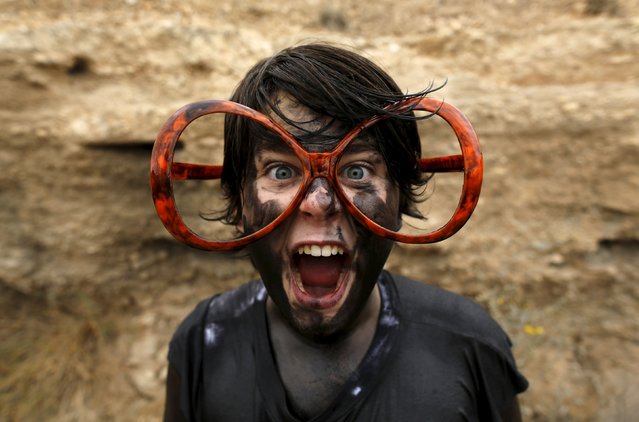
Jose, a reveller covered in grease, poses for a photo as he takes part in the annual Cascamorras festival in Baza, southern Spain September 6, 2015. The festival was inspired by a dispute between the town of Baza and Guadix over the possession of an icon of the Virgin of Piedad. The Cascamorras refers to representatives from Guadix, who were sent to Baza to recover the statue. As the Cascamorras had to stay perfectly clean to gain possession of the statue, Baza residents attempt to make them as “dirty” as possible. (Photo by Marcelo del Pozo/Reuters)

Jose, a reveller covered in grease, poses for a photo as he takes part in the annual Cascamorras festival in Baza, southern Spain September 6, 2015. The festival was inspired by a dispute between the town of Baza and Guadix over the possession of an icon of the Virgin of Piedad. The Cascamorras refers to representatives from Guadix, who were sent to Baza to recover the statue. As the Cascamorras had to stay perfectly clean to gain possession of the statue, Baza residents attempt to make them as “dirty” as possible. (Photo by Marcelo del Pozo/Reuters)
Details
07 Sep 2015 14:11:00
A humanoid robot named “Robi” sits during a promotional event for the launch of a weekly Robi Magazine in Tokyo, Japan, 20 January 2015. Created by roboticist Tomotaka Takahashi, the 34-centimeter tall humanoid robot can recognize and respond to more than 200 words and phrases, walk and dance. (Photo by Franck Robichon/EPA)

A humanoid robot named “Robi” sits during a promotional event for the launch of a weekly Robi Magazine in Tokyo, Japan, 20 January 2015. Created by roboticist Tomotaka Takahashi, the 34-centimeter tall humanoid robot can recognize and respond to more than 200 words and phrases, walk and dance. Parts of the robot will be put on sale in a weekly magazine to be fully assembled with 70 issues. (Photo by Franck Robichon/EPA)
Details
21 Jan 2015 13:19:00
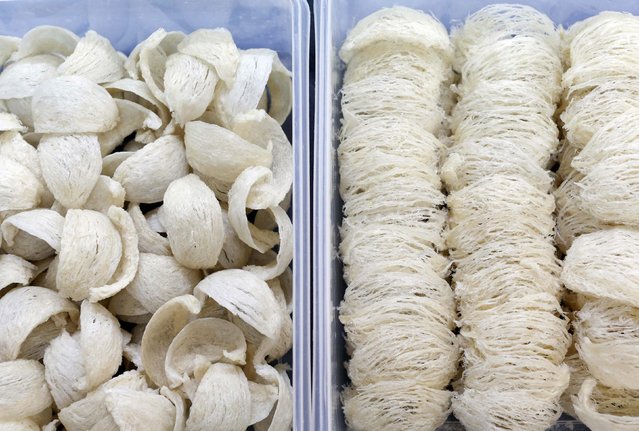
Two styles of cleaned bird's nest, Yan Zhan (L) and Su Zhan (R) await repacking at a processing plant in Kuala Lumpur, February 17, 2015. Prized in China for is alleged health benefits for hundreds of years, nests made from swiftlets' saliva are being mixed into coffee and cereal as the Southeast Asian producers of the delicacy seek to broaden its appeal, and their profit margins. (Photo by Olivia Harris/Reuters)

Two styles of cleaned bird's nest, Yan Zhan (L) and Su Zhan (R) await repacking at a processing plant in Kuala Lumpur, February 17, 2015. Prized in China for is alleged health benefits for hundreds of years, nests made from swiftlets' saliva are being mixed into coffee and cereal as the Southeast Asian producers of the delicacy seek to broaden its appeal, and their profit margins. The nests are among the world's most expensive foods, selling for up to $2,500 a kg and the swiftlets that weave them are indigenous to Indonesia, Malaysia, Thailand and Vietnam. (Photo by Olivia Harris/Reuters)
Details
24 Feb 2015 13:57:00
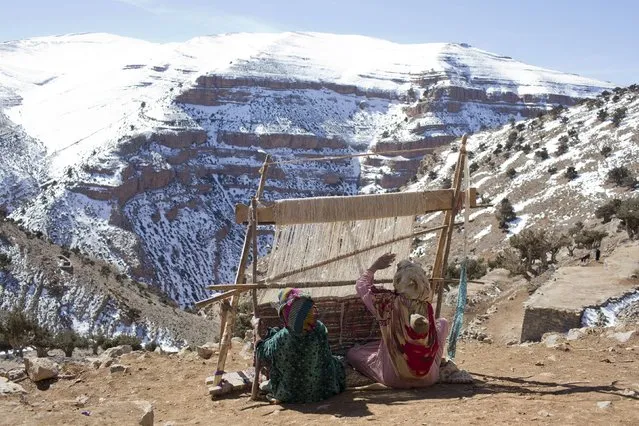
Berber women weave traditional carpets in the village of Ait Sghir in the High Atlas region of Morocco February 15, 2015. The snowy foothills of the High Atlas mountains in Morocco are home to several Berber villages where the inhabitants make their living by farming, baking bread in traditional ovens, herding cattle, and the making and selling of honey, olive oil and pottery. Extreme weather fluctuations and erosion that causes flooding and landslides have led to a drop in agricultural productivity, the United Nations said. (Photo by Youssef Boudlal/Reuters)

Berber women weave traditional carpets in the village of Ait Sghir in the High Atlas region of Morocco February 15, 2015. The snowy foothills of the High Atlas mountains in Morocco are home to several Berber villages where the inhabitants make their living by farming, baking bread in traditional ovens, herding cattle, and the making and selling of honey, olive oil and pottery. Extreme weather fluctuations and erosion that causes flooding and landslides have led to a drop in agricultural productivity, the United Nations said. (Photo by Youssef Boudlal/Reuters)
Details
26 Feb 2015 06:07:00