Loading...
Done
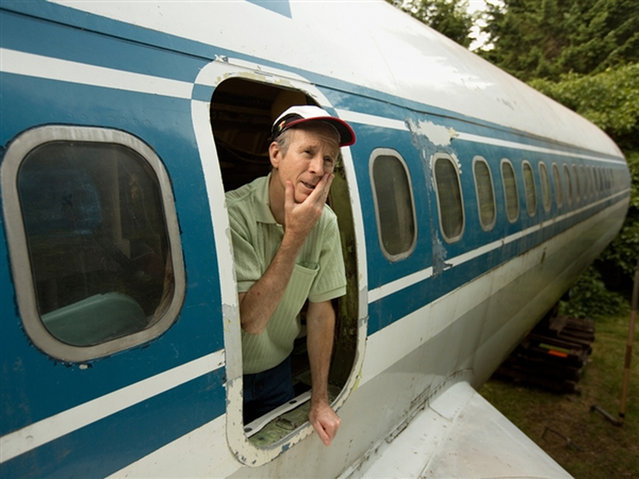
Bruce Campbell's 727 Home Project

Bruce Campbell doesn't just love planes, he lives inside of one. After purchasing a a Boeing 727-200 for $100,000, he placed it in his backyard, otherwise known as the middle of the woods in Oregon.
Campbell's startup costs were actually quite considerable. He paid $17,000 to move the plane from an airport to a staging site, $20,000 to rent the staging site for four months, $21,600 to remove the wings and tail, and $25,000 to finally move it to his house.
Details
15 Aug 2012 10:00:00
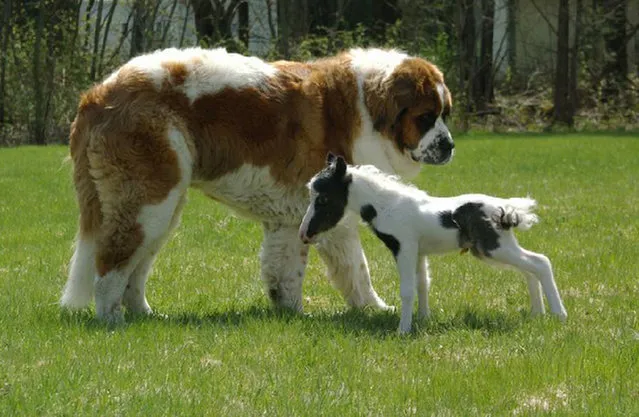
The World’s Smallest Horse by  named Einstein

The World’s Smallest Horse according to Guinness World Records is Thumbelina from Missouri, but another tiny horse named Einstein may take her place when he turns 4, which is the minimum age required for the record. Einstein is from New Hampshire and unlike Thumbelina, he doesn’t have any dwarvish features, he has the same proportions as any other horse – he’s just much much smaller.


Details
16 Aug 2012 08:34:00
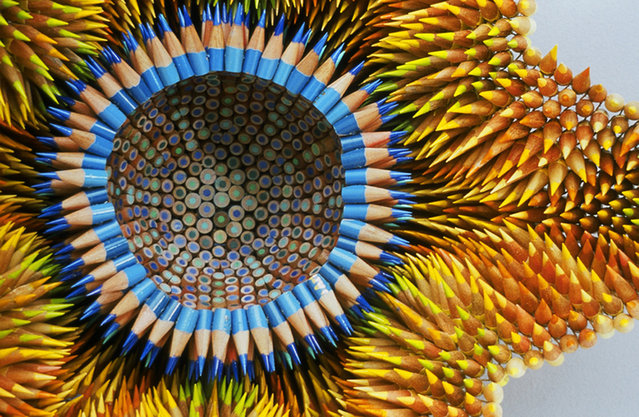
Pencil Sculptures - by Jennifer Maestre

Jennifer Maestre (born 1959 in Johannesburg, South Africa) is a Massachusetts-based artist, internationally known for her unique pencil sculptures.
She derives most of her inspiration from the form and texture of the sea urchin. To make the pencil sculptures, Jennifer makes use of a variety pencils, nails and stitching. She takes hundreds of pencils, cuts them into small 1-inch sections, drills a hole in each section, sharpens them all and sews them together.
Details
22 Aug 2012 13:16:00
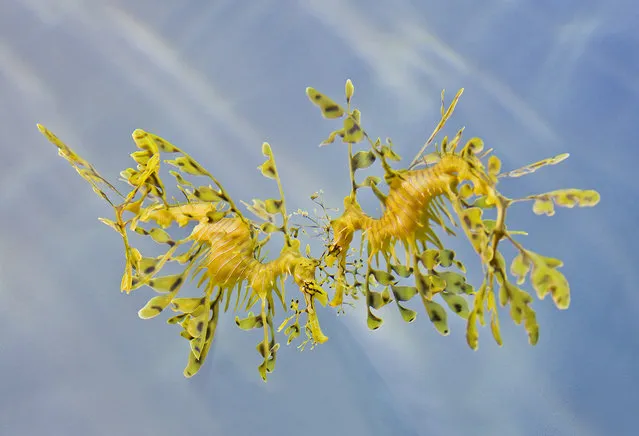
Leafy sea dragon

The leafy seadragon or Glauert's seadragon, Phycodurus eques, is a marine fish in the family Syngnathidae, which also includes the seahorses. It is the only member of the genus Phycodurus. It is found along the southern and western coasts of Australia. The name is derived from the appearance, with long leaf-like protrusions coming from all over the body. These protrusions are not used for propulsion; they serve only as camouflage. The leafy seadragon propels itself by means of a pectoral fin on the ridge of its neck and a dorsal fin on its back closer to the tail end. These small fins are almost completely transparent and difficult to see as they undulate minutely to move the creature sedately through the water, completing the illusion of floating seaweed.
Details
05 Sep 2012 08:51:00
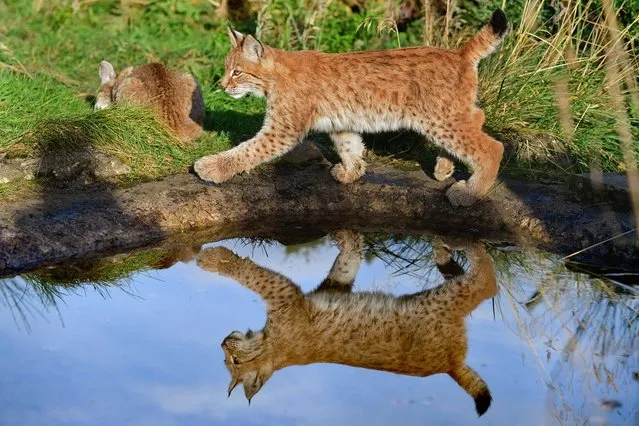
Northern Lynx kittens, explore their enclosure at the Highland Wildlife park on October 9, 2012 in Kingussie, Scotland. The feline twins are believed to be the type of lynx found historically in Scotland. The Highland Wildlife Park specialises in Scottish animal species, both past and present, and species that are well adapted to cold weather.  (Photo by Jeff J. Mitchell)

Northern Lynx kittens, explore their enclosure at the Highland Wildlife park on October 9, 2012 in Kingussie, Scotland. The feline twins are believed to be the type of lynx found historically in Scotland. The Highland Wildlife Park specialises in Scottish animal species, both past and present, and species that are well adapted to cold weather. (Photo by Jeff J. Mitchell)
Details
10 Oct 2012 09:30:00
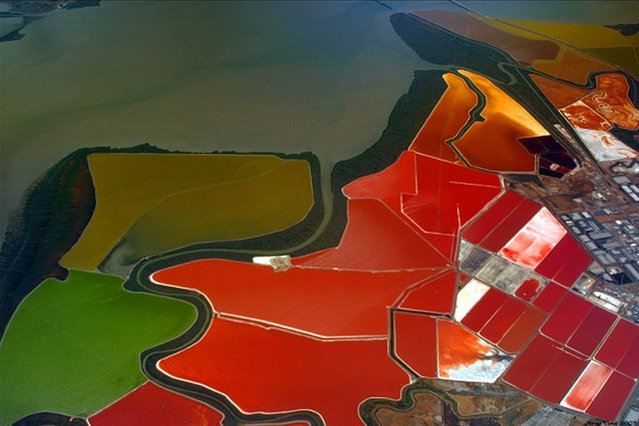
Salt ponds in San Francisco Bay

Salt evaporation ponds, also called salterns or salt pans, are shallow artificial ponds designed to produce salts from sea water or other brines. The seawater or brine is fed into large ponds and water is drawn out through natural evaporation which allows the salt to be subsequently harvested. The ponds also provide a productive resting and feeding ground for many species of waterbirds, which may include endangered species. The ponds are commonly separated by levees.
Details
11 Oct 2012 12:49:00
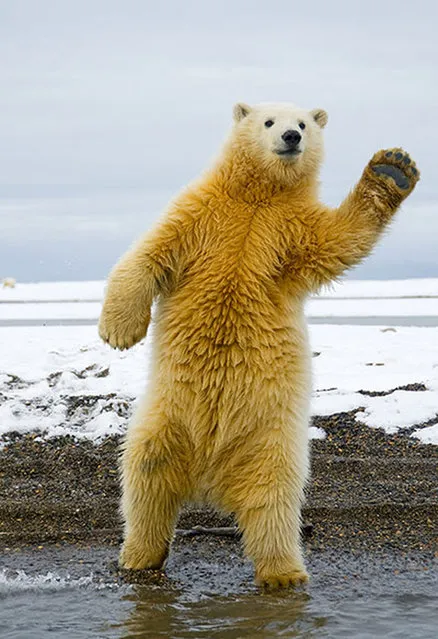
Polar Bear Photo Steven Kazlowski

The polar bear — a charismatic icon in the struggle against climate change — faces a precarious future along with other ice-dependent species as its Arctic habitat rapidly continues to melt away.

With camera in hand, wildlife photographer Steven Kazlowski has dedicated over eight years of work to bring to life the immediate reality of this most pressing environmental crisis — the devastation of the Arctic ecosystem through global warming.
Details
18 Oct 2012 10:14:00
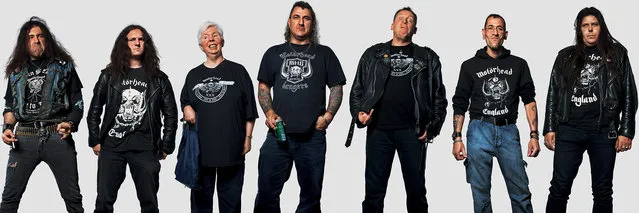
Motorhead fans. (Photo by James Mollison)

“Over three years I photographed fans outside different concerts. I was fascinated by the different tribes of people that attended them, and how people emulated celebrity to form their identity. As I photographed the project I began to see how the concerts became events for people to come together with surrogate “families”, a chance to relive their youth or try and be part of a scene that happened before they were born” – James Mollison.

Photo: Madonna fans. (Photo by James Mollison)
Details
25 Jun 2015 12:45:00