Loading...
Done
A pilgrim crawls in front of the Navy band outside the Holy Church of Panagia of Tinos, on the Aegean island of Tinos, Greece, on Saturday, August 15, 2020. For nearly 200 years, Greek Orthodox faithful have flocked to Tinos for the August 15 feast day of the Assumption of the Virgin Mary, the most revered religious holiday in the Orthodox calendar after Easter. But this year there was no procession, the ceremony – like so many lives across the globe – upended by the coronavirus pandemic. (Photo by Thanassis Stavrakis/AP Photo)

A pilgrim crawls in front of the Navy band outside the Holy Church of Panagia of Tinos, on the Aegean island of Tinos, Greece, on Saturday, August 15, 2020. For nearly 200 years, Greek Orthodox faithful have flocked to Tinos for the August 15 feast day of the Assumption of the Virgin Mary, the most revered religious holiday in the Orthodox calendar after Easter. But this year there was no procession, the ceremony – like so many lives across the globe – upended by the coronavirus pandemic. (Photo by Thanassis Stavrakis/AP Photo)
Details
17 Aug 2020 00:07:00
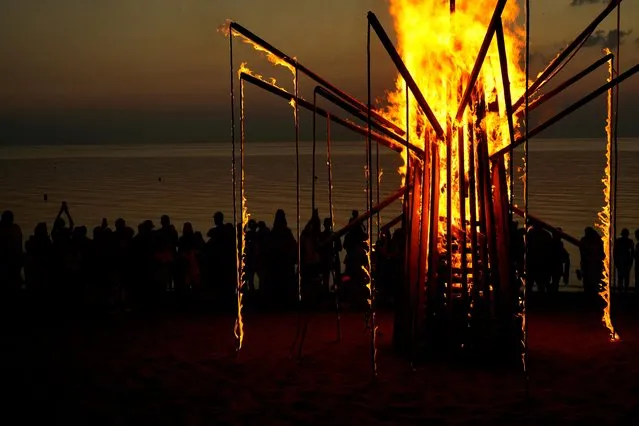
People attend The Night of Ancient Bonfires event in Saulkrasti, Latvia on August 27, 2022. During The Night of Ancient Bonfires people light bonfires along the coastline of the Baltic Sea. (Photo by Ints Kalnins/Reuters)

People attend The Night of Ancient Bonfires event in Saulkrasti, Latvia on August 27, 2022. During The Night of Ancient Bonfires people light bonfires along the coastline of the Baltic Sea. (Photo by Ints Kalnins/Reuters)
Details
07 Nov 2022 04:24:00
A cat sits on the shoulder of Ukrainian serviceman Mykyta of the 93rd separate mechanized brigade at a rest house near the front line in the Donetsk region on December 25, 2023. (Photo by Thomas Peter/Reuters)

A cat sits on the shoulder of Ukrainian serviceman Mykyta of the 93rd separate mechanized brigade at a rest house near the front line in the Donetsk region on December 25, 2023. (Photo by Thomas Peter/Reuters)
Details
29 Dec 2023 21:16:00
Charlotte Louise, Travis Wood and Dylan Collymore in Pinocchio at Theatre Royal Stratford East, London in 2024. (Photo by Tristram Kenton/The Guardian)

Charlotte Louise, Travis Wood and Dylan Collymore in Pinocchio at Theatre Royal Stratford East, London in 2024. (Photo by Tristram Kenton/The Guardian)
Details
29 Dec 2024 01:53:00
A helicopter is silhouetted by glowing embers as it makes a water drop at the “Old Fire”, which burned in Calabasas, California, U.S., June 4, 2016. (Photo by Gene Blevins/Reuters)

A helicopter is silhouetted by glowing embers as it makes a water drop at the “Old Fire”, which burned in Calabasas, California, U.S., June 4, 2016. (Photo by Gene Blevins/Reuters)
Details
07 Jun 2016 13:17:00
A woman picks marigold flowers used to make garlands and offer prayers, before selling them to the market for the Tihar festival, also called Diwali, in Kathmandu, Nepal October 17, 2017. (Photo by Navesh Chitrakar/Reuters)

A woman picks marigold flowers used to make garlands and offer prayers, before selling them to the market for the Tihar festival, also called Diwali, in Kathmandu, Nepal on October 17, 2017. (Photo by Navesh Chitrakar/Reuters)
Details
18 Oct 2017 09:07:00
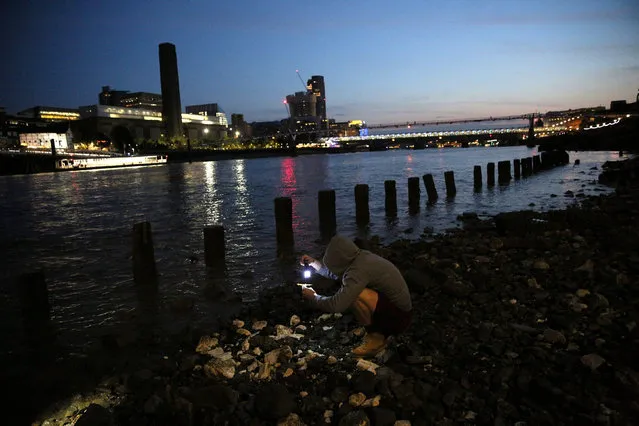
A mudlark uses a torch to look for items on the bank of the River Thames in London, Britain June 06, 2016. Mudlarking is believed to trace its origins to the 18th and 19th century, when scavengers searched the Thames' shores for items to sell. These days, history and archaeology fans are the ones hoping to find old relics such as coins, ceramics, artifacts or everyday items from across centuries. They wait for the low tide and then scour specific areas of exposed shores. "If you're in a field you could be out all day long, with the river you're restricted to about two or three hours," mudlark Nick Stevens said. While many just use the naked eye for their searches, others rely on metal detectors for which a permit from the Port of London Authority is needed. Digging also requires consent. (Photo by Neil Hall/Reuters)

A mudlark uses a torch to look for items on the bank of the River Thames in London, Britain June 06, 2016. Mudlarking is believed to trace its origins to the 18th and 19th century, when scavengers searched the Thames' shores for items to sell. These days, history and archaeology fans are the ones hoping to find old relics such as coins, ceramics, artifacts or everyday items from across centuries. their finds with the Portable Antiquities Scheme. Any item over 300 years old must be recorded. (Photo by Neil Hall/Reuters)
Details
27 Aug 2016 10:43:00
Ukrainian paratrooper Andrii Bashtovyi reacts as he see his comrades in the recently retaken area of Izium, Ukraine, Wednesday, September 14, 2022. (Photo by Evgeniy Maloletka/AP Photo)

Ukrainian paratrooper Andrii Bashtovyi reacts as he see his comrades in the recently retaken area of Izium, Ukraine, Wednesday, September 14, 2022. (Photo by Evgeniy Maloletka/AP Photo)
Details
16 Sep 2022 05:18:00